

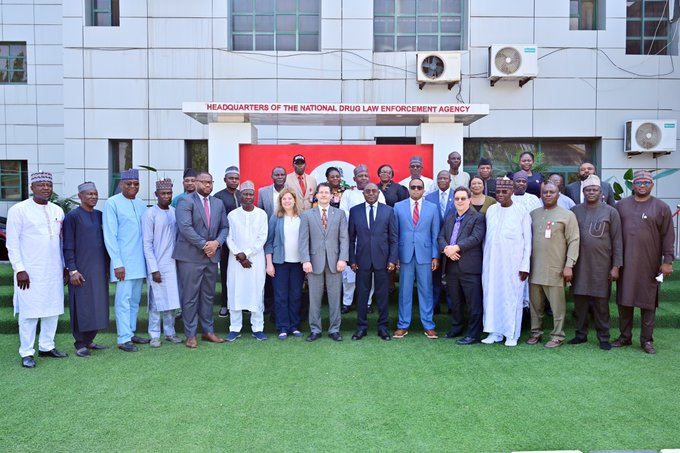
The United States Government has commended Nigeria's National Drug Law Enforcement Agency (NDLEA) for dismantling four clandestine methamphetamine laboratories allegedly linked to Mexican drug cartels, describing the operations as significant achievements in international efforts to combat organised drug trafficking.
The commendation was delivered on Tuesday, October 20, 2026, by the United States Deputy Assistant Secretary of State for International Narcotics and Law Enforcement Affairs (INL) for Africa and the Middle East, Michael Gonzales, during an official visit to the NDLEA national headquarters in Abuja.
Gonzales was received by the agency's Chairman and Chief Executive Officer, Brigadier General Mohamed Buba Marwa (retd.), alongside members of the NDLEA management team.
The American official praised the agency's intelligence-gathering capabilities, operational coordination and cooperation with international partners, particularly in identifying and disrupting facilities allegedly established by transnational criminal organisations.
Speaking during the visit, Gonzales disclosed that he had assumed his position four months earlier and deliberately selected Nigeria as the first country to visit in his new capacity.
He attributed the decision to Nigeria's economic and regional importance, as well as the NDLEA's operational achievements in combating illicit drug production and trafficking.
According to a statement issued by NDLEA spokesperson Femi Babafemi, Gonzales cited the dismantling of four methamphetamine laboratories in 2026 as evidence of the agency's use of intelligence-led investigations and coordinated enforcement operations.
He explained that effective counter-narcotics operations required cooperation across national boundaries, thorough investigations and prosecution of individuals involved in criminal networks.
The American official also emphasised that drug trafficking was not confined to individual countries, noting that the activities of transnational criminal organisations affected communities in both producing and destination countries.
Gonzales warned that intensified pressure on drug cartels in the Western Hemisphere could encourage criminal networks to seek alternative manufacturing locations and trafficking routes through Africa.
He compared the situation to squeezing a balloon, explaining that pressure applied in one region could redirect illicit activities towards other locations.
The official identified Africa, Europe and Oceania as regions potentially affected by such changes in international trafficking patterns.
He also expressed concern about the increasing prominence of synthetic drugs, which can present different detection and enforcement challenges from traditional plant-based narcotics.
Gonzales urged security agencies to focus not only on the seizure of illicit substances but also on the financial networks and organisational structures supporting international drug trafficking.
Responding, Marwa described the partnership between the NDLEA, the United States Department of State's INL bureau and the US Drug Enforcement Administration as an important component of Nigeria's efforts to combat organised drug crime.
The NDLEA chairman disclosed that the agency had recently dismantled what he described as the largest clandestine methamphetamine laboratory discovered in Nigeria.
According to Marwa, the facility was located in a forest in Ijebu East Local Government Area of Ogun State.
He said operatives arrested three Mexican nationals described by the agency as methamphetamine production specialists, alongside Nigerian collaborators allegedly involved in the operation.
The chairman stated that illicit substances valued at more than $360 million were recovered during the operation.
The valuation was provided by the NDLEA and has not been independently established through publicly available forensic or financial documentation.
Marwa further disclosed that approximately four weeks after the Ogun State operation, the agency raided another industrial-scale methamphetamine laboratory in Tapa Village, Oyo State.
He said a Mexican national allegedly recruited for large-scale methamphetamine production was arrested alongside four Nigerian collaborators.
The NDLEA subsequently dismantled two additional facilities in Enugu and Ebonyi states, bringing the number of laboratories identified in the latest operations to four.
Marwa maintained that the discoveries indicated an organised effort by suspected international drug trafficking networks to establish manufacturing operations in Nigeria.
He argued that the laboratories were not intended exclusively to supply domestic drug markets but could also support trafficking routes connecting West Africa with Europe, Asia and the United States.
The chairman said the alleged involvement of Mexican nationals in the operations demonstrated the international character of the suspected criminal networks.
However, the precise relationships between the arrested individuals and specific Mexican criminal organisations remain allegations attributed to the NDLEA.
Those arrested are entitled to the presumption of innocence unless convicted by a competent court.
Marwa also drew attention to the relationship between illicit drug trafficking, illegal arms distribution and the financing of violent criminal organisations.
He warned that proceeds from narcotics trafficking could support armed groups operating across international boundaries, including areas affected by insecurity in the Sahel and Lake Chad Basin.
According to him, the movement of illicit drugs, weapons and criminal proceeds across borders requires coordinated responses involving law enforcement, intelligence agencies and international partners.
The NDLEA chairman credited American assistance with strengthening the agency's forensic capabilities, professional training, investigative techniques and equipment maintenance.
He said the cooperation had contributed to substantial enforcement activity over the preceding five years.
Presenting the agency's operational figures, Marwa disclosed that the NDLEA had arrested 96,157 suspected drug offenders, including 250 individuals it classified as major drug traffickers.
He also reported the seizure of more than 15.8 million kilogrammes of assorted illicit substances and the conviction of 16,691 drug offenders during the same period.
The figures were presented by the NDLEA chairman as the agency's cumulative enforcement record and were not independently audited in the statement.
Marwa said the achievements demonstrated the importance of sustained investment in counter-narcotics operations.
He consequently appealed to the United States Government to maintain or increase its assistance to the agency.
The chairman warned that a reduction in international support could weaken investigative and operational capabilities at a time when criminal organisations were adapting their methods and expanding across borders.
He argued that governments confronting transnational criminal networks needed to maintain the same level of cooperation that criminal organisations employed in conducting their activities.
The meeting highlighted the continuing security relationship between Nigeria and the United States, particularly in combating illicit drugs and organised crime.
American assistance to Nigerian drug enforcement authorities has included training, technical cooperation, investigative support and equipment provided through relevant government programmes.
The latest commendation follows a series of NDLEA operations targeting suspected clandestine drug manufacturing facilities in different parts of Nigeria.
Methamphetamine is a highly addictive synthetic stimulant associated with serious health risks, including cardiovascular complications, dependence and psychiatric symptoms.
Its illicit production and international distribution have become major concerns for law enforcement agencies because manufacturing operations can be relocated and organised through cross-border criminal networks.
The discovery of facilities allegedly connected to foreign criminal organisations has therefore raised questions about the possible use of Nigeria as a production and transit location within the international drug trade.
While the NDLEA maintains that the four laboratories were connected to Mexican cartels, further investigation and judicial proceedings will be important in establishing the full extent of the alleged networks.
The operations also underscore the need for continued cooperation between Nigerian authorities and international partners in tracking illicit financial flows, identifying manufacturing sites and prosecuting suspected traffickers.
For the United States, the dismantling of the laboratories represents an example of how counter-narcotics cooperation outside its borders can contribute to disrupting international drug supply chains.
For Nigeria, the development brings renewed attention to the challenge of preventing organised criminal groups from establishing illicit production facilities within its territory.
The NDLEA has indicated that it will continue targeting suspected drug production and trafficking networks while seeking additional international assistance to strengthen its operations.
The United States' commendation and Marwa's appeal for sustained support reflect the shared concern that international drug trafficking cannot be addressed effectively through isolated national enforcement efforts.
📩 Stone Reporters News | 🌍 stonereportersnews.com
✉️ info@stonereportersnews.com | 📘 Facebook: Stone Reporters News | 🐦 X (Twitter): @StoneReportNew | 📸 Instagram: @stonereportersnews
Add comment
Comments