

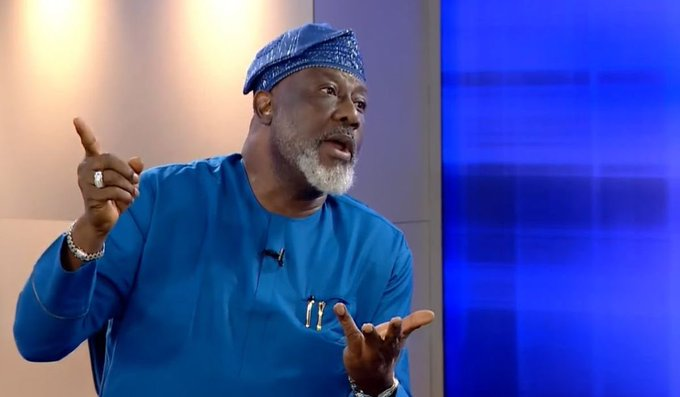
Former Kogi West Senator Dino Melaye has criticised Vice President Kashim Shettima over his record in public office, arguing that his performance as Borno State governor during the Boko Haram insurgency, including the 2014 abduction of schoolgirls in Chibok, does not justify another term as Nigeria's vice president.
Melaye made the remarks in a political statement titled A Record That Cannot Carry a Second Term, published on his verified X account and reported on Wednesday, October 21, 2026.
The former lawmaker, a member of the African Democratic Congress (ADC), questioned Shettima's contributions to security and governance in the North-East, maintaining that his years in public office should be assessed against measurable improvements in the lives of residents.
Shettima served as governor of Borno State from 2011 to 2019, a period marked by some of the most devastating attacks carried out by Boko Haram insurgents.
During his administration, the insurgency displaced large numbers of residents, disrupted economic activities and exposed communities across the state to repeated attacks.
One of the most internationally recognised incidents occurred on April 14, 2014, when Boko Haram fighters abducted schoolgirls from Government Girls Secondary School in Chibok.
The abduction triggered international condemnation and the #BringBackOurGirls campaign, which demanded the rescue of the students and greater action against the insurgency.
Melaye cited the incident as a major episode in Borno's security history, arguing that political leaders who held office during such periods should be prepared to explain their decisions and the results of their interventions.
However, the fact that the abduction occurred during Shettima's governorship does not, by itself, establish that he ordered, facilitated or was personally responsible for the crime. The attack was carried out by Boko Haram insurgents, while military operations and national security policy fell primarily under federal authority.
Melaye's criticism centred on political accountability rather than a judicial finding of wrongdoing.
The former senator also questioned what he described as the continuing insecurity in the North-East despite Shettima's progression from governor to senator and subsequently vice president.
He referred to reports of attacks on military installations, the abduction of civilians and the displacement of communities.
Among the incidents he cited were reported attacks involving a military base in Marte, violence affecting Chibok and the abduction of girls in Askira/Uba.
“These are too numerous to mention. These cannot justify a second term for Shettima,” Melaye said.
His remarks suggested that the persistence of armed violence should be considered when evaluating the political record of officials seeking renewed mandates.
Melaye maintained that public officeholders should be judged by the results of their leadership rather than the positions they have occupied or the efforts they claim to have undertaken.
He argued that Nigerians were entitled to assess whether the years Shettima spent in senior public office had produced sufficient improvements in security, public welfare and governance.
The criticism also extended to Shettima's role in the administration of President Bola Ahmed Tinubu, which assumed office in May 2023.
Although the vice president does not independently command the armed forces, Melaye argued that Shettima's political influence and knowledge of the North-East should be reflected in the government's response to insecurity in the region.
Under Nigeria's constitutional framework, the president serves as Commander-in-Chief of the Armed Forces and exercises executive authority, while the vice president performs responsibilities assigned under the Constitution and by the president.
Consequently, the assessment of Shettima's individual responsibility for federal security decisions requires consideration of the powers and functions of his office.
Melaye nevertheless maintained that holding a senior position in the administration carried political responsibility for explaining its achievements and shortcomings.
His intervention comes amid increasing political exchanges between figures associated with the APC and the ADC ahead of the 2027 general elections.
Recent disagreements have involved comments by Shettima about former Vice President Atiku Abubakar, as well as responses from opposition politicians questioning the record of the current administration.
Melaye's statement represents another development in that wider political confrontation.
Beyond security, the former senator also criticised the economic conditions facing Nigerians under the present administration.
He linked public dissatisfaction to rising living costs and the financial pressures experienced by households following major economic policy changes introduced in 2023.
The Tinubu administration has defended reforms, including petrol subsidy removal and foreign exchange changes, as measures intended to address longstanding economic difficulties.
However, the effects of those policies on household expenditure, transportation costs and purchasing power have remained central to political debate.
Melaye argued that elected leaders seeking another term should be prepared to demonstrate how government policies have improved everyday living conditions.
His assessment of Shettima's record was therefore framed around both security and economic performance.
The vice president's years as Borno governor remain a significant part of his political career.
During that period, his administration operated under difficult security conditions as Boko Haram expanded its activities across parts of the North-East.
Shettima also publicly criticised aspects of the Federal Government's response to the insurgency, particularly under former President Goodluck Jonathan.
In previous statements, he accused the Jonathan administration of mishandling the Chibok abduction and failing to respond adequately to the security crisis.
He also supported rehabilitation initiatives and called for greater investment in communities affected by insurgent violence.
Those positions form part of the wider public record against which Melaye's criticism may be assessed.
The continuing security challenges in Borno have involved successive federal and state administrations, military operations, humanitarian interventions and efforts to resettle displaced populations.
Some communities have experienced rehabilitation and resettlement programmes, while others continue to face threats from insurgent groups.
These circumstances complicate attempts to attribute the region's security situation exclusively to any single officeholder.
Nevertheless, the persistence of attacks and displacement remains a matter of public concern and political scrutiny.
Melaye's statement also raises questions about the standards by which politicians should be evaluated when seeking re-election.
He identified improved protection of civilians, reduced attacks on communities and military facilities, safer conditions for displaced persons and stronger security responses as areas in which government performance should be examined.
The former senator maintained that a leader's record should provide evidence of progress rather than depend principally on promises of future action.
His argument reflects the ADC politician's assessment of Shettima and should not be interpreted as an independently established conclusion about the vice president's overall performance.
As of the reports reviewed, no specific response from Shettima or the Presidency to Melaye's latest statement had been confirmed.
The vice president and his supporters may dispute the characterisation of his record, particularly given the constitutional limits of state governors' authority over the military and the broader security responsibilities of successive federal administrations.
The political disagreement is likely to remain part of discussions about governance and accountability as Nigeria approaches the 2027 elections.
For Melaye, the central issue is whether Shettima's record across his years as governor, senator and vice president provides sufficient justification for renewed political support.
For the wider public, the debate highlights questions about the effectiveness of security interventions, the responsibilities of elected officials and the measurable outcomes of government policies.
The former senator's criticism adds to opposition scrutiny of the Tinubu administration, with insecurity in the North-East and the legacy of the Chibok abduction once again featuring prominently in national political discourse.
📩 Stone Reporters News | 🌍 stonereportersnews.com
✉️ info@stonereportersnews.com | 📘 Facebook: Stone Reporters News | 🐦 X (Twitter): @StoneReportNew | 📸 Instagram: @stonereportersnews
Add comment
Comments