

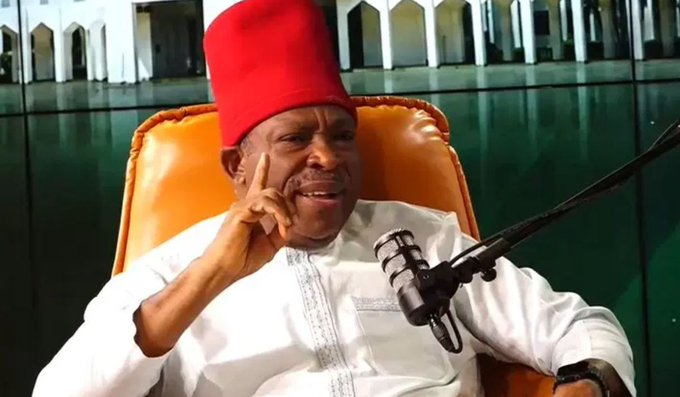
Senator Victor Umeh has challenged the Federal Government to account for funds from previous borrowing approvals, questioning why contractors remain unpaid and capital budgets inadequately implemented while President Bola Tinubu's administration seeks billions of dollars in additional foreign loans. His intervention has intensified concerns about public debt, government spending priorities and the effectiveness of legislative oversight.
Umeh, who represents Anambra Central Senatorial District under the Labour Party, raised the concerns on Tuesday, October 27, 2026, during an appearance on Channels Television's Politics Today. He was responding to President Tinubu's request for National Assembly approval of approximately $20.52 billion and €1.045 billion in external borrowing under the proposed 2026–2027 Supplementary External Borrowing Plan.
The senator questioned the relationship between repeated borrowing approvals and the government's inability to meet outstanding financial commitments, particularly payments owed to contractors executing public infrastructure projects.
"The truth is that we have approved so much funds to be borrowed in the past, and on each occasion we've been told that this borrowing would be able to fund the budgets and these budgets have remained unfunded up till this day," Umeh said.
He expressed particular concern about overlapping budget implementation, arguing that the government had yet to demonstrate sufficient progress in meeting obligations already approved by lawmakers.
"Three budgets are running concurrently and the government is not meeting its obligations to contractors on capital projects and so on and so forth," he said.
Umeh's central question concerned the destination and effectiveness of funds previously authorised for borrowing. He argued that the continued existence of unpaid obligations demanded explanations before lawmakers considered additional financial commitments.
His remarks followed Tinubu's formal communication to the Senate requesting authorisation to process external loans totalling $20,517,755,901 and €1,045,083,643.
Senate President Godswill Akpabio read the president's letter during Tuesday's plenary and subsequently referred the proposal to the Senate Committees on Local and Foreign Debts and Appropriations for examination.
The committees were directed to report back within one week, after which the Senate is expected to consider their recommendations before deciding whether to approve the borrowing request.
According to the president's submission, the proposed loans would finance infrastructure, agriculture, healthcare, education, water supply, security, employment generation and financial management reforms.
The administration maintains that external financing is necessary to address Nigeria's infrastructure deficit and bridge funding gaps that cannot be covered through existing government resources.
Tinubu also stated that the projects identified for financing had undergone technical and economic assessments intended to establish their development value.
However, Umeh argued that the government must demonstrate how previous borrowing has translated into completed projects, improved public services and measurable benefits for Nigerians.
The lawmaker questioned the justification for additional debt when the administration has reported improvements in revenue collection. He argued that higher government receipts should strengthen the capacity to finance public expenditure without continually expanding borrowing requirements.
He also criticised the pace of capital budget implementation, saying the 2026 capital budget had not been meaningfully implemented as October approached its conclusion.
His criticism reflected wider concerns about the consequences of delayed capital expenditure. While recurrent spending supports the routine operation of government, capital allocations finance roads, hospitals, schools, transport infrastructure and other development projects.
When capital budgets are delayed or inadequately funded, approved projects can remain incomplete, contractors may experience payment difficulties and communities can be deprived of expected public services.
Umeh cited the proposed reconstruction of the Eastern Rail Line as an example of infrastructure financing requiring clearer explanations.
He referred to a previously approved borrowing provision of approximately $3 billion associated with the railway project, arguing that visible construction progress had not matched expectations.
The senator called for clarification about whether the relevant financing had actually been accessed and, if so, how the funds had been deployed.
That distinction is important because parliamentary approval to borrow does not necessarily mean the entire authorised amount has been received or spent. External loans may be disbursed in stages, subject to financing agreements, project conditions and implementation schedules.
Consequently, outstanding contractor payments or delayed projects do not independently establish that borrowed funds have been misappropriated. Determining whether money has been properly used requires examination of disbursement records, budget releases, expenditure reports and completed work.
Nevertheless, the questions raised by Umeh concern the government's obligation to provide transparent information about public borrowing and the outcomes of expenditure undertaken in the name of national development.
The latest request follows several borrowing approvals granted during the Tinubu administration.
In March 2026, the National Assembly approved a $6 billion external financing arrangement, including a $5 billion facility from First Abu Dhabi Bank intended to support the federal budget.
The package also included a $1 billion export finance facility arranged through Citibank for rehabilitation works at Tin Can Island Port and the Lagos Port Complex.
In May, lawmakers approved a separate $516.3 million facility from Deutsche Bank for construction of the Sokoto–Badagry Superhighway.
That financing arrangement carried a nine-year tenure, including a grace period of up to three years, with interest linked to the Secured Overnight Financing Rate.
These approvals illustrate the government's reliance on external financing for major infrastructure and budgetary commitments, although the amounts authorised should not automatically be treated as fully disbursed public debt.
Beyond questions about project financing, Umeh expressed concern about the economic difficulties confronting households.
He pointed to high fuel prices and declining purchasing power as evidence that many Nigerians had yet to experience improvements corresponding to the government's borrowing and revenue initiatives.
The senator said he had purchased petrol at ₦1,410 per litre and cited diesel prices of approximately ₦1,889 per litre, using the figures to illustrate pressure on transportation, production and household expenditure.
He argued that government financial decisions should ultimately be assessed against their effects on citizens rather than the volume of borrowing approved.
Umeh also expressed doubts about the opposition's ability to prevent approval of the latest request, citing the numerical advantage enjoyed by lawmakers aligned with the governing All Progressives Congress.
He maintained that opposition senators could question the proposal but lacked sufficient votes to defeat it if the governing majority supported the request.
The Senate's consideration therefore represents an important test of how thoroughly lawmakers will scrutinise the proposed financing arrangements and their expected economic benefits.
For the Federal Government, the immediate challenge is demonstrating that additional borrowing will produce measurable development outcomes while maintaining sustainable debt obligations.
For Umeh, the unresolved issue remains whether previous borrowing approvals have delivered the projects and budgetary support used to justify them.
His intervention has placed renewed attention on financial accountability, contractor payments and the responsibilities of lawmakers entrusted with authorising public debt.
As the Senate committees examine Tinubu's latest proposal, the central issue is not simply whether Nigeria requires external financing, but whether the government can convincingly demonstrate how existing borrowing commitments have been managed and what additional debt will achieve.
📩 Stone Reporters News | 🌍 stonereportersnews.com
✉️ info@stonereportersnews.com | 📘 Facebook: Stone Reporters News | 🐦 X (Twitter): @StoneReportNew | 📸 Instagram: @stonereportersnews
Add comment
Comments