

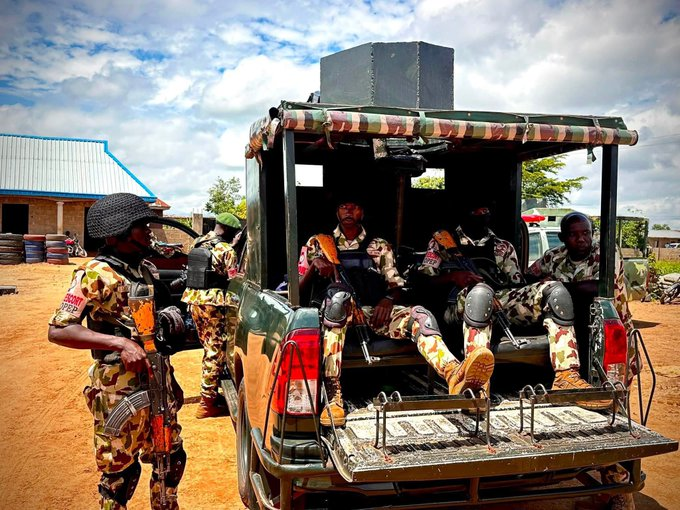
Troops of Operation Whirl Stroke (OPWS) have repelled an attack by suspected armed criminals in Benue State, recovering two AK-47 rifles, four empty magazines, eight calves and other items during an intelligence-led security operation. Military authorities said the armed men opened fire on advancing soldiers but were forced to retreat following an exchange of gunfire.
The confrontation occurred on Monday, October 26, 2026, in Guma Local Government Area of Benue State, where troops operating under the Maritime Component of the Joint Task Force, Operation Whirl Stroke, were deployed following intelligence about suspected armed criminals entering the area from neighbouring Nasarawa State. The operation was subsequently confirmed in a military statement released on Tuesday, October 27.
According to Lieutenant Ahmad Zubairu Zubairu, Acting Media Information Officer of the Joint Task Force, the military received credible intelligence indicating that armed individuals allegedly posing as herders had crossed the riverine boundary between Nasarawa and Benue states.
Acting on the information, troops advanced towards the suspected location to investigate the reported movement and confront any security threat. The operation was also reported to have involved personnel operating from the Gbajimba waterside towards Magungu, an area within Guma Local Government Area.
Military authorities stated that the soldiers encountered armed resistance upon reaching the location. The unidentified individuals reportedly opened fire on the troops, prompting an immediate response that forced the attackers to withdraw into surrounding areas.
The military confirmed that no casualties were recorded among its personnel during the confrontation. However, the statement did not establish whether any of the fleeing suspects sustained injuries, and there was no confirmation that arrests had been made.
Following the exchange, troops conducted a search of the area and recovered two AK-47 rifles, four empty AK-47 magazines, eight calves, three mobile phones, a National Identification Number document bearing the name Umar Yusuf, and ₦20 in cash.
The discovery of the identity document was included in the military's account of the recovered materials. Authorities did not establish whether the individual named on the document was present during the confrontation or connected to the suspected armed group. Possession or recovery of an identification document does not, by itself, establish criminal involvement.
The recovered weapons and other materials were taken into military custody for further investigation and necessary action. The military did not disclose whether forensic examinations had commenced or whether investigators had established the ownership of the livestock and mobile phones.
The Force Commander of Operation Whirl Stroke and General Officer Commanding 5 Division of the Nigerian Army, Major General Moses Kolo Gara, commended the personnel involved for their vigilance, operational response and recovery of the weapons.
He directed troops to strengthen cooperation with communities along the border areas and sustain intelligence-led patrols aimed at preventing criminal infiltration and improving security across the joint operations area.
The commander also acknowledged the contribution of residents who provide information to security agencies. He encouraged continued public cooperation through the prompt reporting of suspicious movements and activities.
The latest operation comes amid persistent security concerns in Benue State, where armed attacks, kidnappings and disputes involving farming and pastoral communities have contributed to recurring violence and displacement.
Guma is among the local government areas that have experienced serious insecurity over several years. The area's location near the Nasarawa State boundary has made cross-border security cooperation an important element of military and law enforcement operations.
Security incidents in the region have involved different categories of armed actors, including suspected kidnappers, cattle rustlers and groups accused of attacking rural settlements. However, the identities and motivations of perpetrators vary between incidents, making independent investigation essential before attributing responsibility to any particular community or occupation.
The military's description of the suspects as criminals posing as herders is particularly significant. It distinguishes the alleged activities of armed individuals from the legitimate occupation of livestock rearing and does not establish responsibility on the part of pastoral communities generally.
The recovery of eight calves also raises questions about the circumstances in which the animals came into the possession of the fleeing individuals. Military authorities have not confirmed whether the livestock was stolen, belonged to the suspects or was connected to any previously reported criminal incident.
The October 26 confrontation followed another security operation in Benue State in which troops rescued two kidnapping victims along the Naka–Ahume Road. According to reports published on October 26, soldiers encountered suspected kidnappers during a patrol conducted on October 24.
The suspects reportedly fled following an exchange of gunfire, abandoning the captives. One of the rescued victims, identified as 36-year-old Mngunengen Ihom, sustained machete injuries and was taken to Naka General Hospital for medical treatment.
Although the two incidents occurred in different locations, they illustrate the continuing deployment of Operation Whirl Stroke personnel against armed groups operating in parts of Benue State.
Operation Whirl Stroke is a joint military security initiative established to address violent attacks and related criminal activities in Nigeria's north-central region. Its operations have included patrols, responses to attacks, rescue missions and efforts to disrupt armed groups threatening communities.
The effectiveness of such operations depends not only on recovering weapons and repelling attacks but also on preventing armed groups from returning to vulnerable settlements. Sustained surveillance, intelligence sharing and cooperation between security agencies and local residents remain important elements of that effort.
The latest recovery represents a reported operational success for the troops involved, although the absence of arrests means the identities of the fleeing attackers remain unconfirmed.
As of the military's latest statement, authorities had not announced additional arrests or provided further information about the suspects' whereabouts. No independent evidence had been presented establishing a connection between the recovered materials and any specific previous attack.
For communities affected by repeated insecurity, the immediate significance of the operation lies in the reported disruption of an armed group and the removal of two assault rifles from the area.
The military has indicated that intelligence-led operations and community engagement will continue as part of efforts to prevent further criminal activity in Benue State and neighbouring areas.
📩 Stone Reporters News | 🌍 stonereportersnews.com
✉️ info@stonereportersnews.com | 📘 Facebook: Stone Reporters News | 🐦 X (Twitter): @StoneReportNew | 📸 Instagram: @stonereportersnews
Add comment
Comments