

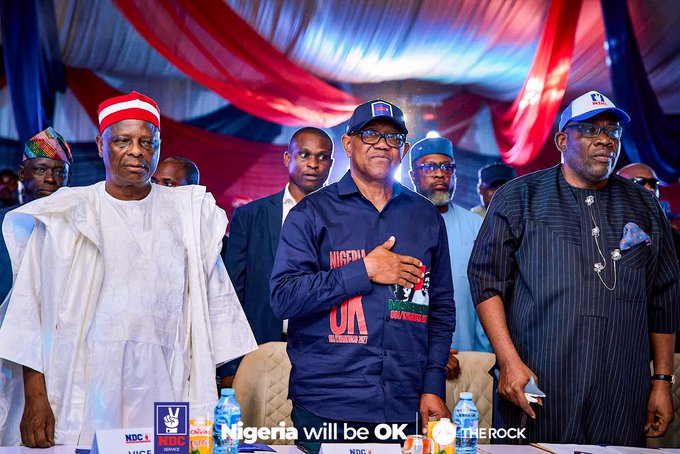
Presidential candidate of the Nigeria Democratic Congress (NDC), Peter Obi, has promised to confront corruption, insecurity, hunger, unemployment and Nigeria's persistent electricity crisis if elected president in 2027. He declared that his administration would concentrate on measurable improvements in the lives of Nigerians rather than blaming previous governments for the country's difficulties.
Obi made the pledge on Monday, October 26, 2026, during a dinner in Abuja marking the inauguration of the NDC National Presidential Campaign Council, the unveiling of the party's national secretariat and the presentation of certificates of return to candidates. The former Anambra State governor, who is contesting alongside former Kano State Governor Rabiu Musa Kwankwaso, said the party would prioritise accountability, economic recovery and effective public service delivery.
“The purpose of governance is to solve problems, not to blame people. Kwankwaso and I will not blame anybody. We will create that new Nigeria that is possible,” Obi declared.
He said Nigerians had endured years of political promises without sufficient improvements in security, employment opportunities and essential public services. According to him, the responsibility of political leaders is to provide solutions and demonstrate results rather than continually explain why problems remain unresolved.
Obi maintained that an NDC administration would begin implementing its priorities immediately upon assuming office, with measurable targets against which the public could assess its performance.
On corruption, the presidential candidate promised an uncompromising approach to the misuse of public resources. He argued that government expenditure must be transparent and directed towards programmes capable of improving the welfare of citizens.
The former governor criticised the economic management of President Bola Tinubu's administration, questioning whether increased government revenue and borrowing had translated into corresponding improvements in infrastructure and public services.
He also raised concerns about the implementation of federal budgets, alleging that capital expenditure had remained below 20 per cent in recent years and that some contractors were experiencing payment difficulties.
Those claims represent Obi's assessment of government finances and would require examination of official budget implementation reports to establish their accuracy across the periods concerned.
Obi said public accountability should involve explaining how money was spent and demonstrating the outcomes achieved with those resources.
Turning to insecurity, he pledged a more direct response to kidnapping, violent attacks and other threats affecting communities across Nigeria.
He argued that national leadership should be visible during security emergencies and that the president must take responsibility for coordinating responses to major incidents.
Obi said an administration under his leadership would respond promptly to attacks and maintain closer engagement with communities experiencing violence.
His campaign has previously outlined plans to strengthen intelligence gathering, improve coordination among security agencies and deploy technology to support crime prevention and security operations.
The NDC candidate also linked insecurity to Nigeria's agricultural and food supply challenges, particularly in northern communities where attacks have disrupted farming activities.
He promised to declare an emergency in agriculture and pursue measures intended to enable displaced and threatened farmers to return safely to their land.
According to Obi, improving security in farming communities would help increase domestic food production, strengthen rural livelihoods and reduce pressure on food prices.
He maintained that Nigeria possesses sufficient agricultural potential to feed its population but requires better security, infrastructure and investment to improve productivity.
The presidential candidate has repeatedly advocated moving Nigeria from an economy heavily dependent on consumption and imports towards one driven by domestic production.
His economic proposals include supporting agriculture, manufacturing, technology and small businesses through improved infrastructure and access to finance.
On unemployment, Obi said economic policy must create opportunities for young Nigerians and support businesses capable of expanding productive employment.
He argued that sustainable job creation would require investment in education, technical skills and industries that produce goods and services.
Obi also pledged emergency interventions in the education sector, expressing concern about the number of children who remain outside the formal school system.
He said access to quality education should not depend on family connections or social background.
“We must create a society where a child of nobody will be somebody without knowing anybody,” he said.
The former governor maintained that improving educational opportunities would strengthen Nigeria's workforce and help address the social conditions associated with poverty and exclusion.
In healthcare, Obi renewed his commitment to expanding primary healthcare services, promising to establish a functional primary healthcare centre in every political ward within two years of taking office.
He argued that accessible healthcare was essential to national productivity and that citizens should not be denied basic medical services because of inadequate public facilities.
The pledge builds on commitments made when he accepted the NDC presidential nomination in May, including proposals to expand health insurance coverage and increase investment in healthcare infrastructure.
On electricity, Obi promised emergency measures to improve power generation, transmission and distribution.
He described unreliable electricity as a major obstacle to industrial development, investment and employment creation.
During his presidential nomination acceptance speech, Obi pledged to increase Nigeria's electricity generation and distribution capacity by at least 10,000 megawatts within four years.
The proposed increase would represent a substantial expansion of the country's electricity system, although achieving it would require significant investment, improvements in transmission and distribution infrastructure, and effective coordination across the power sector.
Obi argued that more reliable electricity would reduce business operating costs, support manufacturing and improve opportunities for entrepreneurs.
The NDC candidate's latest promises come as political parties intensify preparations for the 2027 general elections.
The party's inauguration of its campaign council and unveiling of its national secretariat represent organisational steps towards presenting its candidates and policy programme to voters.
Obi's campaign has emphasised competence, accountability, national unity and economic productivity as central themes of his presidential bid.
However, his proposals will face scrutiny over their financing, implementation timelines and the institutional changes required to deliver the promised results.
The commitments on electricity, healthcare and agricultural recovery involve substantial expenditure and coordination among federal, state and local authorities.
Similarly, reducing corruption and insecurity will require not only political declarations but also effective institutions, lawful enforcement and measurable improvements in public administration.
The Tinubu administration has defended its economic reforms as necessary to address longstanding structural weaknesses and improve Nigeria's financial stability, while opposition candidates have questioned the pace at which those policies are improving household welfare.
As the election approaches, competing claims about economic management, public spending, security and living standards are expected to remain central to the presidential campaign.
Obi maintained that the NDC would offer Nigerians a government focused on results and responsibility.
He insisted that the party's objective was to demonstrate that public institutions could function more effectively and that political leadership could produce improvements in everyday living conditions.
For voters, the effectiveness of those commitments will depend on the detail of the party's policy proposals and the evidence presented to support their feasibility.
The former governor's message at the Abuja event was that an NDC administration would seek to replace political excuses with measurable action on the country's most pressing challenges.
📩 Stone Reporters News | 🌍 stonereportersnews.com
✉️ info@stonereportersnews.com | 📘 Facebook: Stone Reporters News | 🐦 X (Twitter): @StoneReportNew | 📸 Instagram: @stonereportersnews
Add comment
Comments