

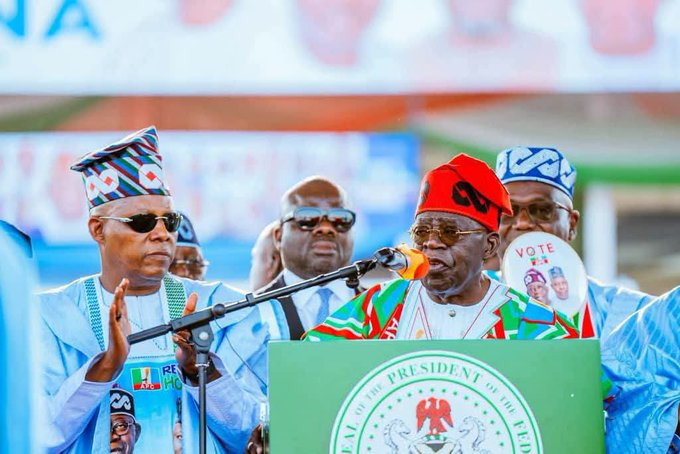
President Bola Tinubu has defended his administration's economic reforms, declaring that Nigeria is moving away from decades of underperformance towards a more productive and competitive economy. He said the government's policies were designed to remove longstanding structural barriers, attract investment and create opportunities for businesses and workers.
Tinubu made the remarks on Monday, October 26, 2026, at the opening of the 32nd Nigerian Economic Summit in Abuja, where he was represented by Vice President Kashim Shettima. The summit, themed Growth That Works: Delivering Jobs, Productivity and Shared Prosperity, brought together government officials, business leaders and development partners to examine Nigeria's economic direction.
“We came to rewrite the story of a nation that has performed below its potential for far too long. But there is no shortcut to economic growth,” the President said in his address.
He acknowledged that the administration's economic programme began with difficult decisions but maintained that stabilising the economy was necessary to establish conditions for sustainable development.
Tinubu argued that the reforms were intended to improve the livelihoods of farmers, manufacturers, entrepreneurs, innovators and young Nigerians seeking employment.
According to him, the country's large population and abundant natural resources would not automatically translate into prosperity without stronger economic institutions, greater productivity and increased investment.
The President said his administration had introduced reforms to address structural weaknesses that had prevented Nigeria from fully benefiting from its human and natural resources.
He maintained that those measures were restoring investor confidence, strengthening economic foundations and creating conditions for sustainable growth.
Tinubu also presented economic figures which he said demonstrated improvements in the country's performance.
Citing data attributed to the National Bureau of Statistics, he stated that Nigeria's inflation-adjusted gross domestic product grew by 3.89 per cent in the first quarter of 2026, compared with 3.13 per cent during the corresponding period of 2025.
He said non-oil activities accounted for 96.08 per cent of GDP, while manufacturing expanded by 3.29 per cent and the oil sector grew by 2.57 per cent.
The President presented those figures as evidence that efforts to diversify the economy and strengthen domestic production were beginning to produce results.
He also highlighted capital importation, stating that Nigeria attracted $10.37 billion in the first quarter of 2026, representing an increase of 83.83 per cent compared with the same period in 2025.
The figure included both portfolio investment and foreign direct investment, two categories that differ in their implications for long-term productive capacity.
While portfolio investment can strengthen financial market activity and capital inflows, foreign direct investment is more closely associated with longer-term business ownership and productive assets.
Tinubu said the administration would continue reducing regulatory barriers, improving transparency and strengthening policy predictability to encourage investment.
He identified taxation, electricity, agriculture and solid minerals as important areas of the government's economic programme.
On taxation, the President said reforms were intended to establish a more equitable system capable of financing development while giving businesses greater certainty.
He also outlined plans to improve electricity supply through changes to the power market and increased investment in generation, transmission, distribution and alternative energy.
Nigeria's electricity challenges have remained a significant obstacle for manufacturers and small businesses, many of which depend on alternative power sources to maintain operations.
Tinubu argued that improvements in infrastructure should be assessed by their contribution to economic activity rather than simply by the completion of projects.
He said education should similarly be measured by the skills and productivity it delivers, while industrial policy should be judged by the competitiveness of Nigerian businesses.
The President maintained that economic growth must translate into better employment opportunities and improvements in the quality of work.
He acknowledged that creating jobs alone would not be sufficient if workers remained trapped in low-paying or unproductive employment.
His administration, he said, was seeking to reduce underemployment and create conditions in which businesses could expand and generate more productive jobs.
In agriculture, Tinubu outlined efforts to improve connections between farms, storage facilities, processing centres and markets.
He said the government was expanding irrigation, mechanisation, agricultural finance and rural infrastructure to strengthen food production and reduce inefficiencies.
The President also identified domestic processing and industrial production as priorities for the solid minerals sector, arguing that Nigeria should capture greater economic value from its natural resources rather than depend primarily on extraction.
Despite his positive assessment, Tinubu acknowledged that the country's economic transformation remained unfinished.
He said the administration's ambition must extend beyond favourable statistics to improvements that Nigerians could experience through employment, business opportunities and stronger purchasing power.
His remarks come as the government continues to defend economic policies introduced after he assumed office in May 2023, including petrol subsidy removal and changes to the foreign exchange system.
Those policies have been credited with improving aspects of Nigeria's public finances and foreign exchange position, but they have also imposed significant costs on households through higher transport expenses and increases in the prices of essential goods.
The distinction between improved macroeconomic indicators and household welfare remains central to the debate over the administration's performance.
Although stronger GDP growth and investment inflows can indicate economic progress, they do not necessarily establish that living standards have improved across all income groups.
At the summit, United Nations Deputy Secretary-General Amina Mohammed acknowledged progress under the government's reforms but called for the gains to be consolidated and stabilised.
She also emphasised the importance of managing public expectations as the government seeks to translate policy changes into broader development outcomes.
Minister of Finance and Coordinating Minister of the Economy Taiwo Oyedele presented the Nigerian Economic Policy Framework, describing it as a proposed national approach to economic decision-making and the measurement of progress.
He invited members of the Nigerian Economic Summit Group and other private-sector experts to examine the framework critically and contribute recommendations based on evidence.
According to the minister, its guiding principles include enterprise development, open but fair markets and coordination across government institutions.
Chairman of the Nigerian Economic Summit Group Olaniyi Yusuf also called for a stronger focus on implementing reforms and achieving measurable outcomes.
He said the task facing policymakers and economic stakeholders was to move beyond agreement on broad reform principles towards practical measures that would improve productivity, create jobs and support inclusive growth.
The summit discussions reflected a central challenge facing the administration: converting improvements in economic indicators into benefits that can be felt by households and businesses.
For manufacturers, that includes reliable electricity, affordable finance and lower production costs. For farmers, it involves security, infrastructure and access to markets, while workers require productive employment and wages capable of meeting living expenses.
Tinubu maintained that the government was laying the foundations for those improvements and would continue pursuing policies intended to strengthen investment and economic diversification.
The President's assessment presents an optimistic account of Nigeria's economic direction, but the durability and inclusiveness of the recovery will depend on whether the reforms deliver sustained improvements in productivity, employment and living standards.
As the 32nd Nigerian Economic Summit continues, attention is expected to focus on how the government's policy commitments can produce measurable economic opportunities for Nigerians.
📩 Stone Reporters News | 🌍 stonereportersnews.com
✉️ info@stonereportersnews.com | 📘 Facebook: Stone Reporters News | 🐦 X (Twitter): @StoneReportNew | 📸 Instagram: @stonereportersnews
Add comment
Comments