

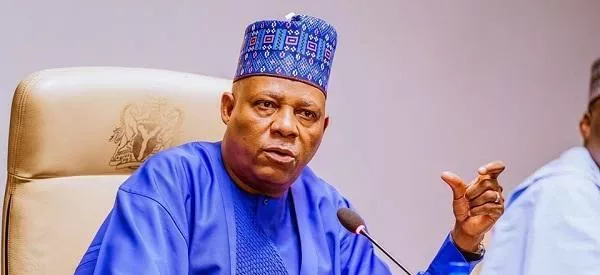
Vice President Kashim Shettima's criticism of Peter Obi's economic arguments has returned to attention amid renewed political disagreement over Nigeria's fuel subsidy policy. A statement attributed to Shettima combines an acknowledgement of Obi's position on subsidy removal with an accusation that the former Anambra State governor relies on questionable statistics rather than convincing economic proposals.
The controversy comes against the background of remarks made by Shettima during the inauguration of the All Progressives Congress Presidential Campaign Council in Abuja in October 2026, when he criticised Obi's use of international economic comparisons. However, the specific statement describing Obi as having nothing to offer beyond dubious statistics dates back to November 2022, when Shettima was the APC's vice-presidential candidate.
At an APC Professionals Forum event in Abuja on November 10, 2022, Shettima criticised Obi while discussing the choices facing Nigerians ahead of the 2023 general election. He referred to Obi as a friend but dismissed his economic arguments, saying he had nothing to offer beyond statistics he considered unreliable.
The comments were reported by ARISE News on November 11, 2022, and formed part of Shettima's argument that Nigeria required experienced leadership capable of responding to domestic and international economic challenges.
His remarks resurfaced in a different political environment in October 2026, when he again questioned Obi's approach to economic policymaking during an APC campaign event.
Shettima described Obi as a politician whose economic prescriptions relied excessively on comparisons with other countries, particularly Bangladesh. He argued that policies successful elsewhere could not automatically be applied to Nigeria without considering differences in population, institutions and economic conditions.
The vice president characterised Obi as a politician associated with unreliable statistics and economic proposals that, in his assessment, did not adequately reflect Nigeria's circumstances.
His criticism represented a political assessment rather than an independently established finding that Obi's economic proposals lacked merit.
Shettima also defended President Bola Tinubu's economic reforms, including the removal of petrol subsidy and changes to the foreign exchange system. He maintained that the administration had inherited serious economic difficulties and that the reforms were necessary to address longstanding fiscal and structural problems.
The subsidy debate has become an important issue in the political discussions surrounding Nigeria's 2027 presidential election.
Tinubu announced the removal of petrol subsidy during his inauguration on May 29, 2023. The decision was presented by the administration as a measure intended to address the financial burden of subsidising petrol and redirect public resources towards other priorities.
The policy was followed by substantial increases in fuel prices, affecting transportation and the cost of goods and services. Its consequences have remained central to public debate over the government's economic management.
Obi has previously supported removing the subsidy while criticising the handling of the proceeds and the absence of sufficient measures to protect households from the effects of higher prices.
Speaking at the Nigerian Bar Association's annual conference in Port Harcourt in August 2026, he argued that the mismanagement of resources recovered from subsidy removal did not automatically justify restoring the former system.
He maintained that the savings should have been invested in public services, particularly healthcare, and that the removal should have been implemented through a more organised process.
However, in an October 2026 BBC interview, Obi said he would retain a subsidy arrangement while eliminating the corruption he believed had undermined the previous system.
His remarks introduced a distinction between opposing the corruption associated with subsidy payments and supporting some form of subsidy designed to benefit consumers.
The position has generated questions about how his proposed arrangement would operate, how its costs would be financed and how it would differ from the system removed under Tinubu.
The debate also involves former Vice President Atiku Abubakar, who has proposed restoring petrol subsidy if elected president in 2027.
Shettima's criticism of Obi formed part of a broader defence of the APC's economic record and its argument that opposition proposals must account for Nigeria's fiscal circumstances.
During the October campaign council inauguration, the vice president argued that governance required an understanding of the country's specific social, institutional and economic realities.
He maintained that international comparisons could inform policy discussions but should not substitute for analysis of Nigeria's own circumstances.
Obi's political allies rejected Shettima's assessment.
Rabiu Musa Kwankwaso, the vice-presidential candidate of the Nigeria Democratic Congress, defended Obi during an interview on Channels Television on October 15.
Kwankwaso said he regularly examined the statistics cited by Obi and considered most of them accurate, although he acknowledged that politicians could occasionally make mistakes.
He disagreed with Shettima's criticism and described Obi's familiarity with international development statistics as an advantage rather than a weakness.
Their disagreement highlights contrasting approaches to economic policy and political communication. Shettima has emphasised Nigeria's particular circumstances, while Obi has frequently used comparisons with other countries to illustrate possible approaches to development.
Neither approach, by itself, establishes the effectiveness of a proposed policy. Assessing competing economic claims requires examination of the underlying data, fiscal assumptions and likely consequences for households and businesses.
The latest controversy also demonstrates the importance of distinguishing older political statements from recent developments.
Although Shettima repeated criticism of Obi's statistics in October 2026, the specific wording that Obi had nothing to offer apart from dubious statistics was documented in 2022.
The additional statement circulating about Shettima respecting Obi's position on fuel subsidy has not been independently authenticated as part of the same speech or a new statement made in October 2026.
For that reason, the two remarks should not be presented as a single newly delivered quotation without further evidence.
As political debate continues, the central policy disagreement remains how Nigeria should manage petrol pricing, public expenditure and the financial pressures facing households.
Shettima maintains that the administration's reforms require continued implementation, while Obi has challenged the government's management of resources and outlined an alternative approach to subsidy administration.
Their competing arguments are likely to remain subjects of public scrutiny as Nigerians examine the economic proposals advanced by political parties and their candidates.
📩 Stone Reporters News | 🌍 stonereportersnews.com
✉️ info@stonereportersnews.com | 📘 Facebook: Stone Reporters News | 🐦 X (Twitter): @StoneReportNew | 📸 Instagram: @stonereportersnews
Add comment
Comments