

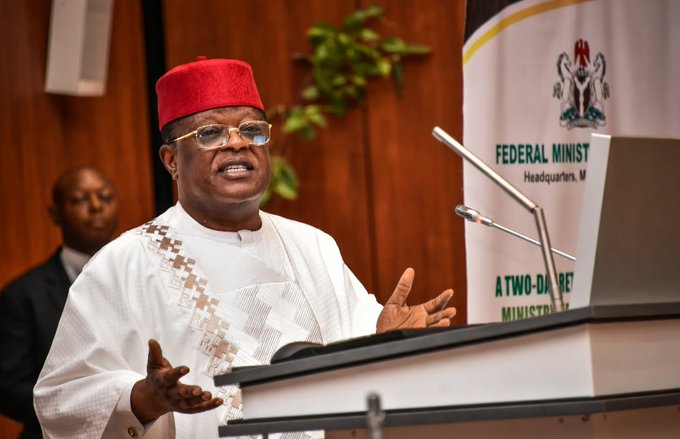
Nigeria's Minister of Works, David Umahi, has defended the cost of the Lagos-Calabar Coastal Highway, arguing that the Federal Government deserves recognition rather than criticism for its pricing. He maintained that comparisons with similar road projects, including a coastal highway in neighbouring Benin Republic, demonstrate the value of Nigeria's investment when differences in construction specifications are considered.
Speaking during an interview with ARISE News, reported between October 23 and 26, 2026, Umahi said the 750-kilometre highway was being designed and costed in sections rather than under a single comprehensive engineering design. His explanation followed renewed scrutiny of the project's estimated cost, environmental approvals, construction arrangements and proposed alignment across southern Nigeria.
“I deserve kudos for the cost of the coastal highway,” Umahi declared while defending the government's expenditure on the project.
The minister argued that public calculations of construction costs were misleading because they frequently divided the contract value by the road's length without accounting for its multiple carriageways, difficult terrain and additional infrastructure.
He cited the first section of the Lagos-Calabar Coastal Highway, extending approximately 47.47 kilometres from Victoria Island towards Eleko Village in Lagos State, with a contract value of about ₦1.06 trillion.
According to Umahi, the section's cost should be assessed against its six-lane configuration and associated engineering works rather than treated as the price of an ordinary two-lane road.
He estimated that the equivalent cost of a standard two-lane carriageway would be approximately $5.5 million per kilometre, representing between ₦7.3 billion and ₦7.5 billion using the exchange rate applied in his calculation.
The minister compared that figure with a coastal road project in Benin Republic, arguing that the neighbouring country's construction costs demonstrated why Nigeria's highway should not automatically be considered excessively expensive.
In a separate account of the interview published by The Sun, Umahi was reported as placing the Benin coastal project's two-lane construction cost at approximately $4.6 million per kilometre.
He argued that the Nigerian highway incorporated additional engineering features that must be considered when comparing expenditure between the two projects.
The figures attributed to Umahi across published reports are not entirely consistent in their description of the Benin project and the applicable carriageway configurations. An independently verified, itemised comparison of both contracts was not available in the reporting reviewed.
Umahi nevertheless maintained that the Nigerian project's cost reflected the extensive work required to construct a coastal highway on challenging ground.
He identified concrete pavement, shoreline protection, retaining walls, drainage, flyovers, underpasses, solar lighting and ground improvement as features contributing to the overall expenditure.
The minister said substantial excavation and replacement of unsuitable soil were required along parts of the Lagos alignment before the road pavement could be constructed.
He explained that some sections involved removing unsuitable material to considerable depths and raising the road above existing ground levels to achieve the required engineering standard.
According to Umahi, the cost of construction materials had also increased since the contract was awarded, although he maintained that the contract price for the relevant section had not changed.
He cited concrete prices rising from approximately ₦350,000 to ₦460,000 per cubic metre as an example of inflation affecting construction activities.
The minister's defence extended beyond the cost of individual sections to the absence of a single engineering design covering the entire 750-kilometre corridor.
Umahi confirmed that the government was developing designs and cost estimates section by section, explaining that soil conditions, bridges, environmental requirements and other technical considerations differed along the route.
He rejected suggestions that an estimated average construction cost could simply be multiplied by the highway's entire length to establish the project's final expenditure.
“Who fixed this N15tn that people are just, you know, brandishing everywhere?” he asked, challenging the widely circulated estimate of ₦15 trillion.
Umahi argued that applying one figure across the full highway would disregard differences in terrain and the engineering requirements of individual sections.
He said the Federal Executive Council had approved a procurement arrangement under which the project would be developed in stages.
However, the absence of a single comprehensive design and publicly established total project cost has remained a subject of scrutiny.
Questions have arisen over how the government will determine the highway's eventual financial commitment, assess changes in scope and communicate the total expenditure to Nigerians.
The minister also addressed environmental approvals, confirming that construction began after the government obtained a provisional Environmental and Social Impact Assessment certificate.
He explained that environmental assessments were being undertaken section by section and said final approval had been obtained for the first section.
The adequacy and timing of environmental assessments have formed part of wider public discussions surrounding the project, alongside concerns about property acquisition and the effects of construction on affected communities.
Umahi further clarified reports concerning changes to the highway's alignment in Ondo State and its proposed connection with the East-West Road.
He said difficult ground conditions had required engineering adjustments and that the government intended to provide an additional connection rather than abandon the original coastal highway route.
The minister acknowledged that describing the proposed connection as a diversion had created confusion, explaining that it was intended as a spur linking the coastal highway with the existing East-West Road.
He maintained that the original alignment remained part of the government's broader infrastructure programme.
The Lagos-Calabar Coastal Highway is one of President Bola Tinubu's flagship transport projects and is intended to improve road connectivity along Nigeria's southern coastline.
The proposed corridor passes through several coastal states and is expected by the government to support commercial transportation and regional economic activities.
Its development has attracted scrutiny because of its scale, financing arrangements, environmental implications and the financial resources required for completion.
Umahi has repeatedly argued that the project should be judged by its engineering specifications and long-term infrastructure value rather than headline expenditure alone.
His comparison with Benin Republic forms part of that argument, although establishing whether one project is more expensive than another would require independently comparable information on road dimensions, construction materials, land conditions, bridges, drainage and other contractual obligations.
For now, the minister maintains that Nigeria's coastal highway is competitively priced and that public assessments must account for the substantial differences between road projects.
The wider questions concerning the highway's final cost, full engineering design and implementation timetable remain central to the continuing public debate over the Federal Government's infrastructure investment.
📩 Stone Reporters News | 🌍 stonereportersnews.com
✉️ info@stonereportersnews.com | 📘 Facebook: Stone Reporters News | 🐦 X (Twitter): @StoneReportNew | 📸 Instagram: @stonereportersnews
Add comment
Comments