

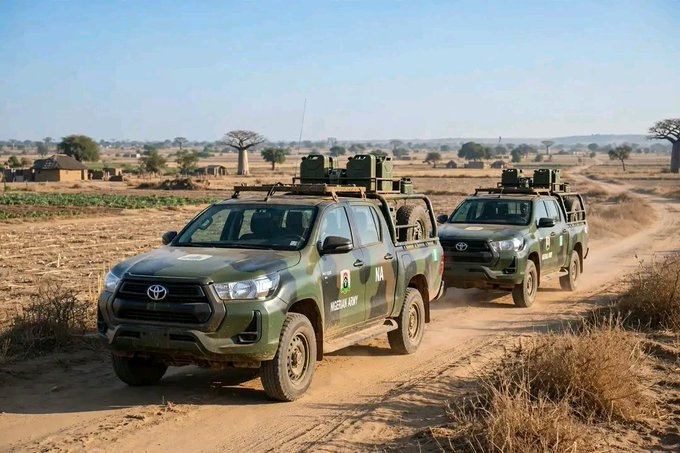
Troops of the Nigerian Army's 8 Division, operating under Operation FANSAN YAMMA, have reportedly cleared a section of the Gusau–Maradun road around Mayanchi and the Kuka Mai Rahu axis in Zamfara State following reports that armed bandits had blocked the route, raising fresh concerns about the safety of travellers in Nigeria's troubled North-West region.
The reported security intervention followed information that suspected bandits had obstructed movement along the highway, an important transport corridor connecting communities and commercial centres in Zamfara. Although the reported clearance has not been independently confirmed through a specific military statement, the development comes amid continuing operations by Nigerian security forces to protect major roads frequently threatened by armed groups.
Details surrounding the latest reported road clearance remain limited. The precise date and time of the operation, the number of soldiers deployed and whether troops encountered armed resistance have not been independently established. There is also no verified information indicating that suspects were arrested, weapons recovered or casualties recorded during the reported intervention.
The Mayanchi and Kuka Mai Rahu corridor has experienced previous security disruptions involving armed groups targeting travellers. Its location along routes connecting Gusau with other parts of Zamfara and neighbouring Sokoto State makes the area important for passenger transportation, commercial activities and movement between rural communities.
In May 2024, armed bandits blocked the Gusau–Talata Mafara highway between Kuka Mai Rahu and Mayanchi, leaving motorists stranded overnight. Contemporary reporting established that security personnel warned travellers against proceeding because of the danger of attacks and abductions. Soldiers subsequently moved to clear the affected section, allowing movement to resume.
That earlier incident illustrated the vulnerability of motorists travelling through areas where armed groups can temporarily obstruct highways. Travellers reported being unable to continue their journeys while security personnel assessed the threat. The disruption also demonstrated how insecurity can affect transportation without an attack necessarily resulting in confirmed kidnappings or fatalities.
More recently, the Mayanchi area has remained an important focus of military activity. In March 2026, troops operating from forward bases at Mayanchi and Fangaltama responded to an attack on passenger vehicles along the Maru–Mayanchi–Gusau road. Security reports indicated that one civilian was killed and 14 passengers abducted during the incident.
Military personnel subsequently pursued the attackers and rescued five of those abducted, according to reports published at the time. The rescued passengers included people who had sustained gunshot injuries and required medical attention. The incident highlighted the continuing dangers faced by civilians travelling through the area despite the presence of security formations.
Another security incident occurred in July 2026 when suspected terrorists attempted to attack the military forward operating base at Mayanchi in Maru Local Government Area. Reports citing security sources indicated that soldiers resisted the assault, with reinforcements arriving from Fangaltama. The attackers reportedly withdrew without breaching the military position.
The military's activities around Mayanchi form part of Operation FANSAN YAMMA, the joint security campaign targeting armed groups across Nigeria's North-West. Its operations involve ground patrols, intelligence-led deployments, responses to distress calls and offensives against suspected criminal hideouts in areas affected by kidnapping, cattle rustling and attacks on communities.
Zamfara has remained one of the states most affected by organised banditry. Armed groups have repeatedly targeted rural settlements, transportation routes and farming communities, creating serious challenges for residents whose livelihoods depend on access to roads, agricultural land and local markets.
The security situation has also complicated economic activities across affected communities. Farmers require access to their fields, traders depend on functioning transport networks, and residents often travel considerable distances to obtain healthcare, education and essential supplies. Highway disruptions can therefore have consequences extending beyond the immediate location of an armed confrontation.
Military operations have continued across the region in recent months. On October 26, 2026, the Nigerian military announced that troops of Operation FANSAN YAMMA had killed eight suspected terrorists and rescued three kidnapped victims during coordinated operations in Katsina, Kaduna and Zamfara states.
According to the military, those operations also resulted in the recovery of firearms, motorcycles and other materials. The announcement reflected continuing efforts to disrupt armed groups operating across state boundaries, although individual operational successes do not necessarily establish that surrounding communities are permanently secure.
On October 28, troops conducting a fighting patrol along the Anka–Guruzu road in Zamfara encountered an ambush by suspected terrorists. Military spokesperson Captain Tamuno Sinivie said the soldiers fought back, forcing the attackers to withdraw before securing the road and restoring movement.
The military reported that one soldier sustained a gunshot injury during that encounter and was evacuated for medical treatment. The same operational announcement detailed a separate intervention in Sokoto State, where troops rescued two abducted herders and recovered 520 livestock following an attempted attack.
These incidents demonstrate the continuing operational pressure on armed groups, but they also underline the persistence of threats along highways and in rural communities. Security forces face the challenge of responding to immediate incidents while maintaining a sufficiently sustained presence to prevent attackers from returning.
Community engagement has also featured in the military's approach. During an earlier meeting with representatives of the Mayanchi Development Association, the leadership of Operation FANSAN YAMMA received concerns about recurring attacks, destruction of property, displacement and the wider effects of insecurity on residents.
For communities along the Gusau–Maradun corridor, the reported clearance would represent an important immediate security intervention if confirmed. However, establishing whether the route remains open and safe for unrestricted civilian travel requires updated information from the military and relevant local authorities.
The latest report reinforces the importance of sustained patrols, reliable intelligence and coordination between security personnel and affected communities. While military interventions can reopen threatened roads, the broader challenge remains preventing armed groups from repeatedly disrupting movement and threatening civilians across Zamfara.
As authorities continue operations under FANSAN YAMMA, residents and travellers remain dependent on timely security information and effective protection along vulnerable routes. Further official clarification is needed to establish the full circumstances and outcome of the reported Mayanchi–Kuka Mai Rahu clearance.
📩 Stone Reporters News | 🌍 stonereportersnews.com
✉️ info@stonereportersnews.com | 📘 Facebook: Stone Reporters News | 🐦 X (Twitter): @StoneReportNew | 📸 Instagram: @stonereportersnews
Add comment
Comments