

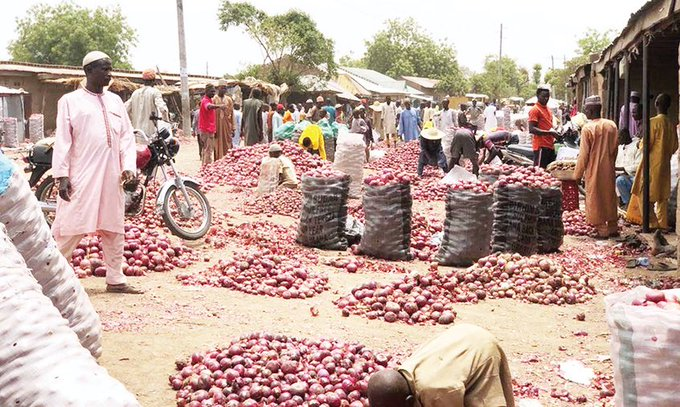
The price of fresh onions in Nigeria has risen by 900 per cent in six months, with a 120-kilogramme bag now selling for approximately ₦300,000, compared with ₦30,000 in April 2026. The sharp increase has been linked to extensive post-harvest losses, inadequate storage facilities, warehouse fires and disruptions affecting onion production and distribution.
The price increase was reported on Wednesday, October 28, 2026, following a market survey at the Mile 12 International Market in Lagos and explanations provided by the National Onion Producers, Processors and Marketers Association of Nigeria (NOPPMAN). The association said Nigeria had lost more than 51 per cent of its onion produce between April and October, severely affecting the quantity available for sale.
According to the market survey, a large 120kg bag of fresh onions was selling for approximately ₦300,000, while dried onions were priced between ₦350,000 and ₦380,000 per bag.
The figures represent a tenfold increase in the reported price of fresh onions over six months, adding pressure to traders, food businesses and households that depend on the commodity.
NOPPMAN National President Aliyu Isah attributed the price increase primarily to losses recorded after harvesting, rather than an outright failure to produce enough onions nationally.
He explained that a substantial proportion of harvested onions had been destroyed or rendered unsuitable for sale before reaching consumers.
“It’s not that we did not produce enough for the country, but we lost more than 51% from April to October,” Isah said.
The association identified poor storage infrastructure as one of the major problems affecting the industry.
Onions require appropriate ventilation and storage conditions to prevent spoilage, particularly when farmers and traders must preserve large quantities between harvest seasons.
Where adequate facilities are unavailable, produce can deteriorate before reaching the market, reducing supplies and increasing financial losses for producers and merchants.
Isah also identified fires at storage facilities in northern Nigeria as another factor contributing to the shortage.
Such incidents can destroy significant quantities of harvested produce, leaving traders with fewer supplies to distribute to markets across the country.
The association further linked the crisis to problems involving onion seeds introduced into Nigeria during the 2024–2025 growing season.
According to Isah, seeds reportedly brought from Algeria were unsuitable for Nigeria's farming conditions and contributed to substantial losses among growers.
He estimated the financial damage associated with the seed problem at nearly ₦100 billion, although that figure represents the association's assessment rather than an independently audited total.
The combined effects of seed-related difficulties, storage losses and warehouse fires have placed pressure on the availability of onions ahead of the next major harvest.
Other market reports have identified flooding, transport costs and insecurity as additional pressures on onion distribution.
In September, BusinessDay reported that onion prices in Lagos had increased by more than 200 per cent, with traders blaming reduced supplies from northern producing states, flooding and the cost of transporting goods.
The report indicated that some onion bags were selling for between ₦150,000 and ₦250,000, depending on their size and variety, compared with ₦50,000 to ₦70,000 in May.
Traders also reported that transporting a bag of onions from northern production areas to Lagos could cost as much as ₦30,000, excluding additional charges.
These distribution expenses can further increase wholesale and retail prices, particularly when supplies are already limited.
The price pressure has also been observed outside Lagos.
A News Agency of Nigeria market survey in Enugu, published in October, found that large bags of onions were selling for between ₦272,000 and ₦280,000 at New Garki Market.
Traders said comparable bags had sold for approximately ₦170,000 to ₦185,000 in September, indicating a substantial increase within one month.
Some sellers reported reducing or suspending their onion businesses because customers were finding the new prices difficult to afford.
The Enugu survey also identified poor roads, transportation expenses, insecurity and inadequate supplies as factors affecting the movement of produce from northern Nigeria to southern markets.
Although these reports demonstrate a widespread increase, onion prices are not identical across the country.
Actual selling prices depend on market location, bag weight, variety, freshness, transportation costs and the quantity available at the time of purchase.
The ₦300,000 figure therefore reflects a reported price for a specified bag size and market, rather than a uniform national price.
NOPPMAN has called for stronger government intervention to address the difficulties facing producers and prevent further disruption to supplies.
Isah said discussions had taken place involving the Federal Ministry of Agriculture, the Bank of Agriculture and the Nigerian Agricultural Development Fund over assistance with seeds and other farming inputs.
He maintained that timely intervention would help farmers recover from earlier losses and prepare for subsequent production cycles.
However, the association said the support being sought had not fully materialised at the time of its latest account.
The union also stressed the need for better storage facilities to reduce the quantity of produce lost between harvest and consumption.
Improving storage capacity could allow farmers and traders to preserve onions for longer periods, maintain supplies between harvest seasons and reduce the risk of severe price fluctuations.
Looking ahead, Isah said new supplies from Sokoto State were expected around November and December.
He added that onions from Aliero in Kebbi State could begin entering markets between late December and January, while the main harvest season was expected around March and April.
The anticipated harvests could improve availability and ease prices, although the extent of any reduction will depend on production conditions, storage capacity and distribution costs.
For consumers, the present increase means that the wholesale cost of a 120kg bag has risen by ₦270,000 compared with April.
For farmers and traders, the situation highlights how significant losses can occur even when agricultural production has taken place.
The development also raises broader questions about Nigeria's ability to preserve perishable food products and transport them efficiently from producing regions to consumer markets.
Without improvements in storage, access to suitable seeds and distribution infrastructure, producers may continue to lose substantial quantities of their harvests while consumers face higher prices.
The latest figures underline the financial consequences of weaknesses across the agricultural supply chain, with the price of a large bag of fresh onions increasing tenfold within six months.
📩 Stone Reporters News | 🌍 stonereportersnews.com
✉️ info@stonereportersnews.com | 📘 Facebook: Stone Reporters News | 🐦 X (Twitter): @StoneReportNew | 📸 Instagram: @stonereportersnews
Add comment
Comments