

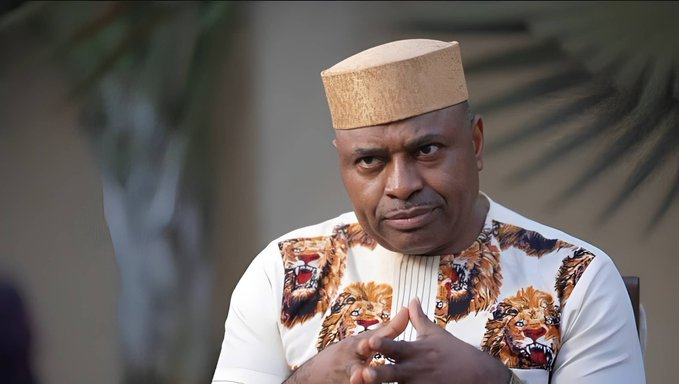
Kenneth Okonkwo, spokesperson for former Vice-President Atiku Abubakar's presidential campaign, has challenged the All Progressives Congress (APC) over allegations that some Nigerian ministers pay billions of naira to secure government appointments, arguing that the claims raise serious questions about corruption, presidential responsibility and the integrity of public office.
Speaking during an interview on Arise News on Thursday, October 29, 2026, Okonkwo criticised remarks made by APC presidential campaign spokesperson Alwan Hassan, who had alleged that some ministers paid substantial sums to obtain appointments before attempting to recover their expenditure through government office. Okonkwo argued that the allegation warranted scrutiny because Nigeria's Constitution assigns the appointment of ministers to the president, subject to Senate confirmation.
The controversy began on October 22, when Hassan appeared on Arise Television's Prime Time programme to defend President Bola Tinubu's management of government expenditure. During questioning about budget implementation and revenue shortfalls, Hassan suggested that some ministers regarded their appointments as financial investments rather than opportunities for public service.
“A lot of ministers pay billions and billions, and, you know, to get themselves appointed. The first thing they think of is how to recoup that money,” Hassan said.
Hassan subsequently clarified that he was describing what he considered a longstanding problem in Nigerian governance, rather than accusing specific ministers serving under Tinubu. He maintained that the alleged practice existed before the APC assumed federal power in 2015.
Nevertheless, the statement prompted demands for evidence from opposition politicians and commentators, who questioned how such payments could occur without implicating individuals involved in the appointment process.
Okonkwo argued that the constitutional framework made the allegation particularly serious. Under Section 147 of Nigeria's 1999 Constitution, the president appoints ministers, subject to confirmation by the Senate. He maintained that any credible allegation of payments for appointments should therefore trigger questions about the institutions responsible for the process.
“If anybody is paying anybody money in billions to be appointed, he's paying it either to the presidency or the Senate, because they are the people constitutionally bestowed with the power to appoint the ministers,” Okonkwo said.
His argument was a political inference rather than proof that either institution received illicit payments. Hassan had not identified any minister who allegedly paid money, named a recipient or presented documentary evidence supporting his claim.
Okonkwo nevertheless insisted that the APC could not dismiss the controversy merely by arguing that the alleged practice preceded Tinubu's administration. He pointed out that the president succeeded Muhammadu Buhari, who also governed under the APC.
“It's an APC affair, paying billions,” Okonkwo declared, arguing that the ruling party should account for allegations concerning appointments made during its period in government.
The criticism followed a formal intervention by the African Democratic Congress (ADC) Presidential Campaign Council, which called on Tinubu to investigate Hassan's statement and explain whether his administration possessed information about alleged payments.
In a statement issued on October 27 by its Director of Media and Publicity, Kola Ologbondiyan, the council said allegations involving the possible purchase of ministerial appointments were too serious to be dismissed without examination.
The opposition campaign organisation demanded that Hassan identify the ministers allegedly involved, specify the amounts purportedly paid and disclose the identities of those who received the money.
It also urged the Economic and Financial Crimes Commission and the Independent Corrupt Practices and Other Related Offences Commission to investigate any credible evidence of financial inducements connected with ministerial appointments.
The council further suggested that the National Assembly consider a public inquiry, including inviting Hassan to explain his remarks and provide supporting information.
The APC, however, has disputed interpretations suggesting that Hassan accused the current administration of selling appointments. Party spokesperson Felix Morka said the comments had been taken out of context and should not be presented as evidence of wrongdoing by Tinubu or his ministers.
Morka's response reflected the distinction between Hassan's broad allegation about historical practices and the opposition's interpretation of its implications for the present government.
That distinction remains central to the controversy. Hassan made an allegation about payments for appointments but did not provide independently verifiable evidence identifying perpetrators. Okonkwo and other opposition figures have challenged the government to explain the claim, but their criticism does not establish that any appointment was purchased.
The controversy also raises questions about transparency in Nigeria's ministerial selection process. Although the Constitution establishes the roles of the president and Senate, allegations involving financial inducements would require evidence of specific transactions, recipients and unlawful conduct before criminal responsibility could be established.
Political appointments are expected to serve public interests, with officeholders exercising authority in accordance with applicable laws and ethical obligations. Any proven exchange of money for public office would raise serious concerns about corruption, accountability and the proper use of government resources.
During the same interview, Okonkwo outlined policies he said an Atiku-led administration would pursue, including implementation of the Oronsaye Report, which recommends rationalising federal agencies with overlapping functions.
He argued that restructuring government institutions could reduce duplication and improve public expenditure. He also reiterated Atiku's support for transferring local government allocations directly to local councils as part of wider governance reforms.
Okonkwo additionally raised concerns about the neutrality of the Independent National Electoral Commission ahead of the 2027 general elections. He questioned the redeployment of Oluyemi Titilayo Adeyemi-Showunmi to head the commission's Electoral Operations Department because of her husband's political involvement.
Her husband, Segun Showunmi, has been associated with Tinubu's re-election activities. Okonkwo argued that the relationship created a potential appearance of bias, given the department's responsibilities for electoral logistics.
However, a family relationship with a political figure does not, by itself, establish professional misconduct or electoral manipulation. No verified evidence presented in the interview demonstrated that Adeyemi-Showunmi had improperly influenced electoral operations.
The wider dispute over ministerial appointments comes as political parties intensify scrutiny of Tinubu's administration ahead of the next presidential election.
Hassan originally made his remarks while praising the president's direct involvement in expenditure decisions, arguing that tighter oversight was necessary to prevent public resources from being mismanaged.
The opposition has instead focused on the implications of his allegation, demanding clarification about whether political appointments have been influenced by financial payments.
For now, the central allegation remains unsubstantiated. No minister has been publicly identified through verified evidence as having purchased an appointment, and no recipient of the alleged billions has been established.
The controversy leaves an important question for those making the claims: whether they can provide evidence sufficient to justify a formal investigation and establish accountability through lawful procedures.
📩 Stone Reporters News | 🌍 stonereportersnews.com
✉️ info@stonereportersnews.com | 📘 Facebook: Stone Reporters News | 🐦 X (Twitter): @StoneReportNew | 📸 Instagram: @stonereportersnews
Add comment
Comments