

Reported by: Ijeoma G | Edited by: Oravbiere Osayomore Promise.
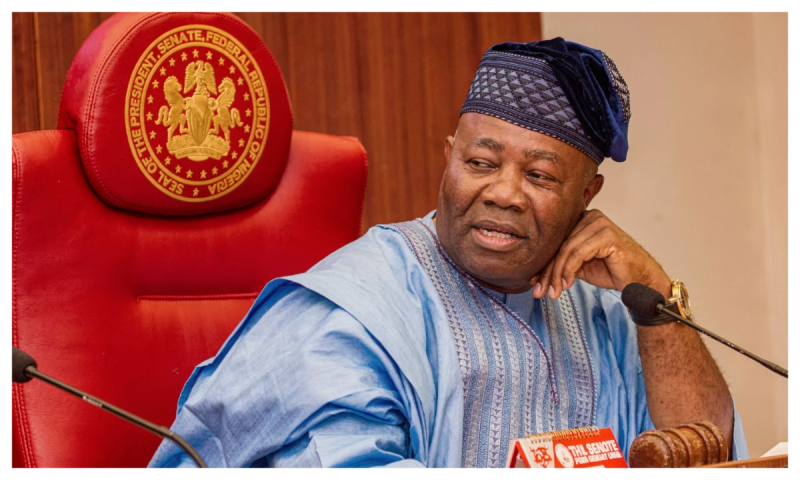
Senate President Godswill Akpabio, a Nigerian politician, has sparked fresh political debate after making remarks that appeared to question the loyalty of former presidential candidate Peter Obi following the 2023 general elections.
Akpabio made the comments on Tuesday during the commissioning of a new Nigeria Revenue Service building in Abuja, where he criticised what he described as the practice of politicians abandoning political parties after benefiting from their electoral strength.
He stated that it was wrong for individuals who secured millions of votes through a party platform to later leave the same party in search of another political base, arguing that such behaviour weakens party structures and undermines democratic stability.
Without naming Peter Obi directly, Akpabio referred to a candidate who “got up to six million votes” in the last presidential election but later left the party that gave him that platform. He added that he was not referring to Anambra State Governor Charles Soludo, but someone from the same political region, a remark widely interpreted as aimed at Obi.
Peter Obi, a Nigerian politician and former Governor of Anambra State, contested the 2023 presidential election under the Labour Party platform and emerged as one of the strongest challengers in the race, securing over six million votes nationwide. His campaign drew significant support from young voters and urban populations, reshaping Nigeria’s electoral dynamics.
The Labour Party, under which Obi ran in 2023, experienced internal disputes after the election, with factions emerging over leadership direction and post-election strategy. In the period leading up to the 2027 political cycle, Obi has been associated with discussions around the African Democratic Congress, a development that has triggered speculation about potential coalition building and party realignment among opposition forces.
The African Democratic Congress has in recent months become a focal point for opposition restructuring efforts, attracting several political figures exploring alternatives to Nigeria’s dominant parties. Obi’s reported alignment with the party has further intensified political conversations about the shape of opposition politics ahead of the next general elections.
Akpabio’s remarks also touched on the broader issue of party discipline in Nigeria’s multi-party system, where politicians frequently switch platforms in response to electoral opportunities or internal disputes. He argued that such movements contribute to instability within parties and weaken democratic institutions by reducing ideological consistency.
Supporters of Akpabio’s position say his comments highlight a recurring challenge in Nigerian politics, where party loyalty is often secondary to personal ambition and electoral strategy. They argue that frequent defections undermine institutional development and weaken voter confidence in political parties.
However, critics of the Senate President’s comments view them as politically charged, suggesting that they may be aimed at discouraging opposition consolidation ahead of the 2027 elections. They argue that politicians have the constitutional right to associate freely and that party switching is a legitimate aspect of democratic participation.
Peter Obi has not issued a formal response to Akpabio’s comments at the time of reporting. However, his political movement continues to maintain that its focus remains on governance reform, economic recovery, and institutional accountability, issues that defined his 2023 presidential campaign.
Political analysts note that the exchange reflects increasing tension within Nigeria’s political elite as positioning for the next general elections begins to take shape. The emergence of new alliances and shifting party loyalties has become a defining feature of the post-2023 political landscape.
The remarks also come amid broader debates about the strength and ideology of Nigeria’s political parties. Observers argue that most parties remain personality-driven rather than ideologically rooted, making defections and realignments more common.
Akpabio, who has held various high-profile political positions including governor of Akwa Ibom State and ministerial roles, has remained a prominent figure in national politics and a leading voice within the ruling establishment. His comments are therefore expected to carry significant weight in ongoing political discourse.
As the 2027 election cycle approaches, attention is increasingly focused on how opposition figures like Obi will position themselves and whether coalitions such as the African Democratic Congress can mount a unified challenge to the ruling party.
The latest remarks by Akpabio are likely to further intensify discussions about loyalty, party ideology, and the future of opposition politics in Nigeria, as political actors continue to realign in anticipation of a highly competitive electoral contest.
Political defections have long been a recurring feature of Nigeria’s democratic landscape, with elected officials and prominent politicians frequently moving between parties in response to internal disputes, electoral calculations, or strategic alliances. Analysts argue that this fluidity reflects both the weakness of ideological structures within many parties and the personalisation of political influence across the country’s democratic system.
The 2023 general election marked a turning point in voter mobilisation, largely due to the emergence of Peter Obi’s campaign, which attracted significant youth engagement and digital activism. His performance, securing over six million votes, was widely interpreted as evidence of shifting voter sentiment, particularly among urban populations seeking alternatives to established political blocs.
In the buildup to the 2027 elections, discussions around coalition-building have intensified, with the African Democratic Congress increasingly mentioned as a potential convergence platform for opposition figures. Political observers note that such alignments are often driven by the need to consolidate fragmented support bases in order to mount a competitive challenge against dominant parties.
Legal and constitutional experts emphasise that Nigeria’s democratic framework guarantees freedom of association, allowing politicians to join or leave parties without legal restriction. However, they also acknowledge that frequent party switching raises questions about accountability, ideological consistency, and the long-term stability of political institutions.
As political positioning continues ahead of the next electoral cycle, the exchange between Akpabio and Obi reflects broader tensions within Nigeria’s evolving political environment. The debate underscores the interplay between personal ambition, party loyalty, and strategic realignment in shaping the country’s democratic trajectory.
This evolving debate is expected to influence political messaging, alliances, and voter perceptions as parties intensify preparations for 2027, with elite contestation likely to remain central to national political discourse.
📩 Stone Reporters News | 🌍 stonereportersnews.com
✉️ info@stonereportersnews.com
| 📘 Facebook: Stone Reporters News | 🐦 X (Twitter): @StoneReportNew | 📸 Instagram: @stonereportersnews
Add comment
Comments