

Published by: Oravbiere Osayomore Promise.
Former Minister of Transportation and ex-governor of Rivers State, Rotimi Amaechi, has renewed longstanding allegations against former President Goodluck Jonathan and former First Lady Patience Jonathan, claiming they orchestrated his removal from the Peoples Democratic Party (PDP) by taking control of the party’s political structure in Rivers State.
Amaechi made the assertions during an interview on Channels Television’s “The Morning Brief” on Friday, revisiting a political conflict that dates back more than a decade and continues to shape alliances and rivalries in Nigeria’s evolving political landscape.
According to Amaechi, his exit from the PDP was not voluntary but the result of deliberate actions by the Jonathan administration and its allies. “The country knew what happened. I was literally chased out of the PDP,” he said, describing what he portrayed as a coordinated effort to sideline him within the party he had helped build at both state and national levels.
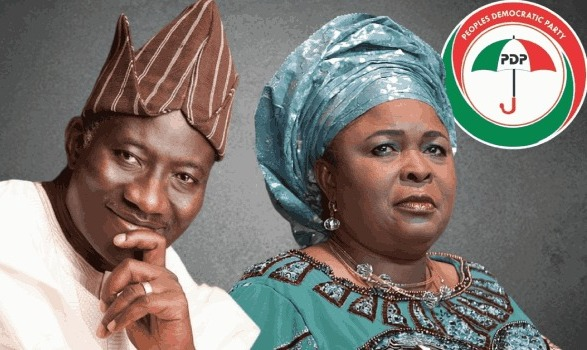
When pressed on who he believed was responsible, Amaechi directly named the former president and his wife. “The president, with his wife. They took over the political structure in Rivers State and chased me out. The president, Goodluck, and his wife handed over the structure to other people, so I moved,” he stated.
The remarks reopen a politically sensitive chapter in Rivers State’s history, where control of party structures has often translated into broader influence over governance and electoral outcomes. At the time of the dispute, Amaechi was serving as governor and was widely regarded as one of the most influential figures within the PDP, particularly in the South-South region.
Central to Amaechi’s account is his role as chairman of the Nigeria Governors’ Forum (NGF), a position he held during a period of heightened tension between state governors and the federal government. The NGF, though not a constitutional body, has historically served as a powerful platform for collective bargaining and political coordination among governors.
Amaechi suggested that his leadership of the forum placed him at odds with the Jonathan administration, contributing to the breakdown in relations. The crisis within the NGF, including a controversial leadership election in 2013, was widely seen at the time as a proxy battle reflecting deeper divisions within the ruling party.
The fallout from that period culminated in Amaechi’s suspension from the PDP in 2013, a move that intensified political hostilities in Rivers State and beyond. He subsequently defected to the All Progressives Congress (APC), aligning himself with opposition forces that would go on to defeat the PDP in the 2015 general elections.
Amaechi’s latest comments suggest that he continues to view those events as a turning point not only in his personal political journey but also in the broader trajectory of Nigerian politics. His departure from the PDP and subsequent role in the APC were instrumental in reshaping the country’s political balance, marking the first time an incumbent ruling party was unseated at the federal level.
In recent years, however, Amaechi has again shifted political affiliation, moving to the African Democratic Congress (ADC), where he is now positioning himself as a key figure ahead of the 2027 presidential election. His renewed criticism of the Jonathan family comes amid broader efforts by opposition politicians to redefine alliances and narratives in preparation for the next electoral cycle.
The allegations also underscore the enduring influence of the Jonathan family in Nigerian politics, particularly in the Niger Delta region. While Goodluck Jonathan has maintained a relatively low profile since leaving office in 2015, he remains a significant figure whose legacy and political relationships continue to attract attention.
Patience Jonathan, for her part, has also been a prominent and sometimes controversial presence in Nigerian political discourse, especially during her husband’s presidency. Her involvement in political affairs, including mobilization efforts in Rivers State, has been the subject of both praise and criticism over the years.
Amaechi’s claims are not new, but their reemergence at this stage highlights how unresolved political grievances can resurface as elections approach. Analysts note that such statements often serve to reinforce existing support bases while drawing clear lines between rival factions.
The political rivalry between Amaechi and the Jonathan camp has long been characterized by disputes over influence, loyalty, and control of resources within Rivers State, one of Nigeria’s most strategically important regions due to its economic significance in the oil and gas sector.
At the height of the conflict, Rivers State witnessed a series of political confrontations, including tensions within the state assembly and clashes between factions loyal to different leaders. These events drew national attention and were seen as emblematic of broader struggles within the PDP at the time.
While neither Goodluck Jonathan nor Patience Jonathan has publicly responded to Amaechi’s latest allegations as of the time of reporting, past responses from their allies have generally rejected claims of undue interference, instead framing the disputes as part of normal political contestation.
The renewed exchange comes amid increasing political activity across party lines, with several high-profile figures, including Amaechi, signaling interest in the 2027 presidential race. As these ambitions take shape, historical narratives and personal rivalries are likely to play a significant role in shaping campaign strategies and voter perceptions.
Observers point out that revisiting past conflicts can serve multiple purposes in a political campaign, from clarifying personal trajectories to drawing contrasts with opponents. However, it can also risk deepening divisions within opposition ranks, particularly at a time when coalition-building is widely seen as critical to mounting an effective challenge to the incumbent administration.
Amaechi’s remarks also contribute to an ongoing conversation about internal party democracy and the role of influential individuals in determining political outcomes. Questions about how party structures are controlled and how candidates emerge remain central to debates about Nigeria’s democratic development.
As the political landscape continues to evolve, the resurfacing of the Rivers State crisis underscores the lasting impact of past events on present dynamics. For many observers, it serves as a reminder that Nigeria’s political history is not merely a backdrop but an active force shaping current alignments and future possibilities.
Whether Amaechi’s renewed allegations will prompt responses from the Jonathan camp or influence broader political discourse remains to be seen. What is clear, however, is that the tensions between these figures, rooted in events more than a decade old, continue to resonate as the country moves toward another pivotal election.
📩 Stone Reporters News | 🌍 stonereportersnews.com
✉️ info@stonereportersnews.com | 📘 Facebook: Stone Reporters News | 🐦 X (Twitter): @Stone ReportNew | 📸 Instagram: @stonereportersnews
Add comment
Comments