

Published by: Oravbiere Osayomore Promise.
Factional tensions within the African Democratic Congress escalated on Friday after its factional National Chairman, Nafiu Bala, declared that the party’s recent national convention led by former Senate President David Mark was illegal and without any binding effect on the party’s structure or membership. The development adds to growing uncertainty within the opposition party as internal disputes over leadership, legitimacy, and coalition arrangements continue to intensify ahead of the 2027 general elections.
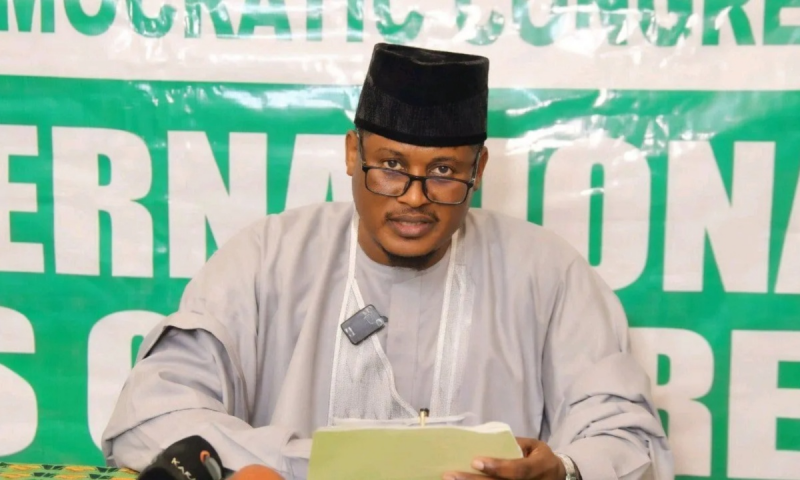
Speaking to journalists in Abuja, Bala rejected the outcome of the convention, insisting that the gathering convened under David Mark’s leadership did not meet the constitutional requirements of the party and therefore could not produce valid resolutions. He maintained that the faction he represents remains the only legitimate authority within the African Democratic Congress, arguing that any decisions taken outside its recognised leadership framework amount to political nullities.
According to Bala, the coalition groups associated with the David Mark-led convention are not recognised as members of the party under its existing structures. He further argued that their participation in the convention did not confer legitimacy on the outcomes, describing the exercise as a political gathering that lacked legal foundation within the party’s constitutional order. He stated that any resolutions reached at the convention were “devoid of legal effect” and could not be enforced within the party hierarchy.
The disputed convention, reportedly convened by a coalition of political figures aligned with David Mark, has been widely interpreted as part of broader attempts to reposition the African Democratic Congress as a stronger opposition platform capable of attracting alliances ahead of the next electoral cycle. However, the emergence of parallel claims to leadership has triggered renewed controversy over who controls the party’s national structure and decision-making authority.
The African Democratic Congress has in recent years experienced recurring internal divisions, with competing factions laying claim to leadership positions and party assets. These disputes have often centred on disagreements over congress outcomes, recognition by electoral authorities, and the role of coalition-building with other political actors. The latest confrontation underscores the fragility of party unity and the ongoing struggle for control among rival blocs within its national executive framework.
Bala’s position reflects one side of a broader dispute over the legitimacy of the convention process. He argued that proper procedures were not followed in convening the gathering, insisting that the party’s constitution outlines clear requirements for notices, delegate accreditation, and quorum before any national convention can be considered valid. He maintained that those requirements were not satisfied, rendering the entire exercise unconstitutional in his view.
He also questioned the authority of the organisers to speak for the party, reiterating that leadership legitimacy must derive from recognised internal structures rather than informal coalitions. According to him, attempts to impose new leadership arrangements through what he described as irregular conventions would not be accepted by the existing party hierarchy. He warned that such actions could further deepen divisions within the organisation if not addressed through established dispute resolution mechanisms.
Supporters of the David Mark-led initiative, however, have previously argued that their intervention is aimed at restructuring and strengthening the party to make it more competitive in national politics. They have presented their efforts as a response to long-standing internal weaknesses and electoral setbacks, suggesting that a broader coalition approach is necessary to reposition the party ahead of future elections. This perspective has been contested by Bala’s faction, which views the initiative as an attempt to bypass legitimate internal processes.
The African Democratic Congress, though not one of the dominant political parties in Nigeria, has often served as a platform for coalition politics and opposition realignment. Its structure has historically attracted politicians seeking alternative political vehicles outside the major ruling and opposition parties. This role has made it particularly susceptible to internal contestation, especially during periods of heightened electoral preparation.
Political observers note that leadership disputes within smaller parties can have wider implications for opposition coordination in Nigeria’s multi-party system. Fragmentation often weakens coalition-building efforts and reduces the ability of such parties to present unified positions during national elections. In the case of the ADC, the emergence of parallel leadership claims is seen as a potential obstacle to its efforts to consolidate influence ahead of 2027.
While Bala did not announce any immediate legal action, his remarks suggest that the faction he represents may challenge the legitimacy of the convention through internal party mechanisms or potentially through judicial channels if the dispute escalates. Party disputes in Nigeria are frequently resolved through a combination of internal arbitration and court rulings, particularly where competing factions seek formal recognition from the Independent National Electoral Commission.
The current disagreement also reflects broader patterns in Nigerian party politics, where leadership struggles and factional alignments are common features of political organisation. Analysts often point to weak internal democracy, personal rivalries, and coalition pressures as contributing factors to such disputes, which tend to intensify in the lead-up to major elections.
Despite the controversy, neither side has indicated a willingness to concede its position, raising the possibility of a prolonged internal crisis. Such disputes, if unresolved, can affect party mobilisation, candidate selection, and strategic planning, particularly as political actors begin early preparations for the next general elections.
For now, the African Democratic Congress remains divided between competing claims of legitimacy, with Bala’s faction insisting on constitutional adherence and the opposing coalition pushing for structural reconfiguration. The outcome of this dispute is likely to shape the party’s direction in the coming months, as stakeholders watch closely to see whether reconciliation, arbitration, or further fragmentation will define its future trajectory.
As the situation develops, attention will remain focused on how the party navigates its internal challenges and whether it can maintain cohesion in the face of competing leadership claims. The resolution of the current crisis may ultimately determine its relevance and effectiveness within Nigeria’s evolving opposition landscape ahead of the 2027 electoral cycle.
📩 Stone Reporters News | 🌍 stonereportersnews.com
✉️ info@stonereportersnews.com
| 📘 Facebook: Stone Reporters News | 🐦 X (Twitter): @StoneReportNew | 📸 Instagram: @stonereportersnews
Add comment
Comments