

Reported by: Ijeoma G | Edited by: Oravbiere Osayomore Promise.
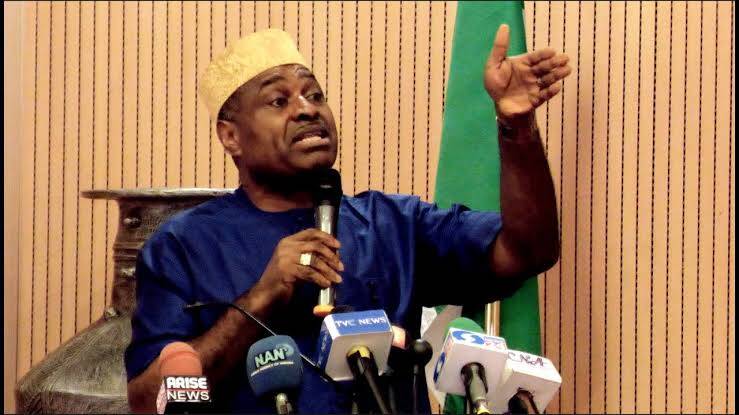
A chieftain of the African Democratic Congress (ADC) and former Labour Party stalwart, Kenneth Okonkwo, has delivered a stinging verdict on the 2027 presidential ambition of his former principal, Peter Obi, declaring that the ex‑governor will lose the entire South‑East in the next general election. Okonkwo, who was once a prominent spokesperson and defender of Obi’s 2023 campaign, made the prediction while appearing as a guest on Channels Television’s ‘Politics Today’ programme on Thursday, May 14, 2026. His comments, which have ignited a fresh firestorm of debate, go beyond mere electoral arithmetic to attack the very slogan that defined Obi’s grassroots support, branding the ‘Obi or Nothing’ mantra as “an abomination culturally in Igbo land.”
Drawing on Igbo cultural philosophy, Okonkwo invoked the principle of ‘Somadina,’ a concept that encapsulates the belief that no single person should monopolise success or prosperity. “Here is the catch. I’m trying to tell you why Peter Obi will lose the entire South‑East. Have you not heard of the slogan ‘Obi or nothing’? First of all, that slogan is an abomination culturally in Igbo land,” Okonkwo declared. “In Igbo land, there is something we call ‘Somadina’, meaning I will not be the only person that will thrive. I will not be the only person that will succeed.” For Okonkwo, the exclusionary nature of the slogan stands in direct opposition to the collaborative political tradition of the Igbo, which he argues has historically favoured strategic alliances over rigid single‑candidate loyalty.
To illustrate his point, Okonkwo reached back into political history, referencing the 1979 election that pitted the late nationalist Dr. Nnamdi Azikiwe against his kinsman, Dr. Alex Ekwueme. According to Okonkwo, Azikiwe, who ran on the platform of the Nigerian People’s Party (NPP), understood that the votes of Ndigbo alone would not deliver the presidency. Rather than demanding that Ekwueme abandon his position as the vice‑presidential candidate of the National Party of Nigeria (NPN), Azikiwe allowed his political brother to pursue his own path. The outcome, Okonkwo argued, ultimately benefited the South‑East, as an Igbo man became Vice President and another rose to become Speaker of the House of Representatives, securing political influence through coalition rather than confrontation. “And somebody here is telling me ‘Obi or nothing’? That is an abomination in Igbo land,” Okonkwo said, his voice rising with incredulity.
The ADC chieftain’s remarks come at a critical juncture in the opposition’s realignment. Both Peter Obi and former Kano State Governor Rabiu Kwankwaso formally defected from the ADC to the Nigeria Democratic Congress (NDC) on May 3, 2026, citing internal crises and legal battles that threatened to derail their joint presidential ambition. Their exit effectively collapsed the grand opposition coalition that had been painstakingly assembled under the ADC’s umbrella. Okonkwo, who has remained within the ADC fold, did not hide his contempt for the decision. He described Obi and Kwankwaso as “mere renegades” and accused them of abandoning the coalition because they were “scared of participating in primary elections.”
“The reason they went there is because they are scared of participating in primary elections,” Okonkwo stated bluntly. “They said the coalition is the best and the only method to send President Bola Tinubu packing, by their own words. And on their own, without any reason, they left for the NDC. Is that not being a con man?” The accusation goes to the heart of the political strategy that will define the 2027 election. While the NDC has since zoned its presidential ticket to the South, effectively clearing the coast for Obi, Okonkwo argues that the decision is self‑defeating and ultimately a gift to President Bola Tinubu. “I told Nigerians that any party that is telling you that it’s zoning to the South is working for Tinubu,” he warned.
Okonkwo also took aim at the “toxic followers” of the Obidient movement, a phrase he used to describe elements he believes are undermining genuine political discourse. He admitted that he was once among Obi’s supporters, driven by the desire for a president of South‑East extraction. However, he said he became disillusioned after the 2023 election, particularly by what he perceived as Obi’s failure to secure his own victory and by the subsequent abandonment of the political structures that had propelled him. While his break with Obi is now complete, Okonkwo insisted that his primary interest remains the election of a competent national leader, not personal vendetta.
The prediction that Obi could lose his home region is a dramatic shift from the 2023 election, when the Labour Party candidate swept the South‑East with over 90 percent of the vote in some states. However, Okonkwo’s analysis aligns with other recent political developments. The All Progressives Grand Alliance (APGA), which controls Anambra State under Governor Chukwuma Soludo, has announced that it is aligning with the ruling APC at the centre, effectively denying Obi the support of his home state’s government machinery. Meanwhile, Abia State Governor Alex Otti, who was elected on the Labour Party ticket, has shown increasing independence from the national leadership, creating a further wedge in Obi’s support base. The Labour Party itself has been plagued by defections, leadership feuds, and a growing perception of organisational weakness.
The political landscape in the South‑East has become increasingly fragmented. Where Obi once stood as the undisputed leader of a unified opposition wave, he now faces multiple rivals. APGA, which has a deep grassroots structure in Anambra, is mobilising its own base. The APC, under President Tinubu, has made significant inroads, winning over governors and lawmakers across the region. And now, the ADC, which Okonkwo represents, is positioning itself as the rightful heir to the coalition spirit that Obi himself helped create. “Anyone who leaves the ADC coalition is indirectly supporting the re‑election of President Bola Ahmed Tinubu,” Okonkwo warned, drawing a clear line in the sand.
The ADC chieftain further claimed that the South‑East and South‑South regions, which have historically felt marginalised since 2015, would align with the coalition and the North to defeat Tinubu in 2027. “In 2027, the South‑South and South‑East will align with the coalition party, with the north and when they align, they will win Tinubu and when they win Tinubu, all the marginalisation will come to an end,” he said. This vision, however, depends on the ADC successfully healing its own internal wounds and presenting a credible candidate—a task made more difficult by the departure of its two biggest political heavyweights.
Okonkwo’s prediction that Obi will lose the South‑East is as much a statement about the former governor’s political strategy as it is about the region’s shifting loyalties. Obi has been criticised for failing to consolidate the Obidient movement into a durable political infrastructure, for neglecting to engage with party structures, and for oscillating between platforms. His drift towards the NDC, while giving him a fresh start, has also exposed him to accusations of political opportunism and a lack of commitment to institutional building.
As the 2027 election draws nearer, the battle for the soul of the South‑East is only just beginning. Okonkwo, once a defender of Obi’s cause, has now positioned himself as one of his most vocal critics. His warning that ‘Obi or nothing’ is an abomination may resonate with those who believe that Igbo political success has always depended on strategic alliances, not isolation. For Obi, the path to the presidency has become steeper and more uncertain, with voices from his own backyard now predicting not just a defeat, but a sweeping loss that could redefine the region’s political future. Whether the ‘Somadina’ principle translates into a rejection of Obi remains to be seen, but Okonkwo has unmistakably fired the first shot.
📩 Stone Reporters News | 🌍 stonereportersnews.com
✉️ info@stonereportersnews.com | 📘 Facebook: Stone Reporters News | 🐦 X (Twitter): @StoneReportNew | 📸 Instagram: @stonereportersnews
Add comment
Comments