

Reported by: Ijeoma G | Edited by: Oravbiere Osayomore Promise.
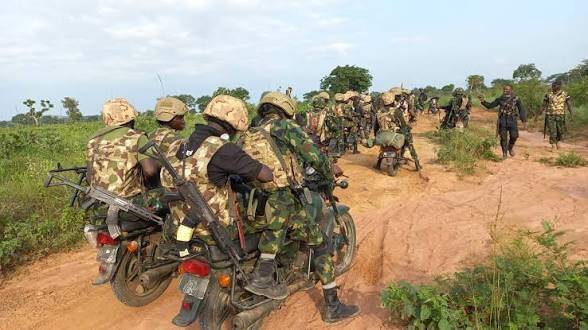
Under the harsh afternoon sun, a patrol of Nigerian soldiers crept through the infamous Timbuktu Triangle. The scrubland had become a fortress for the Islamic State West Africa Province (ISWAP), a stronghold where death was the currency and the mangled skeletons of the fallen served as landmarks. On May 5, 2026, they struck at the heart of the terror machine. At precisely 1:15 p.m., troops from Brigade Group I (25 Brigade Guards/19 Battalion) made contact with a group of heavily armed Boko Haram/ISWAP fighters in the Multe area. The sudden engagement, short but fierce, resulted in a decisive victory. By the time the smoke cleared and the echoes of gunfire faded into the distant hills, four terrorists lay dead on the sand, and one was in handcuffs being dragged toward the nearest base.
The bloody encounter, part of Operation HADIN KAI’s ongoing clearance of the terror triangle, marked a significant step in dismantling the logistical and fighting capacity of the insurgent group. “During the firefight, four terrorists were neutralised while one was captured alive,” a source told security analyst Zagazola Makama. The troops recovered a formidable arsenal from the fleeing insurgents. Among the spoils were three AK-47 rifles, 50 rounds of 7.62mm special ammunition, five AK-47 magazines, nine bicycles, and two motorcycles. The recovery of the bicycles and motorcycles, critical for the militants’ hit-and-run tactics, served as a significant blow to the group's mobility.
The operation did not end with the exchange of fire. Displaying tactical persistence, the troops pushed deeper into the terrorist enclaves, conducting mopping-up operations in the surrounding villages of Dusu, Multe, and Hawan Burum. These settlements, which have often served as staging grounds for attacks on military outposts and civilian travellers, were systematically cleared of any remaining IEDs and logistical supplies.
While the main force dealt the lethal blow to the terrorists, other formations of Operation HADIN KAI ensured that their comrades’ victory was not undone by other fleeing cells. In a related operation, Brigade Group II (231 Battalion/331 Artillery Regiment and 162 Amphibious Battalion) worked alongside the Civilian Joint Task Force (CJTF) to patrol the volatile villages of Kimba and Sabon Gari. Though they made no contact with insurgents, they made a chilling discovery: a freshly detonated improvised explosive device at the entrance of a forward operating base in Sabon Gari. The carcasses of dead cows were also observed nearby, indicating the terrorists had recently been in the area honing their craft of destruction.
As the sun dipped toward the horizon, the troops took control of the security vacuum, dominating the critical Main Supply Route (MSR) from Sabon Gari through Mandaragirau to Biu. This road, a vital artery for food and supplies, had often been a deathtrap for commuters. By securing these routes, troops effectively denied the terrorist remnants the freedom of movement required to launch further attacks, offering a brief respite to the beleaguered communities.
All recovered items, including the cache of weapons and the captured terrorist, have been moved to the Headquarters of the 25 Brigade for further investigation. The prisoner is expected to be interrogated to yield vital intelligence on the remaining terrorist hideouts and their supply networks. The operation is a testament to the ability of the Nigerian military to squeeze the Timbuktu Triangle, a massive area that has long haunted the nation's security conscience. It is a stark reminder that while the individual battles for its control are far from over, the ultimate death of the insurgency may still be years away, but on May 5, 2026, the soldiers won the day, four terrorists died, and one now sings behind bars.
📩 Stone Reporters News | 🌍 stonereportersnews.com
✉️ info@stonereportersnews.com | 📘 Facebook: Stone Reporters News | 🐦 X (Twitter): @StoneReportNew | 📸 Instagram: @stonereportersnews
Add comment
Comments