

Reported by: Oahimire Omone Precious | Edited by: Oravbiere Osayomore Promise.
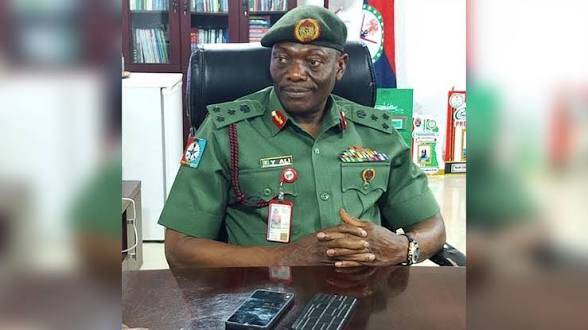
Just weeks after the Federal Government graduated 744 former Boko Haram associates from its De‑radicalisation, Rehabilitation and Reintegration (DRR) camp in Mallam Sidi, Gombe State, the Coordinator of Operation Safe Corridor (OPSC), Brigadier General Yusuf Ali, has pushed back forcefully against public calls for transparency. In a controversial interview on Sunday, May 10, 2026, he argued that those demanding to know the names and backgrounds of the reintegrated individuals are operating from a “misplaced” understanding of the programme’s humanitarian purpose.
“Demand for names of reintegrated 744 ‘repentant terrorists’ misplaced,” Brigadier General Ali stated bluntly. He dismissed the label “ex‑terrorist” as legally and morally incorrect, asserting that the 744 individuals who passed through the programme are not former insurgents but rather “victims of terrorism”——people who were abducted, coerced, or forced by economic hardship into the ranks of Boko Haram.
“On the issue of repentant terrorists, they are not terrorists; they are victims of terrorism,” Ali explained. Acknowledging that some may have participated in killings, he argued that many were either kidnapped as children or handed over to insurgents by relatives at gunpoint. “Some of them were abducted. Others had their parents forced at gunpoint to hand them over to the terrorists, after which they were taken away.” Once such individuals surrender, he noted, under international law they cannot be executed and must be given a pathway to rehabilitation.
The 24‑week programme at the Mallam Sidi camp, a sprawling facility supported by the European Union and other international partners, includes psychosocial therapy, drug rehabilitation, religious reorientation, and vocational training in trades such as tailoring, shoemaking, and farming. At the April 22 graduation ceremony, Chief of Defence Staff General Olufemi Oluyede emphasised that the initiative is “not an amnesty programme” but a structured counter‑insurgency strategy to reduce violence and weaken extremist recruitment pipelines. “This is not a reward but a deliberate approach,” Oluyede told the graduates.
Yet, for millions of Nigerians who have lost loved ones to Boko Haram’s 15‑year campaign of terror, the distinction between “ex‑fighter” and “victim” remains deeply unsatisfying. A breakdown of the 744 graduates shows that the vast majority – 597 – are from Borno State, the epicentre of the insurgency. Others hail from Yobe (58), Kano (15), Bauchi (12), Adamawa (10), and several states across the federation, including Abia, Anambra, Ebonyi, and Plateau. Eight are foreign nationals, including one each from Burkina Faso and Cameroon, two from Chad, and four from Niger Republic.
The decision to reintegrate without judicial oversight has drawn sharp condemnation from key institutions. The Nigerian Bar Association (NBA), through its President Afam Osigwe, warned that failure to address victims’ grievances could endanger both communities and the reintegrated persons themselves. “Reintegrating persons who may have unleashed violence or burned properties… into communities without addressing the hurt of the victims would appear as compensating perpetrators while overlooking the victims,” Osigwe said. He called for stronger monitoring mechanisms, including parole‑style supervision and livelihood support, to prevent re‑offending.
Amnesty International Nigeria has also raised alarms over a deep lack of transparency. Country Director Isa Sanusi demanded that the government “tell the people who these people are, what kind of terrorism they were involved in, and whether they were informants or killers.” He expressed concern that some of those processed could return to violent activity. The Human Rights Writers Association of Nigeria (HURIWA) went further, describing the policy as a dangerous normalisation of impunity. “This is not peacebuilding. It is a dangerous approach at a time when victims of terrorism continue to live with trauma,” the group stated, calling for an immediate suspension of the programme.
Even as these criticisms mount, Brigadier General Ali has defended the selection process, insisting that not every participant is a hardened insurgent. He explained that the Attorney‑General’s office has already convicted numerous high‑risk Boko Haram members, sentencing some to life imprisonment. Those cleared for reintegration, he argued, are individuals who have been legally exonerated – not those found guilty of major atrocities. “Once they have been cleared, because of the long period they spent in the bush with Boko Haram, they may have internalised certain experiences, including anger,” Ali acknowledged. The mandatory 24‑week programme, he said, is designed to de‑programme that anger.
The controversy surrounding Operation Safe Corridor is not new. Launched in 2016, the initiative represents the non‑kinetic pillar of Nigeria’s counter‑insurgency strategy, designed to complement military offensives. Over 2,000 former combatants have been processed through the programme since its inception. Yet with each graduating batch, public outrage resurface, particularly in Borno State where communities feel they have been left to shoulder the burden of reintegration without adequate consultation.
For now, the 744 reintegrated individuals have been issued starter packs by the National Emergency Management Agency (NEMA) and returned to their communities of origin, under the watch of state governments, local security agencies, and the National Identity Number (NIN) system. Whether they will be accepted remains an open question. A Borno resident interviewed by DW, Muhammad Sharif, summed up the prevailing skepticism: “If you forgive somebody and you want to integrate him, take him to another local government where the offended people will not see that person at their midst. They will not bring us peace.”
📩 Stone Reporters News | 🌍 stonereportersnews.com
✉️ info@stonereportersnews.com | 📘 Facebook: Stone Reporters News | 🐦 X (Twitter): @StoneReportNew | 📸 Instagram: @stonereportersnews
Add comment
Comments