

Reported by: Oahimire Omone Precious | Edited by: Oravbiere Osayomore Promise.
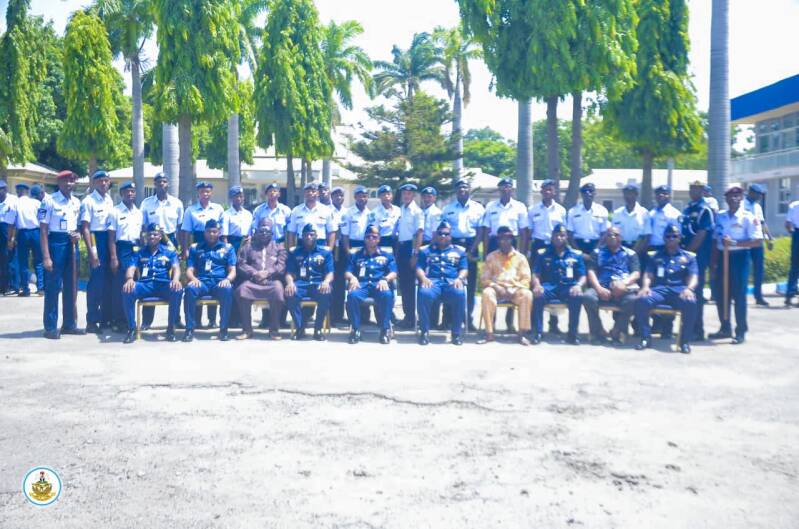
The Nigerian Air Force (NAF) has taken a significant step toward enhancing operational air safety and airfield support capabilities with the graduation of 49 personnel from two intensive upgrading courses at the Air Traffic Services Training Centre (ATSTC). The graduands, who completed the Air Traffic Control Assistant/Base Operations Upgrading Course 9/2026 and the Fire Upgrading Course 10/2026, were honoured at a ceremony on Wednesday, May 20, 2026, at the ATSTC facility. The four-week programmes were designed to equip participants with advanced competencies in air traffic control procedures, aerodrome operations, emergency coordination, and aircraft rescue and firefighting operations—skills deemed essential to sustaining safe and effective air missions across NAF operational theatres and joint-user airfields nationwide.
The training, which combined rigorous classroom instruction, simulator-based exercises, and practical drills, covered a wide array of critical topics. Participants were drilled on runway incursion prevention, flight data processing, aerodrome inspections, NOTAM (Notice to Air Missions) origination, aircraft firefighting tactics, and mass casualty response procedures. The Fire Upgrading Course placed particular emphasis on achieving ICAO-standard emergency response timelines, ensuring that NAF firefighting personnel can respond to aircraft emergencies within the internationally mandated window. To bridge the gap between theory and practice, the trainees undertook guided study tours to the 401 Flying Training School and the Hassan Usman Katsina International Airport in Kaduna, where they gained valuable exposure to real-time operational environments and best practices in airfield management and emergency response.
Speaking at the graduation ceremony, the Commandant of ATSTC, Air Vice Marshal NB Folaji, underscored the indispensable role that air traffic control, base operations, and firefighting personnel play in ensuring safe, efficient, and uninterrupted flying operations. He commended the graduating personnel for their discipline, resilience, and commitment throughout the training, noting that the successful completion of the courses has further strengthened the operational readiness and safety architecture supporting NAF air operations nationwide. "The skills you have acquired here are not just academic; they are life-saving. Every time an aircraft takes off or lands, your vigilance and professionalism stand between safety and disaster," Folaji told the graduands.
The graduation comes at a time when the Nigerian Air Force has been increasingly called upon to support counter-insurgency and anti-banditry operations across the country. With NAF aircraft flying more sorties than ever before—from the North-East fighting Boko Haram to the North-West combating banditry and the South-South conducting maritime surveillance—the demand for well-trained airfield support personnel has never been higher. Air traffic controllers and base operations staff are responsible for coordinating flight movements, preventing runway collisions, managing weather-related disruptions, and ensuring that communication systems function flawlessly. Firefighting crews, meanwhile, must be ready to respond to aircraft fires, fuel spills, and crash incidents within seconds of an alarm. The graduation of 49 new specialists represents a significant boost to NAF's human capital in these critical areas.
The Air Traffic Services Training Centre, which hosted the courses, has a long history of producing skilled personnel for both military and civil aviation in Nigeria. Established to meet the growing demand for certified air traffic controllers and airfield emergency responders, the centre has trained hundreds of NAF personnel and collaborated with civil aviation authorities to standardise training curricula in line with International Civil Aviation Organization (ICAO) guidelines. The upgrading courses specifically target personnel who already have foundational knowledge but require advanced skills to handle complex scenarios, such as coordinating multiple aircraft in congested airspace or managing large-scale emergency responses involving multiple agencies.
The graduation ceremony was attended by senior NAF officers, representatives of the Federal Airports Authority of Nigeria (FAAN), and instructors from the training centre. In his closing remarks, Air Vice Marshal Folaji urged the graduands to be ambassadors of safety and professionalism wherever they are posted. "You are now equipped to handle the most challenging situations. Do not betray the trust that the NAF has placed in you," he said. The 49 personnel will now be deployed to various NAF units and joint-user airfields across the country, where they are expected to immediately contribute to improving airfield safety and operational efficiency.
This initiative is part of a broader modernisation drive under the current NAF leadership, which has prioritised training, equipment upgrades, and infrastructure development. In recent months, the NAF has also commissioned new aircraft, renovated runways at key airbases, and established forward operating bases in conflict zones. The graduation of the 49 airfield support personnel complements these hardware investments by ensuring that the human element of aviation safety keeps pace with technological advancements. As Nigeria continues to face multifaceted security challenges, the ability to project air power safely and effectively remains a cornerstone of the national security strategy. With these 49 newly trained specialists, the NAF has taken another step toward achieving that goal.
📩 Stone Reporters News | 🌍 stonereportersnews.com
✉️ info@stonereportersnews.com | 📘 Facebook: Stone Reporters News | 🐦 X (Twitter): @StoneReportNew | 📸 Instagram: @stonereportersnews
Add comment
Comments