

Reported by: Ijeoma G | Edited by: Oravbiere Osayomore Promise.
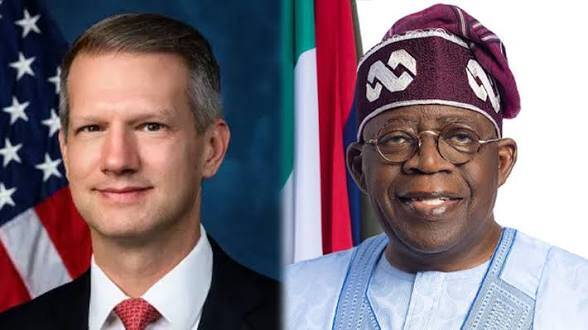
A senior United States lawmaker has escalated his campaign against the administration of President Bola Tinubu, accusing Nigeria of spending millions of dollars to lobby the U.S. Congress while failing to adequately address what he calls the "genocide" of Christians in the country. Representative Riley Moore, a Republican from West Virginia and member of the House Appropriations Committee, announced on Wednesday that the committee had advanced provisions in its fiscal year 2027 State Department funding bill that impose strict conditions on U.S. assistance to Nigeria. "The Tinubu Administration is spending millions lobbying Congress while failing to adequately address the genocide Nigerian Christians face daily," Moore said in a series of posts on his official X handle.
The action represents the latest and most consequential move in a sustained campaign by Moore and a group of Republican lawmakers who have made Nigeria's security and religious freedom records a top priority. The provisions, which Moore said he worked on with Representative Mario Diaz-Balart, restrict security assistance to Nigeria unless specific criteria are met. These include effectively responding to violence and holding perpetrators accountable, prioritizing resources for internally displaced persons, and actively facilitating the return of displaced persons to their ancestral homelands. The bill also requires Secretary of State Marco Rubio to assess Nigeria's compliance with these standards before any further security aid can be disbursed.
Moore's accusation that the Tinubu administration is spending heavily on lobbying is not new. In January 2026, a Nigerian newspaper reported that the government had paid $9 million to a Republican lobbyist in an effort to curry favour with Washington and prevent potential U.S. military intervention targeting terrorists accused of attacking Christians. The report cited multiple sources familiar with the arrangement, describing it as a desperate attempt to shape U.S. policy ahead of a highly contested presidential election in the United States. Moore appears to have seized on this narrative, using it to galvanize support for his legislative push. "In my view, the Tinubu Administration has failed to live up to the conditions the appropriations committee placed on security assistance," Moore added, urging Rubio to take this into account in administering both fiscal year 2026 and 2027 funding.
The legislative text approved by the subcommittee is sweeping in its scope. It mandates that funds appropriated for Nigeria be used on a "cost-matching basis to the maximum extent practicable" and prioritizes several explicitly defined areas: atrocities prevention, including early warning systems; advancing religious freedom; investigations and prosecutions of violence committed by Fulani militia groups, jihadist terror groups, and criminal gangs; the effectiveness and accountability of police and security forces in protecting civilians; the delivery of humanitarian assistance; and the restoration of basic services in conflict-affected areas, including through faith-based organisations. The bill also adds Nigeria to a list of countries requiring "much higher levels of congressional oversight," compelling the Secretary of State to submit a plan for every dollar appropriated to Nigeria, with every expenditure subject to direct congressional scrutiny.
Moore's campaign against the Tinubu administration predates the committee's latest action by several months. In February 2026, Moore and a bipartisan delegation presented a comprehensive report to the White House detailing findings and recommendations on the alleged persecution of Christians in Nigeria. The report, which Moore described as the culmination of months of investigation including hearings with expert witnesses, consultations with religious leaders, and a fact-finding visit to Nigeria, outlined "concrete actions to end the persecution of Christians in Nigeria and counter growing extremist violence in the region." Among its recommendations were the establishment of a bilateral U.S.-Nigeria security agreement, the withholding of certain U.S. funds pending measurable action by Nigerian authorities, the imposition of sanctions and visa restrictions on individuals linked to religious persecution, and the repeal of Sharia and blasphemy laws. The report also called for enhanced collaboration with international partners, including France, Hungary, and the United Kingdom.
The drive for legislative action intensified weeks earlier when Moore, alongside Representative Chris Smith of New Jersey, introduced the Nigeria Religious Freedom and Accountability Act of 2026 (H.R. 7457). That bill, which Moore described as a natural progression of President Donald Trump's redesignation of Nigeria as a Country of Particular Concern (CPC) in October 2025, requires the Secretary of State to compile and submit to Congress a comprehensive report on U.S. efforts to address religious persecution and mass atrocities against Christians in Nigeria. The bill also directs the State Department to consider designating Fulani ethnic militias as a Foreign Terrorist Organisation, a move that would trigger a range of sanctions and restrictions. Cosponsors of the legislation include House Appropriations Committee Chairman Tom Cole, House Foreign Affairs Committee Chairman Brian Mast, and Appropriations Subcommittee on National Security and Related Programs Chairman Mario Diaz-Balart, among others.
The legislative push has been accompanied by a parallel information campaign. In recent days, Moore has repeatedly pointed to what he described as two recent attacks as evidence of the urgent need for action: forty people killed during a Palm Sunday service and thirteen Christians killed at a wedding on the same day. He has also cited statistics from the 2026 annual report of the U.S. Commission on International Religious Freedom (USCIRF), which described Nigeria as facing a "terrifying crisis of religious violence" and noted that Christians have been frequent targets of attacks by non-state militants promoting a violent interpretation of Islam. The report recommended that Nigeria be maintained on the CPC list, a designation that President Trump has already applied.
The Nigerian government has consistently rejected the premise of Moore's campaign. In February 2026, the Minister of Information and National Orientation, Mohammed Idris, issued a detailed rebuttal to the congressional report, stressing that Nigeria "does not have, and has never had, a state policy of religious persecution." Idris argued that the violence confronting Nigeria is not rooted in state policy or religious bias but stems from complex security threats, including terrorism, organised criminality, and longstanding communal tensions. "The violence being confronted by our security agencies is not driven by government policy or religious bias, but by complex security threats, including terrorism, organised criminality, and longstanding communal tensions," Idris said. He emphasised that the government is undertaking a number of measures to combat the violence, including boosting military and law enforcement operations, improving intelligence sharing, and investing in equipment and technology to support security agencies.
The Nigerian government has also attempted to manage the diplomatic fallout through the establishment of a U.S.-Nigeria Joint Working Group, which held its first meeting in Abuja in January 2026. That working group, established in response to Nigeria's CPC designation, is co-chaired by National Security Adviser Nuhu Ribadu and Under Secretary of State Allison Hooker. Its stated objectives include reducing violence against vulnerable groups, particularly Christians, and creating conditions for all Nigerians to freely practice their faith. The group is also tasked with strengthening counter-terrorism cooperation, including operational cooperation, access to technology, and building law enforcement capacity. Despite these diplomatic efforts, Moore's continued pressure suggests that the political battle in Washington is far from over.
The provisions advanced by the Appropriations Committee now move to the full House for consideration. If enacted, they would significantly reshape the contours of U.S.-Nigeria security cooperation, tying American assistance to specific performance metrics on human rights and religious freedom while subjecting every dollar of aid to direct congressional oversight. For the Tinubu administration, already navigating a complex security environment and an approaching election season, the spectre of restricted U.S. support adds a new layer of diplomatic and political pressure.
Moore's comments also reflect broader trends within the Republican Party, which has increasingly sought to frame U.S. foreign policy around the protection of religious minorities abroad. The Nigeria Religious Freedom and Accountability Act has attracted support from a coalition of human rights and faith organisations, which have urged swift bipartisan passage. Whether the bill and the related funding provisions survive the full legislative process remains uncertain, but Moore's determination suggests that Nigeria's religious freedom record will remain a subject of intense scrutiny in Washington for the foreseeable future. For now, the Tinubu administration finds itself at the centre of a political storm that shows no signs of abating, its efforts to build relations with the Trump administration constantly shadowed by accusations of complicity in violence it says it is doing its best to combat. The outcome of this standoff will help define the tenor of U.S.-Nigeria relations for the remainder of President Trump's term and beyond.
📩 Stone Reporters News | 🌍 stonereportersnews.com
✉️ info@stonereportersnews.com | 📘 Facebook: Stone Reporters News | 🐦 X (Twitter): @StoneReportNew | 📸 Instagram: @stonereportersnews
Add comment
Comments