

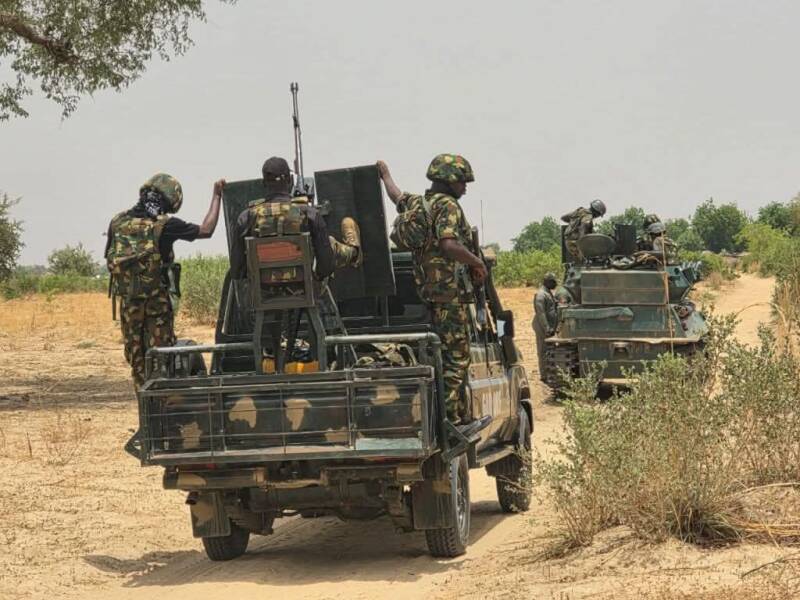
Troops of the Joint Task Force (North East), Operation HADIN KAI, have successfully foiled a coordinated attack by suspected terrorists in Nigeria’s North East and rescued civilians during the encounter, military authorities have confirmed, in an incident that also led to the surrender of a 17-year-old relative of one of the assailants.
According to a statement by the Theatre Command, the attackers were riding on motorcycles and attempted to infiltrate a populated settlement from multiple directions before being detected by surveillance and rapid response units, triggering a swift defensive operation that disrupted their advance and forced them to retreat.
Troops engaged the fleeing attackers, neutralising the threat and securing the area, while search operations were extended to ensure that no additional explosives or trapped victims remained within the affected community, the military said.
During the operation, several civilians who had been caught in the initial movement of the attackers were safely rescued and moved to secure locations for medical checks and psychological support, according to officials overseeing the mission.
A notable development was the surrender of a 17-year-old who is believed to be a relative of one of the suspected fighters, highlighting ongoing efforts to encourage defections and disengagement from armed groups in the region through non-kinetic approaches.
Military authorities said the incident underscores both the persistent security challenges in the North East and the evolving tactics of armed groups, who continue to rely on mobility, surprise, and dispersed movement patterns to evade detection by security forces.
Operation HADIN KAI, which forms part of Nigeria’s broader counter-insurgency campaign in the North East, has over recent years combined ground offensives with intelligence-led operations aimed at degrading the capacity of insurgent networks and restoring stability to affected communities.
Officials reiterated that community vigilance and timely reporting remain crucial components of the overall strategy, as many recent successful interceptions have been attributed to early warnings provided by local residents working in coordination with security personnel.
The North East region of Nigeria has faced prolonged insecurity over the past decade, driven by a series of armed insurgent activities that have affected rural communities, disrupted livelihoods, and prompted sustained military operations across multiple states in the region.
Security operations such as Operation HADIN KAI were established to coordinate responses among different branches of the armed forces and intelligence agencies, focusing on both combat engagements and efforts to stabilize liberated communities through humanitarian support and reconstruction initiatives.
In recent months, military briefings have indicated an increase in attempts by armed groups to exploit remote terrain and cross-border corridors, prompting intensified patrols and enhanced surveillance technology deployment across vulnerable areas.
Despite these challenges, officials maintain that coordinated operations have significantly reduced the frequency of large-scale attacks in several parts of the region, even as smaller skirmishes and sporadic incidents continue to occur.
Officials emphasized the importance of continued collaboration between security agencies and local communities, noting that recent successes in disrupting planned attacks demonstrate the value of intelligence sharing and rapid response coordination in volatile areas.
They also reiterated that rehabilitation and reintegration initiatives for individuals disengaging from armed groups remain a key part of the long-term strategy to weaken insurgent recruitment pipelines and restore social cohesion.
Media reports from the theatre command described how rapid mobilization of ground troops, supported by intelligence surveillance assets, allowed forces to intercept movement routes and prevent the attackers from reaching the targeted settlement.
Residents in affected areas often live in dispersed rural settlements, making rapid evacuation difficult during sudden security incidents, which increases reliance on timely alerts and coordinated security presence to minimize harm.
The surrender of the 17-year-old relative was described by officials as part of ongoing efforts to encourage individuals associated with armed groups to abandon violent pathways, particularly younger persons who may have been exposed through family or community ties.
Security cooperation across Nigeria’s North East continues to involve joint military task forces, police units, and intelligence services working in tandem to address both immediate threats and long-term stability objectives.
Operation HADIN KAI operates as the principal theatre command for counterinsurgency efforts in the region, coordinating air, land, and intelligence assets under a unified command structure designed to improve operational efficiency and responsiveness.
Local intelligence gathering has been repeatedly highlighted as a decisive factor in preventing attacks, with residents providing early warnings that enable security forces to mobilize quickly and intercept hostile movements before they reach populated areas.
Rehabilitation programmes for defectors and surrendering individuals are increasingly integrated into broader counterinsurgency strategy, aiming to reduce recidivism and support social reintegration through education, counseling, and vocational training initiatives.
Military officials say morale among troops remains high despite ongoing operational challenges, citing improved coordination, better equipment, and enhanced intelligence sharing as key factors supporting sustained engagement.
Recent assessments from security briefings indicate that coordinated air and ground surveillance has significantly improved situational awareness across key corridors used by armed groups. Analysts within the theatre command note that enhanced communication systems now allow for faster relay of field intelligence, reducing response time during emerging threats. The integration of drone reconnaissance, ground patrols, and community reporting networks has created a layered security approach that is increasingly effective in detecting movement patterns before attacks materialize. Officials caution, however, that sustained vigilance remains essential, particularly in remote border communities where terrain and limited infrastructure continue to present operational challenges for security personnel.
The recent incident in the North East reflects the ongoing complexity of security operations in the region as forces continue to adapt to evolving threats posed by armed groups operating across difficult terrain. While authorities report tactical successes in preventing attacks and rescuing civilians, they stress that long-term stability depends on sustained cooperation between military units, intelligence agencies, and local communities. Continued emphasis on intelligence-led operations and community engagement remains central to reducing vulnerability and strengthening resilience across affected populations. Officials maintain that although progress has been recorded, the security situation requires continuous monitoring, investment, and adaptive strategies to ensure lasting peace and protection for civilians living in high-risk areas region
📩 Stone Reporters News | 🌍 stonereportersnews.com
✉️ info@stonereportersnews.com | 📘 Facebook: Stone Reporters News | 🐦 X (Twitter): @StoneReportNew | 📸 Instagram: @stonereportersnews
Add comment
Comments