

Reported by: Ijeoma G | Edited by: Oravbiere Osayomore Promise.
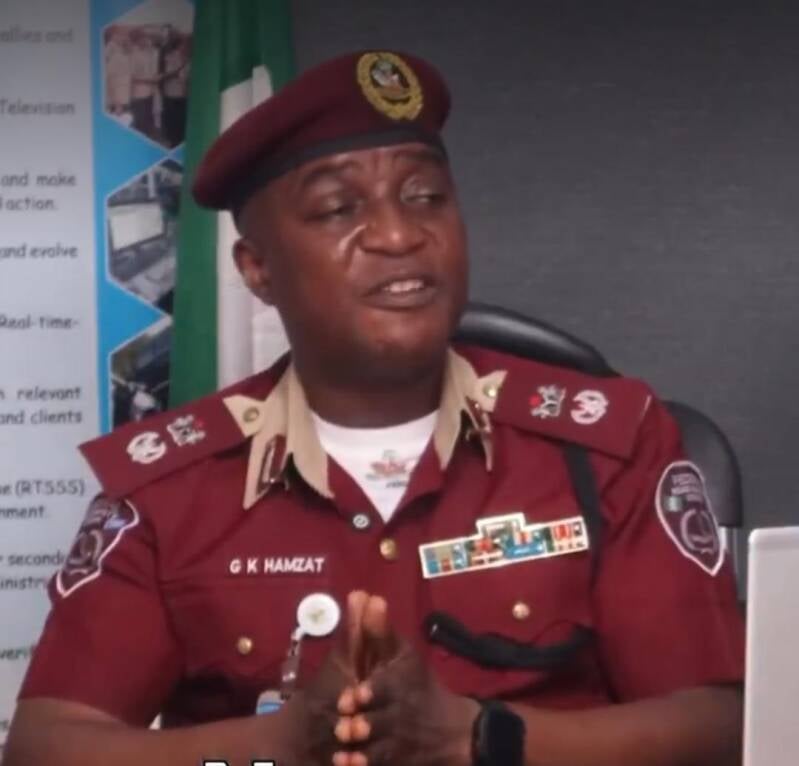
A senior commander of the Federal Road Safety Corps (FRSC) has ignited a fresh controversy after publicly declaring that foreign driver's licences are not valid on Nigerian roads and warning that the rule would be strictly enforced by the agency, a statement that has triggered widespread reactions from Nigerians at home and abroad, particularly from members of the diaspora who hold licences issued in countries such as the United Kingdom, Germany, Canada and the United States. The declaration was made by the Lagos State Sector Commander of the FRSC, Corps Commander Kehinde Ganiyu Hamzat, also referred to as G.K. Hamzat, in a video clip that circulated widely on social media on Wednesday, May 20, 2026, prompting immediate debate over the legal framework governing foreign driving credentials in Nigeria and the potential impact on returning residents and tourists.
In the video, Commander Hamzat was unequivocal in his position, stating that foreign driving licences are not recognised for driving on Nigerian roads and that the FRSC would begin strict enforcement of this provision. His statement drew swift pushback from Nigerians living abroad, who pointed out what they described as a glaring double standard. Many noted that their host countries, including the United Kingdom and various European nations, typically recognise Nigerian driver's licences as valid for up to one year. In contrast, Nigeria's own driver's licence acquisition process is notoriously slow, bureaucratic and riddled with issues related to document forgery and corruption, making it difficult for returning residents to obtain a local licence within a reasonable timeframe. One diaspora Nigerian, who identified himself as a medical doctor based in Manchester, told reporters: "I can drive in the UK with my Nigerian licence for up to 12 months without any problem. But when I come home, I am told my UK licence is worthless. It makes no sense."
However, existing regulations tell a more nuanced story than the commander's blanket statement might suggest. Legal experts and driving authorities have pointed to the National Road Traffic Regulations of 2012, which align with the provisions of the Geneva Convention on Road Traffic. Under these rules, visitors to Nigeria are permitted to drive using a valid foreign driver's licence accompanied by an International Driving Permit (IDP) for a period of up to 90 days. Those who remain in the country beyond that window are required to either obtain a local driver's licence or have their foreign one formally exchanged through a recognised process. The regulation also allows for the recognition of foreign licences from countries with which Nigeria has bilateral agreements, though such agreements are rare and not widely publicised. This distinction between short-term visitors and long-term residents appears to have been overlooked in Commander Hamzat's public remarks, leading to confusion and alarm among diaspora Nigerians who frequently travel home.
The FRSC has a long history of enforcing driver's licence regulations, with previous convictions recorded against motorists using foreign licences. In January 2018, a mobile court attached to the FRSC in Awka, Anambra State, sentenced a motorist, Mr. Azuka Okoye, to two months imprisonment for driving with a South Korean driver's licence, with an option of a fine. The magistrate ruled at the time that only diplomats, envoys and tourists were permitted to use foreign driving licences in Nigeria, and that ordinary citizens were not covered by any such exception. The court further noted that a foreign licence could only be used if there was a bilateral arrangement between the traffic agencies of the two countries concerned, a condition that did not apply in that case. That conviction set a precedent that the FRSC has continued to cite in its enforcement operations, and it suggests that Commander Hamzat's recent declaration, while startling to many, is not entirely without legal foundation. Nevertheless, the 2018 case also underscored the confusion surrounding the rules, as the magistrate's ruling appeared to permit tourists to use foreign licences, whereas Commander Hamzat's statement appeared to suggest no foreign licence whatsoever would be accepted.
The controversy has also highlighted the slow and cumbersome process of obtaining a Nigerian driver's licence, which remains a significant barrier for returning residents. The process requires applicants to first enrol at an FRSC-accredited driving school, undergo a mandatory training period, pass a driving test conducted by a Vehicle Inspection Officer (VIO), complete a medical and eye examination, undergo biometric capture, and pay fees totalling between ₦45,000 and ₦50,000. The entire process can take several weeks or even months, a timeline that is impractical for diaspora Nigerians who may be visiting for only a few weeks during the holidays. Many have called on the FRSC to establish a streamlined process for returning residents, similar to the systems in place in countries like the United Kingdom and the United States, where foreign licences can be exchanged for local ones with minimal testing or bureaucratic delay. Others have suggested that Nigeria should enter into reciprocal recognition agreements with major countries to eliminate the disparity entirely.
In light of Commander Hamzat's remarks and the possibility of roadside enforcement, driving and legal experts are advising Nigerians in the diaspora who visit home to always travel with an International Driving Permit (IDP) as a safeguard against potential fines or harassment during police or FRSC stops. An IDP is a document that translates a driver's existing licence into multiple languages and is recognised under international conventions. It is not a standalone licence but must be presented alongside the original foreign licence. While the IDP does not confer any additional driving privileges beyond those already granted by the original licence, it can help clarify a driver's credentials to law enforcement officers who may be unfamiliar with foreign documents. However, experts caution that even an IDP may not protect a driver who is stopped after the 90-day visitor window has expired, at which point a Nigerian licence would be legally required regardless of any other documentation.
The FRSC has not issued an official statement clarifying whether Commander Hamzat's declaration represents a change in policy or merely a reiteration of existing regulations. The agency's national headquarters in Abuja has remained silent on the matter, though sources indicate that internal discussions are ongoing regarding the need for clearer public communication on the issue. Meanwhile, the debate rages on social media, with diaspora Nigerians sharing stories of being stopped at checkpoints and forced to pay bribes because their foreign licences were deemed unacceptable. One woman who resides in Houston, Texas, told an online forum that she was detained for two hours at a checkpoint in Ogun State last December because she presented her Texas driver's licence. "I had to call my cousin to come with his Nigerian licence before they would let me go," she wrote. "It was humiliating and frightening."
The clash between Nigeria's rigid enforcement of its driver's licence laws and the expectations of its globally mobile citizens appears unlikely to be resolved quickly. What is clear, however, is that Commander Hamzat's statement has succeeded in drawing attention to a long‑standing but poorly understood area of Nigerian traffic law. Until the FRSC issues definitive guidelines and until Nigeria addresses the bureaucratic bottlenecks in its own licence acquisition process, diaspora Nigerians returning home will continue to navigate a legal landscape that is as confusing as it is unforgiving.
📩 Stone Reporters News | 🌍 stonereportersnews.com
✉️ info@stonereportersnews.com | 📘 Facebook: Stone Reporters News | 🐦 X (Twitter): @StoneReportNew | 📸 Instagram: @stonereportersnews
Add comment
Comments