

Reported by: Ijeoma G | Edited by: Oravbiere Osayomore Promise.
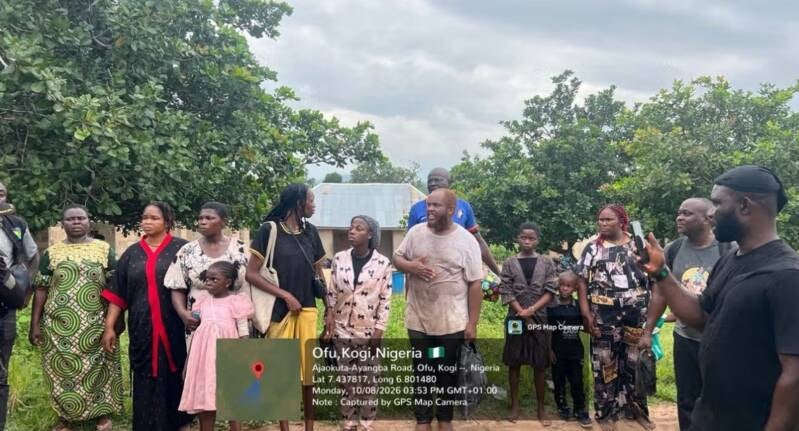
It began as a routine journey along the Ojuwo–Ajengo–Memarebo and Ojiwo–Itobe roads in Ofu Local Government Area of Kogi State. On Sunday, August 9, 2026, armed criminals attacked commuters and abducted 16 people, shattering the ordinary lives of men, women and children who had simply been travelling through the area. Their 48‑hour ordeal, which ended in a dramatic rescue on Monday, August 10, has now been laid bare by two of the survivors, Ngozi Stephen and Joshua Daniel, who spoke at the Kogi State Police Command headquarters on Tuesday, August 11. The revelations include ransom demands as high as N100 million, threats to sell the victims to ritualists, and a harrowing escape attempt that left one man bleeding through the night. The joint rescue operation, involving the Nigerian Army, Navy, police and local vigilantes, came at a heavy cost: one local hunter lost his life, and a police officer sustained injuries.
For Ngozi Stephen, the nightmare began when the kidnappers realised she could speak Hausa. Her linguistic ability, which might have been a small comfort, became a burden. The abductors forced her to serve as their interpreter, relaying their demands to the other captives and communicating their threats. “So they told me, tell this person N50 million, tell this person N100 million, tell this person N70 million. That was how they were sharing it,” Stephen recalled. The ransoms were arbitrary and staggering, with each victim assigned a different price for their freedom. Stephen herself was given a N70 million ransom. When she attempted to plead for a reduction, the kidnappers threatened to beat her. They did not physically assault her, perhaps because they needed her to continue interpreting, but the threat was ever present. “Even when I tried to plead and ask them to reduce it a little, they threatened to beat me up because they were beating people and all that,” she said.
The psychological torment was relentless. The abductors confiscated the victims' phones and switched them off, maintaining complete control over their communication with the outside world. They only returned the devices when they wanted the victims to contact their families and demand ransom payments. But the most terrifying threat came when the kidnappers warned that if the ransoms were not paid, they would sell the victims to ritualists. “At some point, they were even threatening that if we were not able to provide the money, they would just sell us to ritualists and all that,” Stephen narrated. The threat of ritual murder, a practice that preys on the most vulnerable, added a layer of existential dread to the ordeal.
Joshua Daniel, another victim, experienced a different kind of horror. Shortly after the abduction, he spotted an opening in the kidnappers' security and attempted to escape. He ran into a nearby bush, but one of the abductors pursued him and attacked him with a cutlass. Daniel raised his hand to protect himself, but the weapon cut deep into his vein. “That is when the cutlass landed here and cut my vein. So, I was bleeding throughout the night,” he said. He had no access to medical care, and the bleeding continued unabated. It was only the following morning, when he found herbs in the bush and applied them to the wound, that the bleeding stopped.
The kidnappers, speaking in Igala, Fulani and Hausa, deliberately used multiple languages to prevent the victims from understanding their conversations. Daniel identified one of the abductors as Peter. The criminals' ability to switch languages reflected the diverse composition of the gang, a common feature of the kidnapping syndicates that operate along the highways of north‑central Nigeria.
The rescue came on Monday, August 10, when a joint security operation involving the Nigerian Army, Navy, police and local vigilantes tracked the abductors to the Adumu community in Dekina Local Government Area. The security forces engaged the kidnappers in a fierce gun battle. Overwhelmed by the combined response, the criminals abandoned all 16 victims and fled into the surrounding forest, with some reportedly sustaining gunshot wounds. The rescued group comprised six adult men, six adult women and four children. They were taken for documentation, medical assessment and reunification with their families.
The success of the operation was tempered by loss. One local hunter, who had volunteered to support the security forces, was killed during the rescue. A police officer also sustained injuries and is receiving medical treatment. Daniel, despite his own injury, helped evacuate the wounded police officer from the hideout to the main road. “Even when I had this cut on my hand, I helped in carrying the officer from where we were held captive to the main road where we entered the car. My hand was swelling,” he said.
The victims expressed gratitude to the security operatives for their rescue. Stephen said the kidnappers fled after hearing gunshots, leaving behind a bag containing the phones and laptops they had seized. “We were able to get back our phones. We were also able to get back the laptops. Thank God. We are now safe,” she said.
The Kogi State Police Command has not yet disclosed whether any arrests have been made in connection with the abduction. The Nigerian Army has urged citizens to continue providing timely information to security agencies, noting that such intelligence remains essential to disrupting kidnapping networks and denying criminal groups freedom of action. The kidnapping along the Ojuwo–Ajengo–Memarebo and Ojiwo–Itobe roads is part of a broader pattern of highway abductions in Kogi State, where criminal gangs have increasingly targeted commuters for ransom.
For Ngozi Stephen, Joshua Daniel and the 14 other victims, the ordeal is over. But the psychological scars of hearing that they might be sold to ritualists, of bleeding through the night in a forest, and of watching a local hunter give his life for their freedom, will linger. Their testimony offers a rare glimpse into the brutality of Nigeria's kidnapping economy, where human lives are reduced to ransom figures and threats of ritual murder are used as bargaining chips. The rescue of all 16 victims is a testament to the bravery of the security forces and the local vigilantes who risked their lives. But it is also a stark reminder that for every successful rescue, there are countless others who never make it home.
📩 Stone Reporters News | 🌍 stonereportersnews.com
✉️ info@stonereportersnews.com | 📘 Facebook: Stone Reporters News | 🐦 X (Twitter): @StoneReportNew | 📸 Instagram: @stonereportersnews
Add comment
Comments