

Published by Osasere Edomwonyi Ikpoba
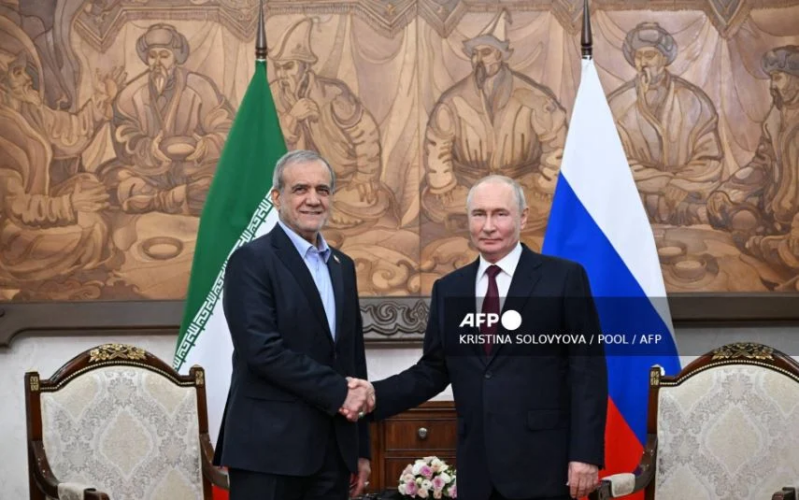
Iranian President Masoud Pezeshkian has publicly thanked Russian President Vladimir Putin for Moscow's steadfast support during Tehran's ongoing military confrontation with the United States, declaring that their "strategic relationship" has helped Iran resist American pressure and expressing confidence that Iran would emerge victorious from the conflict. The meeting, held on Tuesday on the sidelines of the Shanghai Cooperation Organisation summit in Bishkek, Kyrgyzstan, marked the first face-to-face encounter between the two leaders since war erupted between Iran and the United States on February 28.
"We appreciate and thank you for your positions at every stage, both during the period when the fighting and acts of aggression were taking place and under normal circumstances, when the United States was imposing sanctions on us, both at the United Nations and in international forums," Pezeshkian told Putin during the closed-door meeting. The Iranian leader emphasised that Moscow's diplomatic backing had been invaluable, particularly in international bodies where Russia has consistently shielded Tehran from punitive measures. "This shows that our relationship is a strategic relationship; it is not an ordinary relationship," Pezeshkian added, underscoring the depth of the burgeoning Moscow-Tehran axis.
Pezeshkian went further, framing the alliance as a bulwark against what he termed American "unilateralism." According to Russia's state-run TASS news agency, the Iranian president told Putin, "We can resist US unilateralism". He also expressed Iran's alignment with Russia's vision of a multipolar world, stating, "We are here to fight against unipolarity. We want to break free from the constraints of this unipolar system. I am confident that we will prevail". The Iranian leader also criticised the United States directly, saying Washington had "no grounds to justify their actions against Iran" despite its rhetoric about democracy and human rights.
For his part, Putin assured Pezeshkian of Russia's continued support, describing the US-Iran ceasefire agreement reached in June as "unstable and too fragile". The Russian leader confirmed that Moscow had been actively providing Tehran with essential goods during the difficult period, stating, "During this difficult period, we are trying to provide you with the necessary assistance. We have discussed this. We are supplying the necessary goods". Putin also expressed solidarity with the Iranian people, saying, "I have repeatedly stated that Russia stands in solidarity with the Iranian people" and praising their "courage and resilience in defending your national interests".
The war between Iran and the United States erupted on February 28, 2026, following US-Israeli strikes that killed Iran's supreme leader, Ayatollah Ali Khamenei, along with senior military officials. Iran retaliated with attacks across the region, and Tehran subsequently blockaded the strategic Strait of Hormuz, a vital global energy conduit, while Washington imposed a naval counter-blockade on Iranian ports. An April 8 ceasefire brought an end to the most intense phase of fighting, but sporadic attacks—mainly near the Strait of Hormuz—have continued to undermine prospects for a lasting peace agreement. The United States has recently shifted toward a strategy of "economic asphyxiation" against Iran, intensifying sanctions pressure on the Islamic Republic.
The SCO summit in Bishkek, which marks the organisation's 25th anniversary, provided the backdrop for the high-stakes meeting. The two leaders last met during a summit in Turkmenistan in December 2025. Since launching its full-scale invasion of Ukraine, Russia has massively deepened its military and economic ties with Iran, with both nations seeking to counterbalance Western influence. Putin noted that despite the military-political situation, Moscow and Tehran had maintained the momentum of their trade and economic cooperation from the previous year, citing the regular work of the bilateral intergovernmental commission and the free trade agreement between the Eurasian Economic Union and Iran as key factors supporting economic ties.
Pezeshkian's expression of gratitude to Putin comes just days after he offered an olive branch to the United States, vowing to match any American move to return to the June ceasefire memorandum. However, his comments in Bishkek made clear that Tehran views Moscow as an indispensable partner in its confrontation with Washington. The Iranian president described the bilateral relationship as strategic in nature, one that "helped Iran confront the United States". He also reiterated Iran's support for Russia's position on transitioning away from a unipolar world order, signalling a convergence of geopolitical visions between the two nations.
The meeting has significant implications for the broader Middle East and global energy security. Iran's blockade of the Strait of Hormuz has already disrupted global oil supplies, and any further escalation could have severe consequences for the world economy. Russia's continued support for Iran, including the supply of goods and diplomatic cover at the United Nations, has complicated US efforts to isolate Tehran economically and militarily. Putin's pledge to do "everything" to help secure peace in the Middle East, made during an April meeting with Iran's Foreign Minister Abbas Araghchi, has yet to yield concrete results, but Moscow's role as a mediator remains a factor in the conflict.
As the war grinds on and the prospects for a final peace agreement remain uncertain, the Putin-Pezeshkian meeting in Bishkek has sent a clear signal: the Russia-Iran alliance is not merely tactical but strategic, built on shared opposition to US dominance and a mutual commitment to reshaping the global order. For Tehran, Moscow's support has become a lifeline. For Moscow, Tehran offers a foothold in the Middle East and a partner in challenging Western hegemony. Whether this partnership will tip the balance in Iran's favour remains to be seen, but for now, Pezeshkian's message to Putin was unambiguous: Iran is grateful, and Iran believes it will win.
📩 Stone Reporters News | 🌍 stonereportersnews.com
✉️ info@stonereportersnews.com | 📘 Facebook: Stone Reporters News | 🐦 X (Twitter): @StoneReportNew | 📸 Instagram: @stonereportersnews
Add comment
Comments