

Reported by: Ijeoma G | Edited by: Oravbiere Osayomore Promise.
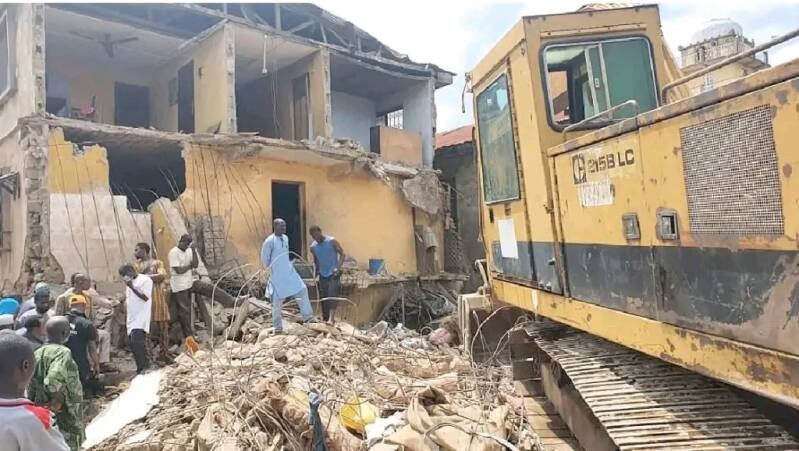
The first call to prayer had just drifted from the mosque near Popo Giwa in Ilorin, Kwara State, on Tuesday, September 1, 2026, when the quiet of the early morning was shattered by a deafening crash. At No. 41 Popo Giwa Street, beside the Gogoro Mosque, a three-storey residential building that had stood for more than 70 years suddenly gave way. It was a few minutes after 5am. The section that collapsed was the boys' quarters attached to the main building, burying eight members of the same family beneath tons of concrete, blocks, and debris.
Among those trapped was the family of a Staff Sergeant in the Nigerian Army, Bolakale Kudus, who had reportedly just returned from his duty station in Akure, Ondo State, on medical leave. His wife and four children were killed in the collapse. The soldier himself survived after being rescued from the rubble. His elder brother, Mallam Kudus Olanrewaju, who also survived, recalled the terrifying moment: "I was contemplating going to the toilet to perform ablution. Thank God I had not moved close to the toilet before I heard a loud sound, gbaa," he told Sunday PUNCH. "Everybody woke up immediately, but I could not see anything because dust had covered everywhere," he said. He explained that his brother was in the bathroom preparing for ablution when the structure collapsed. "He was the first person to be rescued alive," he said. But the relief that accompanied his rescue was soon overtaken by grief. "I have lost my children. I lost their mother and four of them. Only my brother, who is a staff sergeant in the Nigerian Army, is alive. I have lost five of them," Olanrewaju said.
Eyewitness Abdulganiy Musa told Channels Television that the father of the family is a serving soldier while the mother worked as a casual staff member at the Michael Imoudu National Institute for Labour Studies in Ilorin. Musa said rescuers were engaged in frantic efforts to evacuate those trapped under the collapsed structure. A child identified as Firdaus, the second-to-last born of the family, was among those rescued alive as emergency responders intensified the operation.
The Kwara State Fire Service said it received a distress call at about 5am and immediately mobilised personnel to the scene. An excavator was later deployed to assist rescuers in removing the debris and gaining access to the remaining trapped victims. Several emergency and security agencies were involved in the rescue operation, including the State Emergency Management Agency, the National Emergency Management Agency, the Nigeria Security and Civil Defence Corps, the police, health officials, and the Red Cross. Six to seven ambulances were also deployed to evacuate survivors for medical attention. The Kwara State Fire Service Public Relations Officer, Hassan Adekunle, who was at the scene, disclosed that four people were rescued alive while four others were recovered dead from the rubble. However, the death toll later rose to five. The five victims—a mother and her four children—were laid to rest in accordance with Islamic rites at the Muslim Cemetery in Oko-Olowo, Ilorin. A renowned Ilorin cleric and University of Ilorin scholar, Professor Abubakr Imam Ali-Agan, led the funeral prayers. The Kwara State Governor, Mallam AbdulRahman AbdulRazaq, was represented at the funeral by his Special Adviser on Special Duties, Alhaji AbdulRazaq Jiddah.
The head of the family, Mr Lanre Qudus, said the building had failed a structural integrity test and that the family had already moved out of the remaining section. He added that the remaining part of the structure would be brought down. The collapse has renewed concerns over the safety of ageing buildings in the state. Chairman of the Kwara State Technical Committee of the Council for the Regulation of Engineering in Nigeria (COREN), Bashir Lawal, called for a comprehensive structural audit of buildings across the state to reduce the risk of similar disasters. Lawal stressed that regular inspections and strict compliance with building standards are necessary to safeguard lives and property. The Kwara State Commissioner for Education and Human Capital Development, Lawal Olohungbebe, who represented the governor at the scene, stressed the importance of accessible roads in residential areas, saying the access route to the building contributed to the ease with which emergency responders were able to reach the scene. He urged residents and developers to respect building and town-planning regulations. As the family mourns its devastating loss, the tragedy serves as a stark reminder of the urgent need for stronger enforcement of building regulations across Kwara State.
📩 Stone Reporters News | 🌍 stonereportersnews.com
✉️ info@stonereportersnews.com | 📘 Facebook: Stone Reporters News | 🐦 X (Twitter): @StoneReportNew | 📸 Instagram: @stonereportersnews
Add comment
Comments