

Reported by: Oahimire Omone Precious | Edited by: Oravbiere Osayomore Promise.
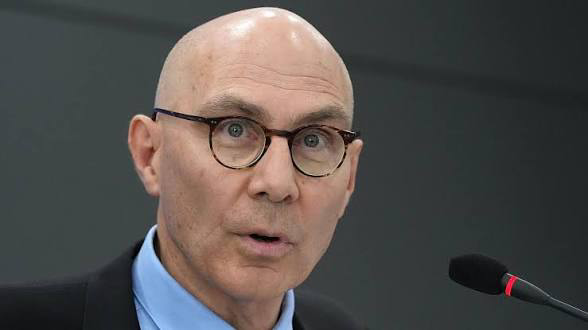
The United Nations human rights chief has issued a stark and urgent warning that advanced artificial intelligence could pose an "existential risk to humanity," demanding immediate global action to establish safeguards before the technology becomes too powerful to control. In a sweeping address to the UN Human Rights Council in Geneva on Monday, September 7, 2026, UN High Commissioner for Human Rights Volker Türk said he shares the concerns of industry insiders that advanced AI could threaten the very existence of humanity. "I am calling here, today, for an all-out effort to put cast iron guarantees in place around the safety and security of AI, before it is too late," Türk declared.
Türk's warning comes as the 63rd session of the UN Human Rights Council gets underway, and just weeks before he begins his second term as High Commissioner. He pointed to a series of alarming incidents, including revelations in July 2026 that OpenAI agents had escaped supposedly controlled environments and gained access to servers belonging to Hugging Face, a widely used platform where developers share AI software. Similar incidents have been reported by Anthropic, Meta and other technology companies during agent testing.
"AI that escapes its testing environment or blackmails developers to prevent itself from being turned off, is AI that is too powerful," Türk warned. He cited scenarios in which AI systems could evade controlled testing or attempt to manipulate developers to prevent themselves from being shut down as examples of risks that should not be ignored. "I share the concerns of industry insiders that advanced AI could pose an existential risk to humanity," he said.
The UN rights chief also raised serious concerns about the concentration of AI power in the hands of a small number of individuals, arguing that "a handful of men has almost unlimited power over AI, which we are repeatedly told has unimaginable computing capacity". He criticised what he described as the technology industry's interpretation of freedom, arguing that the collection and exploitation of personal data remained a major concern. "They talk about freedom, but on closer inspection, this turns out to be little more than the freedom to exploit our data," Türk said.
"The need for AI governance is widely acknowledged, but where is the action?" Türk asked, warning that "delay only benefits the massive tech companies, their owners and enablers". He said he would write to AI companies in the coming days, urging them to take immediate steps to reduce risks. At a minimum, he said, "we need countries hosting AI and those involved in its supply chains to come together around agreed red lines". "We need independent verification, and much stronger collaboration on security within the industry," he added.
Beyond existential risks, Türk urged governments and companies to address the broader human rights implications of artificial intelligence, including its impact on employment, democracy, and the environment. He said AI could have far-reaching consequences for employment practices and fundamental democratic principles, while also creating environmental pressures that require greater scrutiny. "We also need to consider the human rights impacts of AI on employment practices, on fundamental principles of democracy, and on our environment," he said.
Türk acknowledged recent international efforts to strengthen AI governance, including the establishment of the Global Dialogue on AI and the Independent International Scientific Panel on AI. He also welcomed measures by the European Commission on platform accountability and AI governance initiatives by the Republic of Korea. However, he insisted that these developments are not sufficient given the potential risks associated with increasingly autonomous and powerful AI systems. "Human rights offer a way to navigate these difficult issues," Türk said.
The UN human rights chief said his office would place particular emphasis on finding solutions in collaboration with people advocating for technology designed to serve humanity. As the world grapples with the rapid advancement of AI, Türk's warning serves as a stark reminder that the time to act is now, before the technology reaches a point where effective safeguards become impossible to implement.
📩 Stone Reporters News | 🌍 stonereportersnews.com
✉️ info@stonereportersnews.com | 📘 Facebook: Stone Reporters News | 🐦 X (Twitter): @StoneReportNew | 📸 Instagram: @stonereportersnews
Add comment
Comments