

Reported by Ariajegbe Sylvia Esezobor
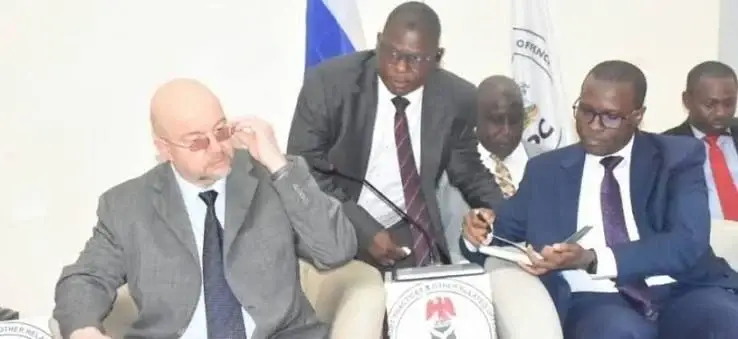
The Minister Counsellor and Chargé d’Affaires of the Russian Embassy in Nigeria, Igor Ivannikov, has said the fight against corruption must combine punishment for offences already committed with preventive measures that address the underlying causes of the crime, outlining Russia’s national experience at a diplomatic dialogue organised by the Independent Corrupt Practices and Other Related Offences Commission and the Anti-Corruption Academy of Nigeria in Abuja on Tuesday.
Speaking at the Fourth ACAN International Diplomatic Dialogue, themed “Development of Anti-Corruption Strategies and Policies: The Russian National Experience,” Ivannikov said corruption undermines fair competition, reduces the quality of public administration and weakens citizens’ trust in government institutions. “Corruption is a major problem for any state. It leads to inefficient use of resources, undermines the principles of fair competition, reduces the quality of public administration, and undermines citizens’ trust in government institutions,” he said. “Therefore, modern policy generally combines two areas: suppressing offences that have already been committed and addressing their underlying causes.”
Ivannikov said Russia’s anti-corruption system had evolved over several decades through three distinct phases: the establishment of the first control mechanisms in the 1990s, the creation of a comprehensive legal framework in the late 2000s, and the subsequent improvement of preventive measures and international cooperation. He recalled that Presidential Decree No. 361 of 1992, “On Combating Corruption in the Public Service,” was among the country’s first legal acts addressing corruption, banning public officials from entrepreneurial activity and requiring declarations of income, property and bank deposits for senior appointments. A major turning point came in 2008 with the adoption of Federal Law No. 273, “On Combating Corruption,” which brought together preventive measures and requirements for public officials, established rules for resolving conflicts of interest, and introduced control mechanisms designed to strengthen accountability within public institutions.
The Russian envoy said the model emphasised prevention alongside punishment, combining legal, administrative, financial, technological and educational measures. He identified income and property declarations by public officials as a key preventive instrument, explaining that declarations make it possible to compare an official’s declared income with their property holdings, with expenditure monitoring applied in some cases to identify unexplained wealth. He also cited the prevention of conflicts of interest, requiring civil servants to report situations where personal interests could affect the objective performance of their duties, and the anti-corruption review of existing regulatory laws to identify provisions that could create conditions for criminal conduct.
Public procurement reform emerged as a central pillar of Russia’s preventive framework. Ivannikov said Russia had transferred significant parts of the procurement process to an electronic platform through the Unified Information System, making it possible to monitor different stages from the publication of information about a tender to the conclusion and performance of a contract. Digitalisation, he said, reduces opportunities for concealing information, makes it easier to review the actions of contracting authorities, and creates a common body of data for government oversight and public scrutiny. He cautioned, however, that technology alone could not eliminate corruption. “Digitalisation alone cannot eliminate the problem: its effectiveness depends on the quality of oversight, the accessibility of information, and the accountability of officials for violations,” he said.
On enforcement, Ivannikov outlined a clear division of responsibilities among Russian law enforcement agencies. Detection of corruption-related crimes is carried out by the Ministry of Internal Affairs and the Federal Security Service within their respective areas of competence, preliminary investigations are conducted primarily by the Investigative Committee, and the Prosecutor’s Office supervises compliance with the law during investigations and represents the state in court. Offences are defined under the Criminal Code, including accepting a bribe under Article 290, giving a bribe under Article 291 and mediation under Article 291.1, abuse of official powers under Article 285, and commercial bribery under Article 204, with liability depending on the amount involved.
The envoy disclosed that Russia was ready to share its experience with Nigeria in financial investigations, tracing illicit funds and recovering assets located abroad. He said Russia had developed a practical approach to international asset recovery through the Prosecutor General’s Office, covering the search, seizure, confiscation and recovery of criminal proceeds located abroad. The Prosecutor General’s Office has also prepared a step-by-step guide explaining how foreign authorities can request Russian assistance in identifying and recovering assets. He noted that Nigeria and Russia signed a Treaty on Mutual Legal Assistance in Criminal Matters in 2018, providing a legal basis for cooperation in criminal investigations and related proceedings. He cited a 2026 case in the Republic of Buryatia where prosecutors recovered more than four million rubles, about sixty million naira, transferred to a former minister, as an example of the asset recovery framework in practice.
Ivannikov proposed professional cooperation between Nigerian and Russian authorities in financial investigations, illicit-fund tracing, asset recovery, public procurement risk assessment, conflict-of-interest monitoring and capacity building. He said every government institution in Russia had an anti-corruption department responsible for monitoring compliance, appointing responsible officials and adopting codes of ethics.
The ICPC Chairman, Dr Musa Aliyu, said the engagement would enable Nigeria to learn from Russia’s experience in developing anti-corruption legislation, institutional reforms and enforcement mechanisms. “As Nigeria continues to deepen its anti-corruption efforts, there is much value in learning from comparative experiences, understanding best practices, and identifying innovative approaches that can be adapted to our local realities,” Aliyu said. He added that knowledge shared through the dialogue should translate into practical action that strengthens institutions, public trust, transparency and accountability.
The dialogue comes as Nigeria pursues a multi-pronged anti-corruption strategy that increasingly emphasises prevention alongside enforcement. The ICPC has launched the C-H-I-L-D-R-E-N Values Initiative, aimed at instilling honesty and discipline in children from an early age, and the Citizens Digital Responsibility Initiative. The commission has also signed a memorandum of understanding with the Fiscal Responsibility Commission to strengthen accountability, and has partnered with the African Development Bank to enhance integrity in bank-financed projects. In July 2026, the Senate passed the Proceeds of Crime Act (Amendment) Bill, establishing an independent agency tasked exclusively with the recovery and management of forfeited assets.
The Russian envoy’s emphasis on prevention as a necessary complement to punishment reflects a growing consensus among anti-corruption practitioners that enforcement alone cannot address the systemic conditions that enable corruption. For Nigeria, where corruption remains a defining challenge and where the political season has produced a series of corruption allegations involving high-profile figures, the dialogue offers a framework for considering how preventive measures such as asset declarations, conflict-of-interest controls and digitalised procurement could be adapted to strengthen the country’s anti-corruption architecture. Whether the shared experiences translate into concrete reforms will depend on the follow-through, but the conversation has been placed on the record.
📩 Stone Reporters News | 🌍 stonereportersnews.com
✉️ info@stonereportersnews.com | 📘 Facebook: Stone Reporters News | 🐦 X (Twitter): @StoneReportNew | 📸 Instagram: @stonereportersnews
Add comment
Comments