

Reported by Ariajegbe Sylvia Esezobor
Traffic has been restored on the Lagos-Ibadan Expressway after emergency responders cleared the wreckage of a multiple-vehicle crash at Otedola Bridge, the latest in a series of incidents that have turned the corridor into a daily ordeal for commuters and compounded the misery caused by ongoing repairs at nearby Kara Bridge.
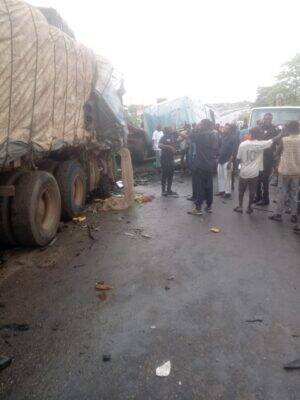
The crash occurred on Wednesday, September 16, 2026, at Otedola Bridge, inward Berger, and involved three trucks and two other vehicles. According to the Lagos State Emergency Management Agency, a containerised truck developed a mechanical fault and rammed into vehicles, triggering a pile-up that left several people injured but no fatalities. One trapped victim was rescued alive by a joint team comprising the Federal Road Safety Corps, the Nigeria Police Force, the Lagos State Traffic Management Authority and LASEMA. The injured victims were taken to trauma facilities for urgent medical care. The collision caused a traffic backlog that extended to Toll Gate and spilled onto inner roads, intensifying congestion that had already been building for days due to the rehabilitation of expansion joints on Kara Bridge.
The Lagos State Traffic Management Authority confirmed that recovery operations had been completed and normal vehicular movement restored. The agency said its officers remained at the scene to manage traffic flow and ensure that the backlog cleared progressively. The clearance of the Otedola crash brought relief to motorists who had endured hours of gridlock, but the respite was likely to be temporary. The Kara Bridge repairs, which began on September 8 and are scheduled to continue until September 22, have reduced the expressway’s capacity and created a bottleneck that amplifies the impact of every accident, vehicle breakdown or traffic violation on the corridor.
The human cost of the crisis was captured in vivid detail by commuters who spoke to journalists in the days following the crash. Laolu Jenkins, a father of three who works around Opebi, described a journey from Alausa to Magboro that should have taken less than an hour but stretched to seven. “I’ve been on the corridor for close to 20 years, and I will say we have never had it this bad,” he said. Kayode Peter, who lives in Arepo and works in Lekki, said the daily commute was affecting his health. “Moving from Arepo to Lekki has its own stress, and adding this to it can be killing,” he said. Some employers introduced remote-working arrangements or provided temporary accommodation for staff who could not realistically commute, while roadside traders and commercial motorcyclists found opportunities amid the chaos. For thousands of residents in Magboro, Arepo, Ibafo and other communities along the Lagos-Ogun axis, the corridor has become a test of endurance rather than a route to work.
The frequency of crashes at Otedola Bridge has made it one of the most dangerous stretches of road in Nigeria. In March 2026, a truck carrying two 20-foot containers overturned at the bridge, blocking the highway and causing a gridlock that stretched beyond Kara Bridge. In April, a dispatch rider was killed when a Volvo truck crushed his motorcycle at Otedola Bridge inward Secretariat. In August, LASEMA responded to a multiple-vehicle accident at the same location. On September 5, a couple and their child died in a crash at Otedola Bridge inward Berger. On September 15, a journey from Ibadan to Lagos that should have taken two hours took thirteen. Barely twenty-four hours later, another serious accident involving articulated vehicles occurred at Otedola Bridge. The pattern is relentless, and it has made the bridge synonymous with tragedy for a generation of Lagos commuters.
The Federal Road Safety Corps has blamed motorists’ impatience and reckless driving for many of the incidents, while transport analysts point to the structural challenges of the corridor: high traffic volume, heavy-duty vehicles, inadequate enforcement of load limits and the absence of effective deterrents for drivers who flout traffic rules. The ongoing Kara Bridge repairs have exposed the fragility of the entire Lagos-Ibadan Expressway, a critical artery that connects Nigeria’s commercial capital to the rest of the country and carries goods, fuel and people across the South-West and beyond. When accidents occur at Otedola or Kara, the consequences ripple outward, disrupting supply chains, inflating transport costs and deepening the frustration of a public that has come to expect delays as a fact of life.
For the emergency responders who cleared Wednesday’s crash, the operation was another routine deployment in a corridor that demands constant vigilance. LASEMA, LASTMA, the FRSC and the police worked together to rescue the trapped victim, remove the wrecked vehicles and reopen the road. Their efforts restored traffic, but they did not address the underlying conditions that make such incidents inevitable. As the Kara Bridge repairs enter their final days, motorists along the Lagos-Ibadan Expressway will be hoping for a return to normalcy. But the history of Otedola Bridge suggests that the next crash is never far away, and the next gridlock is already forming. For the millions who depend on this road, the question is not whether the traffic will be restored, but for how long.
📩 Stone Reporters News | 🌍 stonereportersnews.com
✉️ info@stonereportersnews.com | 📘 Facebook: Stone Reporters News | 🐦 X (Twitter): @StoneReportNew | 📸 Instagram: @stonereportersnews
Add comment
Comments