

Reported by Ariajegbe Sylvia Esezobor
Nigeria's Minister of Education, Dr. Maruf Tunji Alausa, has called for stronger global investment in education, urging governments, development partners, philanthropic organisations and the private sector to match national efforts with effective international support to transform education systems and expand opportunities for children and young people.
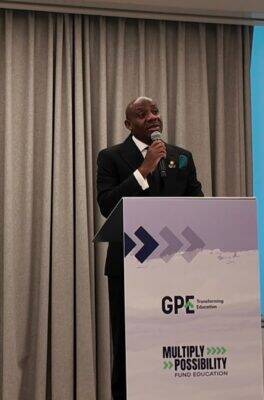
Alausa made the call on Tuesday while delivering Nigeria's opening remarks at the Global Partnership for Education's Multiply Possibility financing campaign in New York, which Nigeria is co-hosting with Italy. He said Nigeria accepted the co-hosting role because of its conviction that education and skills are among the most important investments any country can make, particularly in harnessing the potential of its young population and building resilient economies with a sustainable future.
According to a statement by his Special Adviser on Media and Communications, Ikharo Attah, the Minister said Nigeria's global advocacy was being matched by concrete action at home, with efforts focused on expanding access, reducing cost barriers, strengthening skills development and using digitalisation to improve the education system. He said these measures formed part of the broader agenda for macro-fiscal stability and inclusive economic growth under the leadership of President Bola Ahmed Tinubu.
The Minister highlighted Nigeria's domestic financing commitments for education through 2030, bringing together updated Federal Government expenditure projections and financing commitments at the state level. He said the approach reflected the scale of Nigeria's federal system and the determination to mobilise resources for education at every level of government. Nigeria's commitment forms part of a wider movement among GPE partner countries, with 50 countries collectively committing more than $400 billion in domestic financing for education through 2030.
Alausa stressed that country leadership and domestic financing must be complemented by effective international partnership if education systems are to achieve lasting transformation. He described the GPE as an important platform for bringing governments and partners together around nationally determined priorities and helping translate national ambition into stronger education systems and better outcomes for children. He therefore urged governments, development partners, philanthropic organisations and the private sector to sustain the momentum generated by the Multiply Possibility campaign and support the forthcoming High-Level Financing Event.
The Minister said the ultimate focus must be on translating political commitments and resources into measurable improvements in classrooms and meaningful opportunities for children and young people. He reaffirmed Nigeria's resolve to sustain the reforms and cooperation required to strengthen the education system and widen opportunities for every child and young person. He assured stakeholders that, under President Tinubu's Renewed Hope Agenda, education would remain a central priority, with the Federal Government continuing to expand access, strengthen learning and skills development, harness digital opportunities and equip learners to contribute meaningfully to a more prosperous and peaceful Nigeria.
The call comes against the backdrop of Nigeria's persistent underfunding of education. In June 2026, Alausa disclosed that government allocations to the sector had consistently ranged between five and eight per cent of the national budget, significantly below the fifteen to twenty per cent benchmark recommended by UNESCO. The Minister described inadequate funding as one of the major obstacles confronting tertiary education in the country. The Federal Government has since commenced plans to access five hundred million dollars from the GPE, which is expected to raise eleven point five billion dollars to boost learning across eighty countries. Alausa said the replenishment initiative presents an opportunity for Nigeria to access additional funding to fast-track key reforms in the sector. In July 2026, he also urged state governments to fulfil the conditions required to access the five hundred and fifty-two million dollar World Bank-supported HOPE Education Programme, noting that while all thirty-six states were eligible, many had yet to meet the performance-based conditions for accessing the funds.
The GPE Multiply Possibility campaign, launched in 2026, is designed to mobilise greater global investment and strengthen international partnerships in support of quality education. Nigeria's role as co-host with Italy reflects its growing prominence in global education advocacy. Alausa has been at the forefront of that engagement, and Nigeria's domestic financing commitments through 2030 represent a significant statement of intent at a time when many lower-income countries are struggling to maintain education budgets amid fiscal pressures. The forthcoming High-Level Financing Event is expected to secure pledges from governments, philanthropies and the private sector to close the financing gap in global education. For Nigeria, the stakes are considerable. The country has the largest out-of-school population in the world, with an estimated fifteen million children out of school as of 2025. The Federal Government has said over one point one million children returned to school in 2025, but the scale of the challenge remains enormous. The Minister's emphasis on digitalisation, skills development and reducing cost barriers reflects a recognition that access alone is insufficient without quality and relevance. The Renewed Hope Agenda has positioned education as a cornerstone of human capital development, and the government has launched several initiatives, including the Nigeria Education Loan Fund, which has disbursed over three hundred and fifty-five billion naira to students and institutions, and a hundred billion naira allocation for new hostels across fifty schools.
For Nigeria, the message from New York is clear: domestic financing is necessary but not sufficient, and the gap between commitment and delivery will be closed only if international partners match the country's own investments with predictable and sustained support. Whether that support materialises at the scale required will determine whether the ambitions outlined by Alausa translate into measurable improvements in classrooms across Africa's most populous nation.
📩 Stone Reporters News | 🌍 stonereportersnews.com
✉️ info@stonereportersnews.com | 📘 Facebook: Stone Reporters News | 🐦 X (Twitter): @StoneReportNew | 📸 Instagram: @stonereportersnews
Add comment
Comments