

Reported by Ariajegbe Sylvia Esezobor
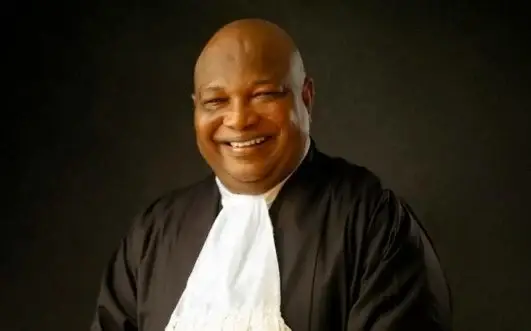
Senior Advocate of Nigeria and anti-corruption lawyer, Dr Wahab Kunle Shittu, has declared that Nigeria’s progress is being hindered by unexplained wealth, lamenting that while the country is richly endowed with human and natural resources, the bulk of its wealth is being siphoned away through means that defy logical explanation, in remarks made on Monday at the public presentation of his three-volume book in Lagos.
Shittu spoke at the Oriental Hotel, Victoria Island, where his 54-chapter work, titled “Unexplained Wealth: A Trilogy of Nigerian Financial Law,” was formally unveiled before an audience that included former President Olusegun Obasanjo, who chaired the event, the 15th Emir of Kano, Muhammadu Sanusi II, former Vice President Yemi Osinbajo, and a broad spectrum of legal practitioners, policymakers and stakeholders. “The summary of it is that no country can progress if that country is faced with unexplained wealth,” Shittu said. “This country is very rich in terms of human and natural resources, but the bulk of our wealth is being siphoned away through unexplained means. So, if the country has a mechanism for recovering such unexplained wealth, this country will progress.” He was equally emphatic about the inverse danger, warning that no country can progress when the innocent are labelled with the smear of corruption even though they have worked hard to acquire their wealth, adding that “the illict acquisition of wealth is indefensible”.
Shittu disclosed that he drew inspiration from two experiences in his legal career. The first was a case he prosecuted successfully to the Supreme Court against a former local government chairman in Kogi State, who was unable to justify assets acquired in excess of his legitimate income. The court, he said, used that case to establish a principle that where a person acquires assets or income in excess of their legitimate income, they owe the state a duty of explanation. The second was an invitation from the National Judicial Institute in collaboration with the EFCC to discuss the subject of unexplained wealth, for which he prepared and circulated around a thousand copies to judges. It was in the course of that research that he discovered Nigeria had no legislative framework on unexplained wealth, unlike the United Kingdom and other advanced countries. “This is the first text on unexplained wealth in Africa,” Shittu said, adding that it is also the first time the doctrine of unexplained wealth is explained worldwide.
The trilogy is divided into three volumes. The first, titled “Law, Prosecution and the Recovery of Illicit Assets,” examines the constitutional and international foundations of unexplained wealth enforcement, including prosecution, asset recovery and the evidential challenges involved in establishing whether wealth was acquired unlawfully. The second, “Sectoral Manifestations, Governance and Reform,” examines the issue across key sectors of Nigeria’s economy and public sector, including foreign exchange, capital markets, taxation, healthcare, elections, terrorist financing, public institutions, the power sector and the petroleum industry. The third, “Explained Wealth in the Age of Suspicion: Legal Accountability in Theory and Practice,” shifts attention to the rights of individuals called upon to account for their wealth, exploring how legitimate wealth can be established while balancing anti-corruption enforcement with constitutional rights, economic freedom and due process. Among the trilogy’s major proposals is a Three-Tier Test for Explained Wealth, based on lawful source, documentary coherence and proportionality, anchored on Sections 36 and 44 of the 1999 Constitution, alongside an Anti-Weaponisation Framework intended to guard against the misuse of anti-corruption mechanisms for political purposes. The work also contains proposed legislative interventions, including a draft Nigeria Antigraft Commission (Establishment) Bill, a draft law on Unexplained Wealth Orders and a Presidential Committee on Lifestyle Audit.
The event drew differing perspectives from the political and traditional leaders who attended. Obasanjo, who chaired the event, described corruption as “development’s greatest, deadly peril,” and characterised unexplained wealth as “anti-social, anti-development and anti-progress.” He recalled his involvement in the global anti-corruption movement through the co-founding of Transparency International with German activist Peter Eigen, and disclosed that when his administration attempted to establish the ICPC, the bill sat in the National Assembly for about 18 months because lawmakers believed that if passed in its original form, many of them would end up in prison. “Those who suffer most in the corrupt society are the poor. And it makes them poorer,” Obasanjo said, urging African governments not to allow corruption to become a way of life. Sanusi, however, emphasised that legal reforms alone would be insufficient without strong political will and an independent judiciary, decrying selective enforcement. “We live in a society where if you have unexplained wealth and the right political cover, nobody asks questions. But if you are on the wrong side of politics, you get into trouble. This must change,” he said, noting that illicit wealth extends beyond bribery to include inflated contracts, subsidy abuses and other forms of rent-seeking. Osinbajo, represented by his former Chief of Staff, Ade Ipaye, said Nigeria needed a clear, fair and constitutionally sound approach to asset recovery that protects constitutionally guaranteed property rights.
The book reviewer, Professor Olanrewaju Fagbohun, SAN, cautioned against treating the absence of conventional documentation as automatic proof of criminality, arguing that the absence of an orthodox paper trail did not necessarily establish that wealth had been illegally acquired, particularly for Nigerians operating within the informal economy. Shittu himself acknowledged this tension, noting the importance of reliable records in establishing the legitimacy or otherwise of assets and warning that without credible records, society could end up “suspecting everyone and proving nothing.”
The launch comes amid a broader reckoning with corruption and asset recovery in Nigeria. The EFCC has reported recoveries of approximately ₦1.23 trillion and $684.48 million between October 2023 and June 2026, including 1,177 real-estate properties, 370 automobiles and 251 plots of land. The commission has also secured 10,872 convictions over the same period. In July 2026, the Senate passed the Proceeds of Crime Act (Amendment) Bill, establishing an independent agency for the recovery and management of assets linked to unlawful activities, while the House of Representatives has advanced legislation to introduce non-conviction-based asset recovery. Despite these measures, Nigeria still lacks a dedicated legislative framework for unexplained wealth orders of the kind that exist in the United Kingdom, Australia and Mauritius, a gap Shittu’s trilogy seeks to address.
For Nigerians, the debate over unexplained wealth is not abstract. It touches on the visible gap between the lifestyles of some public officials and their legitimate incomes, the billions lost to inflated contracts and subsidy abuse, and the poverty that persists despite the country’s vast natural wealth. Shittu’s trilogy argues that the solution lies not only in stronger enforcement but in a system that can distinguish legitimate wealth from illicit enrichment, protecting honest citizens from wrongful suspicion while ensuring that those who acquire wealth dubiously face legal consequences. As Shittu put it, “The fight against corruption is won not on the day the thief is convicted, but on the day the honest man is believed.”
📩 Stone Reporters News | 🌍 stonereportersnews.com
✉️ info@stonereportersnews.com | 📘 Facebook: Stone Reporters News | 🐦 X (Twitter): @StoneReportNew | 📸 Instagram: @stonereportersnews
Add comment
Comments