

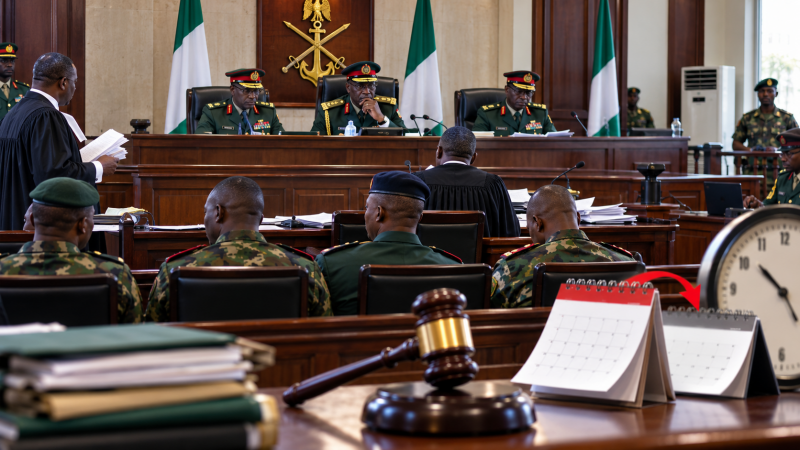
The General Court Martial trying military officers accused of involvement in an alleged plot to overthrow President Bola Tinubu’s administration has postponed a crucial ruling on whether disputed statements attributed to some of the accused officers can be admitted as evidence.
The ruling, which was scheduled for Wednesday, September 30, 2026, has been moved to Monday, October 5, 2026, when the military court is expected to reconvene at 10 a.m. at the Scorpion Officers’ Mess in Asokoro, Abuja.
A notice issued to members of the court and other parties confirmed the change.
“The GCM sitting earlier adjourned to Wednesday, 30 September, 2026, has now been postponed to Monday, 5 October, 2026,” the notice stated.
It added that the new sitting would begin at 10 a.m. and expressed regret over any inconvenience caused by the postponement.
The notice was signed by Major M.U. Ardo, identified as the liaison officer.
No reason was given for the latest postponement.
Reports indicate that this is the fourth time the expected ruling has been deferred, extending uncertainty over an important evidential dispute in the ongoing military proceedings.
The October 5 decision will not determine whether the accused officers are guilty of plotting a coup.
Instead, the General Court Martial is expected to decide whether statements the prosecution seeks to use against some of the officers were voluntarily obtained and can therefore be admitted as evidence.
That distinction is important because allegations surrounding the circumstances in which the statements were obtained have become a major dispute between the prosecution and defence.
Defence lawyers challenged the statements and prompted what is legally known as a trial-within-a-trial — a separate proceeding conducted within the main trial to determine whether disputed statements were obtained voluntarily.
The defence alleges that some of the accused officers were subjected to coercion, intimidation, inducement and physical abuse while being held and questioned by officials of the Defence Intelligence Agency.
Some officers have also alleged that they were made to reproduce statements that had already been prepared for them.
According to testimony reported from the proceedings, some defendants disputed information contained in the statements attributed to them, maintaining that portions were false or concerned matters about which they had no knowledge.
The prosecution disputes those allegations.
Evidence has been presented seeking to establish that the statements were made voluntarily and were not obtained through unlawful pressure.
It will now be for the General Court Martial to assess the competing accounts and determine whether the disputed documents satisfy the requirements for admission as evidence.
Defence lawyers have also raised questions about whether some officers were properly cautioned and informed of their rights before making statements.
They have argued that lawyers or witnesses selected by some of the accused officers were not present when the statements were obtained.
Another issue raised by the defence concerns video recordings.
The lawyers questioned what they described as the absence of recordings demonstrating that some of the accused officers personally wrote their statements in the presence of witnesses of their choice.
One of the soldiers whose testimony has been reported is Corporal Momoh Audu.
Audu reportedly told the military court that he was detained for months and pressured to copy a prepared statement allegedly connecting him with the coup investigation.
He disputed suggestions that he had worked closely with Colonel Mohammed Alhassan Ma’aji, one of the officers identified in reporting surrounding the wider investigation.
Audu also alleged that investigators suggested cooperation could result in his release and that he could become a prosecution witness.
Those claims remain allegations made during the proceedings and have not been accepted as fact by the court. The prosecution maintains that the statements it seeks to rely upon were voluntarily obtained.
The General Court Martial is presided over by Air Vice Marshal H.I. Alhaji of the Nigerian Air Force.
The proceedings form part of the wider legal consequences of an alleged coup plot that security authorities say was uncovered in 2025.
Sixteen military officers were initially reported detained in October 2025 over what the military at the time described as acts of indiscipline and breaches of service regulations.
The Defence Headquarters initially rejected reports connecting the detentions with an attempted coup.
Following an investigation, however, the military announced in January 2026 that some personnel had allegations against them relating to a plot to overthrow the government and would face military judicial proceedings.
Defence Minister Christopher Musa subsequently said in September that investigations had established an attempted coup and that suspects had been taken before the appropriate courts.
Musa described the alleged plot as genuine and said authorities believed those involved intended to overthrow the government.
Those statements represent the government's account of the investigation. They do not constitute findings of guilt against individual defendants, whose cases remain subject to judicial determination.
The military proceedings involving serving officers are also distinct from a related criminal case being heard at the Federal High Court in Abuja.
In April, the Federal Government arraigned a retired major-general and five other defendants before Justice Joyce Abdulmalik on charges connected with the alleged plot.
Those defendants included retired Major General Mohammed Ibrahim Gana, retired naval captain Erasmus Ochegobia Victor, police inspector Ahmed Ibrahim, Zekeri Umoru, Bukar Kashim Goni and Islamic cleric Abdulkadir Sani.
Former Petroleum Minister Timipre Sylva was also listed in the federal charge but was reported to be at large at the time of the arraignment.
The defendants who appeared before the Federal High Court pleaded not guilty.
The charges in that separate civilian proceeding include alleged treason, terrorism, failure to disclose security intelligence and money laundering connected with alleged terrorism financing.
That Federal High Court case has itself involved disputes over statements obtained from defendants.
In May, Justice Abdulmalik ordered a trial-within-a-trial after defence lawyers challenged whether extra-judicial statements the prosecution sought to tender had been voluntarily made.
That proceeding should not be confused with the current General Court Martial dispute, although both arise from the wider alleged coup investigation.
The military case has particular significance because statements attributed to defendants can form an important part of a prosecution.
If the court rules that particular statements were obtained voluntarily and comply with applicable evidential requirements, the prosecution may be permitted to rely upon them as the trial continues.
If the court rejects them, prosecutors would have to proceed without those statements while relying on whatever other admissible evidence they possess.
Neither outcome would automatically determine the final guilt or innocence of the officers.
The October 5 ruling therefore represents an important procedural stage rather than the conclusion of the alleged coup case.
Nigeria's history also gives allegations of military involvement in politics particular sensitivity.
The country experienced repeated military interventions following its first coup in January 1966 and spent substantial periods under military government before returning to civilian democratic rule in 1999.
That history makes any allegation of an attempt by serving officers to overthrow an elected government a matter of significant public interest.
At the same time, the seriousness of a coup allegation makes adherence to proper legal procedure especially important.
Accused officers remain entitled to challenge prosecution evidence, including statements they allege were obtained through coercion, while prosecutors are entitled to present evidence supporting their position that the statements were made voluntarily.
The General Court Martial must determine that dispute based on the evidence before it.
For now, the military has provided no public explanation for why the September 30 sitting was postponed.
The next scheduled development is therefore Monday, October 5, when the court is expected to decide whether the contested statements can form part of the evidence in the continuing trial.
Until the substantive proceedings are completed, allegations that individual officers participated in an attempt to overthrow President Tinubu remain accusations to be proved through the appropriate judicial process.
📩 Stone Reporters News | 🌍 stonereportersnews.com
✉️ info@stonereportersnews.com | 📘 Facebook: Stone Reporters News | 🐦 X (Twitter): @StoneReportNew | 📸 Instagram: @stonereportersnews
Add comment
Comments