

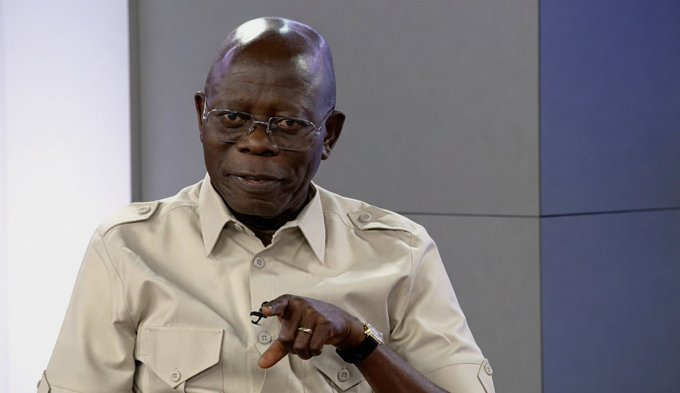
Former Edo State governor and Senator representing Edo North, Adams Oshiomhole, has questioned former Vice President Atiku Abubakar’s proposal to restore petrol subsidy if elected president in 2027, recalling that Atiku previously argued strongly that the subsidy system was wasteful and should be removed.
Oshiomhole made the remarks during an interview with TVC while responding to the renewed debate over petrol subsidy ahead of the 2027 presidential election. He said Atiku personally explained the case for subsidy removal to him during the period when Oshiomhole served as president of the Nigeria Labour Congress and Atiku was Nigeria’s vice president.
“Atiku Abubakar himself, in his quiet moment, will laugh at himself,” Oshiomhole said.
“Don’t forget, I was the president of the NLC, and as vice president, Atiku lectured me about the waste of petroleum subsidy and why it is necessary to remove it, except that I disagree with them.”
Oshiomhole’s argument is that Atiku’s current proposal appears inconsistent with the economic position he held both while in government and during previous presidential campaigns.
The former Edo governor also recalled Atiku’s position during the 2023 presidential election, when the former vice president advocated the removal of petrol subsidy and proposed significant changes to the management and ownership of Nigeria’s national oil company.
“Remember, Atiku is on record, just in 2023, as saying that he will privatise NNPC,” Oshiomhole said.
He then questioned how a government could transfer an oil company into private ownership while simultaneously attempting to determine the price at which petroleum products produced by private operators should be sold.
“So can you privatise something in private hands, and yet dictate to the new owner how to sell the product that he produces?” he asked.
Atiku’s previous support for subsidy removal is documented.
During the campaign for the 2023 presidential election, he described the existing petrol subsidy arrangement as unsustainable and said its removal was inevitable.
In July 2022, Atiku argued that subsidy should be removed through consultations with organised labour and other stakeholders rather than through an abrupt process.
Later that year, he said that if elected president, his administration would complete the removal of petrol subsidy and redirect resources to other areas of the economy.
He also described the subsidy arrangement at the time as a “fraud.”
His position ahead of the 2027 election has changed.
Atiku, now the presidential candidate of the African Democratic Congress, has pledged to restore a form of petrol subsidy if elected.
“On the question of subsidy, my position has not changed and will not change: I will restore it!” Atiku said in August.
He argued that a resource-rich country such as Nigeria should be able to provide economic protection for citizens experiencing hardship.
Atiku had earlier explained that although he initially supported the principle of removing subsidy, his assessment changed after observing developments following President Bola Tinubu’s decision to end the arrangement.
“I initially did not oppose the removal of the fuel subsidy. But now that it has been removed, where is the money?” Atiku asked.
He argued that Nigerians should have experienced clearer improvements in healthcare, education, security and youth empowerment from resources that were previously committed to subsidising petrol.
“If I win the presidential election, I will restore the subsidy,” he said.
Atiku’s campaign has subsequently provided additional context, describing the proposal as a targeted intervention intended to support domestically refined petroleum products rather than simply returning Nigeria to the previous system of subsidising imported petrol.
That distinction is significant because the structure of Nigeria’s petroleum industry has changed since the subsidy regime that existed before Tinubu took office.
Domestic refining capacity has expanded, while the Petroleum Industry Act provides a different regulatory framework for the downstream petroleum sector.
Atiku’s proposal has therefore generated questions about exactly what would be subsidised, who would receive the government support and how any reduction in production costs would translate into lower prices for consumers.
The Tinubu campaign has demanded further details.
The APC Presidential Campaign Council recently asked Atiku to disclose the projected annual cost, source of funding, quantity of petrol that would be covered and safeguards against diversion or fraudulent claims.
It also asked whether refiners receiving government support would be required to sell petrol at government-prescribed prices and how such an arrangement would operate under the Petroleum Industry Act.
The Presidency has similarly criticised Atiku’s changed position.
In an August statement, presidential spokesperson Bayo Onanuga argued that restoring the former subsidy arrangement could recreate fiscal pressures associated with the previous system.
The Presidency said any alternative proposed by Atiku should clearly explain its cost, funding mechanism and compatibility with the existing petroleum-sector framework.
Those statements represent the position of Tinubu’s government and campaign rather than an independent determination that Atiku’s proposed policy could not work.
Atiku maintains that the economic consequences of subsidy removal justify reconsidering the policy.
The disagreement therefore involves more than whether Atiku once supported subsidy removal.
It also concerns whether changing economic conditions provide sufficient reason for a politician to revise an earlier policy position and whether the alternative now being proposed can be financed sustainably.
For ordinary Nigerians, the central issue is the price of transportation and its effect on household expenses.
Tinubu announced the end of petrol subsidy during his inauguration on May 29, 2023.
Petrol prices subsequently increased sharply compared with their pre-removal levels, contributing to higher transportation and operating costs across different parts of the economy.
The government has defended the decision as necessary to end an expensive system and redirect public resources while encouraging a more market-driven petroleum sector.
It has also promoted compressed natural gas and other transportation alternatives as measures intended to reduce dependence on petrol.
Atiku has focused instead on whether the financial benefits claimed from subsidy removal have translated sufficiently into improved living conditions.
The Federal Government recently estimated that subsidy removal generated ₦15.8 trillion in savings for the federation between June 2023 and December 2025.
According to the government’s breakdown, the figure was distributed across the federal, state and local levels rather than representing cash retained exclusively by the Federal Government.
Atiku has questioned what Nigerians have received in return for those savings.
Oshiomhole’s intervention adds a historical dimension to that argument.
As NLC president between 1999 and 2007, he was one of Nigeria’s most prominent labour leaders and repeatedly confronted the federal government over increases in petroleum-product prices.
Atiku served as vice president throughout the same period under President Olusegun Obasanjo.
Oshiomhole is therefore drawing on his direct encounters with Atiku during earlier government-labour disputes to challenge the former vice president’s present position.
His criticism does not itself establish whether restoring some form of subsidy would be economically beneficial or harmful.
Likewise, Atiku’s promise that the policy would ease hardship does not establish how effectively it would operate without a detailed fiscal and implementation framework.
Those questions depend on the design of the proposed programme, its cost, funding source, effect on pump prices and measures to prevent the abuses historically associated with Nigeria’s subsidy system.
The dispute nevertheless highlights a major economic question likely to feature prominently in the 2027 campaign.
Tinubu’s camp is defending subsidy removal as a structural reform that should not be reversed, while Atiku is arguing that the economic pressure experienced by Nigerians requires a different approach.
Oshiomhole’s challenge is specifically about consistency: he says the same Atiku who once explained to him why petroleum subsidy was wasteful is now campaigning to restore it.
Atiku’s response, through his recent statements and policy explanations, is that his position has evolved because the removal implemented since 2023 has not, in his assessment, delivered sufficient relief or improvements to citizens.
For voters, the competing proposals ultimately present a policy question that goes beyond political exchanges: how Nigeria can make transportation and energy more affordable while determining who pays the difference between market costs and whatever lower price government policy seeks to achieve.
📩 Stone Reporters News | 🌍 stonereportersnews.com
✉️ info@stonereportersnews.com | 📘 Facebook: Stone Reporters News | 🐦 X (Twitter): @StoneReportNew | 📸 Instagram: @stonereportersnews
Add comment
Comments