

Reported by Ariajegbe Sylvia Esezobor
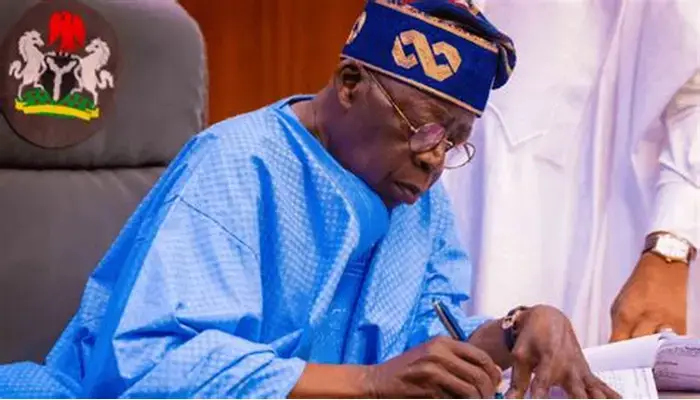
President Bola Ahmed Tinubu has signed the Appropriation (Amendment) (No. 4) Bill, 2025, into law, extending the implementation period of the 2025 budget from September 30, 2026, to December 31, 2026. The amendment was passed by both the Senate and the House of Representatives on Tuesday, September 29, 2026, before being transmitted to the President for assent, according to a statement issued on Wednesday by Bayo Onanuga, Special Adviser to the President on Information and Strategy.
The extension gives Ministries, Departments and Agencies additional time to complete ongoing capital projects and ensures that funds already appropriated are fully utilised without disrupting critical government programmes. "The extension gives Ministries, Departments and Agencies more time to complete ongoing capital projects," the statement said. "It ensures that funds already appropriated are fully put to work for Nigerians, without disrupting critical programmes." Tinubu commended the leadership and members of the National Assembly for what the statement described as the prompt consideration of the amendment, saying the development demonstrated continued cooperation between the Executive and Legislative arms of government in the interest of the country.
The President's assent followed a request to the National Assembly for additional time to allow ministries, departments and agencies to complete ongoing infrastructure projects and other capital programmes captured in the 2025 budget. The House of Representatives suspended its rules and passed the bill, sponsored by Majority Leader Julius Ihonvbere, through first, second and third readings in a single sitting after resuming plenary from its annual recess. The Senate similarly passed the bill, sponsored by Senate Leader Opeyemi Bamidele, through an expedited legislative process. During the debate, Ihonvbere said the extension was necessary because of factors affecting the Nigerian economy that had made it difficult to complete the implementation of the capital component within the previously approved timeframe.
The latest adjustment represents the fourth extension of the capital implementation deadline. The N54.99 trillion 2025 Appropriation Act was passed by the National Assembly on February 13, 2025, and signed into law by President Tinubu on February 28, 2025, with the budget originally structured to run until December 31, 2025. The deadline was first moved to March 31, 2026, following an extension approved by the National Assembly in December 2025. It was subsequently extended to June 30, 2026, and later to September 30, 2026, before the latest extension to December 31, 2026. The 2025 budget included N3.65 trillion for statutory transfers, N14.32 trillion for debt servicing, N13.64 trillion for recurrent expenditure, and approximately N23.96 trillion for capital expenditure.
The repeated extensions have drawn mixed reactions from financial experts and political stakeholders. The National President of the Association of Small Business Owners of Nigeria, Dr Femi Egbesola, said the extension could support the economy if it resulted in the completion of productive projects. He noted that spending on roads, power, transport, agriculture and other infrastructure could stimulate demand, generate contracts for small businesses, improve the movement of goods and reduce operating costs. Payments to legitimate contractors, he added, could inject liquidity into the economy and help businesses meet wage and other obligations. "For small businesses and ordinary citizens, the benefit will depend on whether the money gets into the real economy," Egbesola said. "A completed road can reduce transport costs for traders; reliable electricity can lower the cost of running shops and factories; completed agricultural and irrigation projects can improve food production and incomes."
However, he warned that repeated extensions highlighted persistent challenges with budget execution. "If funds continue to be delayed or projects remain unfinished, citizens will not feel the intended economic benefits, while businesses face uncertainty," he said. He urged the government to use the extension to complete viable projects, settle verified obligations and ensure value for money, adding that the real measure of success was not how long the budget remained open but how much it improved economic activity, small-business survival and household livelihoods.
Economic analyst Tunde Oyediran said the extension raised concerns about budget credibility and fiscal discipline. He noted that while it could prevent some projects from being abandoned, running the 2025 and 2026 capital budgets concurrently could create difficulties for tracking, reporting and accountability. The 2026 Appropriation Act, valued at N68.32 trillion, came into force on April 1, 2026. "When you run 2025 and 2026 capital budgets at the same time, you create fiscal opacity," Oyediran said. "Tracking, reporting and accountability become difficult. It becomes hard to determine the true performance of either budget." He added that delayed capital spending also affected contractors, small businesses and employment. "Contractors are owed for months, projects stall, and jobs are affected. When you spread implementation over 21 months, you delay economic impact. GDP may grow on paper, but the transmission to the real economy is weak." He said repeated extensions could weaken budget discipline by reducing the incentive for ministries, departments and agencies to complete procurement early, adding that the long-term fix was to enforce the budget calendar.
The Democratic and Leadership Alliance also faulted the extension. In a statement on Wednesday, the Head of Media and Publicity of the DLA National Campaign Council, Dr Tosin Odeyemi, said the repeated extensions reflected what the party described as a worsening fiscal and economic situation. He said the party was particularly concerned that the 2024 budget had yet to be fully funded while implementation of the 2026 budget was also facing challenges. "We are more concerned that this is the fourth time the implementation of this same budget has been extended and with the latest one, it shows that the Bola Tinubu-led administration has continued to fail Nigerians in even the most basic metric of governance," he said. He added that the latest extension could further complicate budget implementation and lead to the rollover of outstanding capital expenditure. "The looming fiscal and economic crisis this administration is inviting shows that over N35tn, which is the capital component of 2026 budget, will be moved to the 2027, thereby continuing this shambolic process of running minimum of two budgets at a time," Odeyemi said.
The extension comes amid broader concerns about Nigeria's fiscal position. The 2026 budget of N68.32 trillion is the largest in the country's history, and the government has projected a deficit of N23.85 trillion. The National Assembly has also received the 2026 statutory budget proposal of the Niger Delta Development Commission for consideration. The decision to extend the 2025 budget reflects the challenges the administration has faced in executing capital projects on schedule, a recurring issue that has characterised budget implementation across successive governments. With the new deadline, federal ministries, departments and agencies now have until December 31, 2026, to utilise and execute capital allocations provided under the 2025 Appropriation Act. Whether the additional three months will translate into completed projects and tangible economic benefits, or become another chapter in the cycle of extensions, will be determined by the pace of implementation in the final quarter of the year.
📩 Stone Reporters News | 🌍 stonereportersnews.com
✉️ info@stonereportersnews.com | 📘 Facebook: Stone Reporters News | 🐦 X (Twitter): @StoneReportNew | 📸 Instagram: @stonereportersnews
Add comment
Comments