

Reported by Ariajegbe Sylvia Esezobor
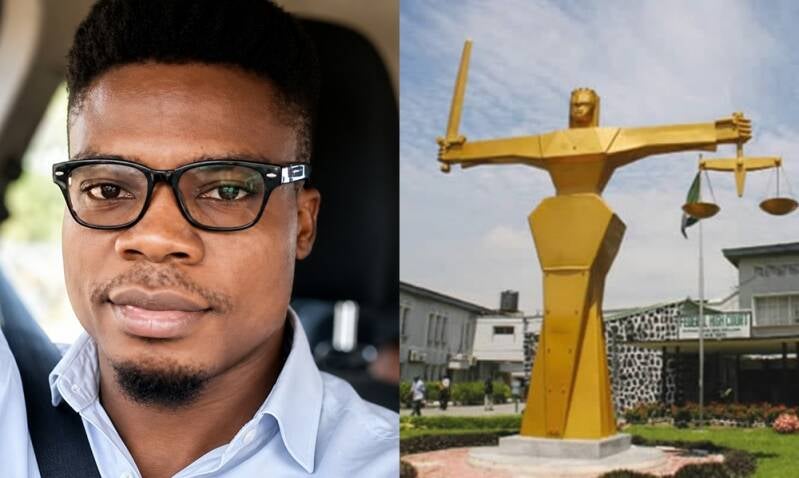
Human rights activist and blogger Chidiebere Justice Mark, popularly known as Justice Crack, has sued the Nigerian Army, the Chief of Army Staff and the Attorney-General of the Federation and Minister of Justice for N5.3 billion over alleged torture, illegal detention and the seizure of his car following his arrest by soldiers in April 2026.
The suit, filed through his legal team led by Professor Sam Amadi, was instituted at the Federal High Court in Abuja by an originating motion dated August 26, 2026, and marked Chidiebere Justice Mark v. The Nigerian Army & 2 Ors. It was brought pursuant to the Fundamental Rights (Enforcement Procedure) Rules 2009, the African Charter on Human and Peoples’ Rights and relevant provisions of the 1999 Constitution. The Nigerian Army, the Chief of Army Staff and the Attorney-General of the Federation are listed as the first, second and third respondents respectively.
Justice Crack is asking the court to declare that the Nigerian Army and the Chief of Army Staff lacked the statutory authority to arrest, detain, investigate or torture him over the alleged offences of false publication and breach of the Nigerian Army’s social media policy. He is also challenging the alleged seizure and detention of his vehicle, a Hyundai saloon car, which the court documents say was registered in the name of Yusuf Salim Ibrahim. Justice Crack alleged that the vehicle was seized on April 28 and released on June 9, 2026, in a damaged condition and without a court order.
He asks the court to declare the alleged arrest, detention, investigation and torture between April 28 and April 30, 2026, unconstitutional, unlawful, illegal and ultra vires. He is also seeking an injunction restraining the Army and its officers, commands, formations and sections from arresting, detaining, investigating or torturing him. He is demanding N5 billion in exemplary damages against the three respondents over what he described as humiliation, harassment, embarrassment, suffering, intimidation and hardship arising from his alleged arrest, detention and torture. He is further seeking N100 million in exemplary damages over the alleged seizure and damage to his vehicle, and N200 million in general damages over the alleged violations of his fundamental rights and the seizure of his vehicle.
In a statement issued on Wednesday, Justice Crack said he was subjected to what he described as severe and degrading treatment during his detention by the Army. He said he was handcuffed and blindfolded, kept under the sun during the day and in extremely cold conditions at night, and denied adequate access to water and basic necessities. He recalled being subsequently transferred to the custody of the Department of State Services, where he spent approximately 21 days in detention. “At the time, I did not know what would happen to me. I cried out for help and held on to my faith in God. I remain grateful to God for preserving my life through that experience,” he said.
The suit marks the latest chapter in a legal saga that began on April 28, 2026, when Justice Crack was arrested by the Nigerian Army alongside some soldiers over an alleged attempt to incite soldiers and breach military social media policy. The Army said at the time that he had shared complaints by some soldiers about their feeding and welfare on social media, and that preliminary reports revealed he seemed to be inciting soldiers to create discontent within the system. The Army alleged that a chat bordering on subversion had taken place between Justice Crack and the soldiers, and that a situation where civilians cultivate vulnerable personnel towards acts of subversion had far-reaching implications on discipline and national security. While the soldiers remained in military custody, Justice Crack was handed over to the relevant civil authorities for further investigation and possible prosecution.
The Department of State Services subsequently arraigned him before Justice Joyce Abdulmalik of the Federal High Court in Abuja on a three-count charge bordering on cybercrime. In the first count, the DSS alleged that he circulated false information through his X handle, @JusticeCrack, regarding inadequate feeding of soldiers, with intent to cause annoyance, ill-will and hatred among citizens, contrary to section 24(1)(b) of the Cybercrimes (Prohibition, Prevention, etc.) Act, 2015. In the second count, the prosecution alleged that he published a viral video and statements about the Nigerian Army which generated widespread negative reactions and were likely to cause fear and breach of peace, contrary to section 59 of the Criminal Code Act. The third count accused him of attempting to commit a felony by publishing a derogatory video and statements about the Nigerian Army, an offence punishable under section 509 of the Criminal Code Act. He pleaded not guilty to all three counts.
He was remanded in DSS custody following his arraignment, and his bail application initially suffered a setback when lawyers clashed over representation. The Federal High Court subsequently granted him bail in the sum of N5 million with one surety in like sum, and ordered him to surrender his international passport and report regularly to authorities. He remained in custody until he perfected his bail conditions.
The case has attracted significant public attention, with supporters mobilising fundraising efforts and public campaigns to help him meet the bail requirements. The Army, for its part, has consistently maintained that the arrest was connected to an ongoing investigation involving alleged breaches of military social media regulations and suspected incitement of soldiers. It has denied the allegation that Justice Crack was abducted, saying he was picked alongside the soldiers for investigation and later handed over to civil authorities. The Human Rights Writers Association of Nigeria and other civil society organisations have weighed in on the matter, with some expressing concern over the treatment of online activists and the implications for freedom of expression in Nigeria.
The suit comes amid a broader national conversation about the boundaries of free speech, the treatment of critics of the military and the accountability of security agencies in Nigeria. The 2027 general elections are less than four months away, and the political environment has been marked by arrests and prosecutions of individuals over their online activity. Legal analysts say the case could become a major test of the balance between national security concerns and constitutional rights to free speech in the digital age. For Justice Crack, the suit represents both a demand for accountability and a personal reckoning with an experience he describes as traumatic. For the Nigerian Army and the Chief of Army Staff, it is an opportunity to defend their conduct and clarify the legal basis for the arrest and detention of a civilian over social media posts. The court is yet to schedule a hearing date, and the respondents are expected to file their responses within the period prescribed by law.
📩 Stone Reporters News | 🌍 stonereportersnews.com
✉️ info@stonereportersnews.com | 📘 Facebook: Stone Reporters News | 🐦 X (Twitter): @StoneReportNew | 📸 Instagram: @stonereportersnews
Add comment
Comments