

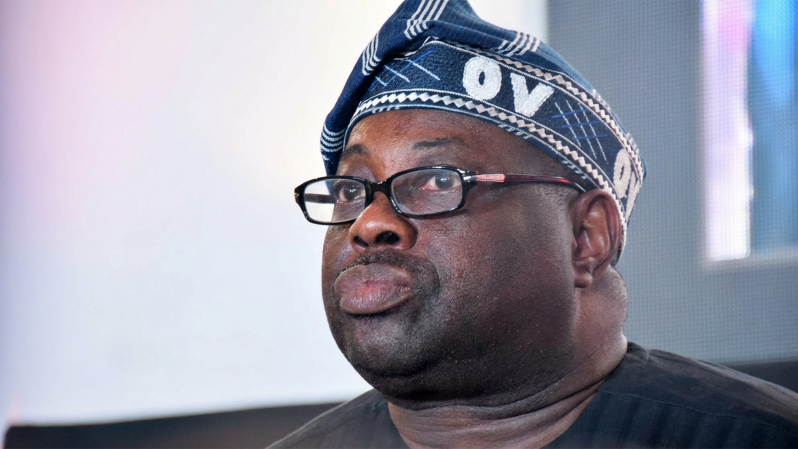
Veteran journalist and African Democratic Congress (ADC) chieftain Dele Momodu has accused President Bola Ahmed Tinubu of adopting political tactics similar to those associated with Nigeria's former military ruler, General Sani Abacha. He alleged that the president was seeking to consolidate political power ahead of the 2027 general election by exerting influence over opposition politicians and major institutions of government. Momodu's remarks have renewed debate about political defections, the independence of democratic institutions and the relationship between the ruling All Progressives Congress (APC) and opposition parties.
Speaking during an interview on Arise News' Prime Time programme on Wednesday, October 14, 2026, Momodu criticised what he described as Tinubu's determination to secure another presidential term through political pressure rather than public persuasion. The former presidential aspirant alleged that the administration had extended its influence across the executive, legislature and judiciary, drawing comparisons with Abacha's attempts to consolidate power during military rule. His allegations were presented as his assessment of Nigeria's political environment, rather than findings established by a court or independent investigation.
Momodu argued that the concentration of political influence under the current administration had weakened the ability of opposition parties to operate independently. He maintained that the movement of politicians into the APC should not automatically be interpreted as an endorsement of Tinubu's policies or government performance. According to him, political survival, personal interests and pressure could also influence decisions to change party affiliation.
The ADC chieftain went further by suggesting that the present political environment had become more troubling than the circumstances encountered during the struggle against military dictatorship. He accused the president of exercising excessive influence over institutions expected to perform separate constitutional responsibilities. However, Momodu did not establish through independently verified evidence that the presidency directly controls the judiciary or that every political defection resulted from coercion.
His criticism follows similar concerns he expressed in April 2025, when he warned Tinubu against interpreting defections from opposition parties as proof of genuine political loyalty. During an appearance on Channels Television's Politics Today, Momodu questioned whether politicians were joining the ruling party because they supported the president or because they believed remaining in opposition carried political risks.
The comments followed the movement of prominent Delta State politicians into the APC, including Governor Sheriff Oborevwori, his deputy Monday Onyeme and former Governor Ifeanyi Okowa. Momodu argued that political realignments should be examined in the context of Nigeria's wider political environment, where access to government influence and the desire to retain political relevance can affect party decisions.
At the time, he warned that the administration risked creating conditions in which politicians felt compelled to support the ruling party. He urged Tinubu to uphold democratic principles and avoid practices that could undermine political competition. His warning centred on the distinction between securing support through public confidence and obtaining it through alleged intimidation.
Momodu's comparison with Abacha carries historical significance because both men were associated with Nigeria's pro-democracy struggle during the 1990s. Abacha governed Nigeria as a military ruler from November 1993 until his death in June 1998. His administration was marked by restrictions on political activity, the detention of opponents and widespread criticism over human rights violations.
During Abacha's rule, the military government introduced a transition programme intended to return Nigeria to civilian administration. However, the process became controversial as the five officially recognised political parties moved towards adopting Abacha as their presidential candidate. The arrangement attracted criticism from democracy campaigners who regarded it as an attempt to prolong military rule through a controlled political process.
The comparison does not mean that Nigeria's current constitutional government operates under the same legal framework as Abacha's military administration. Nigeria presently has an elected president, a National Assembly, functioning political parties and a constitutional electoral process. Momodu's argument concerns what he considers excessive political influence within those institutions, rather than the formal abolition of civilian government.
Tinubu and Momodu were both associated with opposition to military rule, particularly during the campaign for the restoration of democracy following the annulment of the June 12, 1993 presidential election. The election, widely regarded as having been won by Moshood Kashimawo Olawale Abiola, became a defining issue in Nigeria's democratic history. Tinubu later emerged as a prominent political figure within the National Democratic Coalition, while Momodu participated in the wider pro-democracy movement.
Their shared political history has featured prominently in Momodu's criticism of the president. He has repeatedly argued that someone who participated in the struggle against military dictatorship should be particularly conscious of the need to protect political freedoms. His statements reflect disappointment with what he regards as a departure from the democratic principles both men once defended.
In March 2025, Momodu also criticised Tinubu's declaration of a state of emergency in Rivers State, which resulted in the suspension of Governor Siminalayi Fubara, his deputy and members of the state House of Assembly. He described the intervention as undemocratic and questioned its implications for the independence of elected state institutions. The administration presented the emergency measures as a response to the political and security crisis affecting the state.
Momodu has also expressed concerns about the conduct of the 2027 presidential election. In January 2026, he argued that opposition parties could challenge the incumbent administration if the electoral process was properly monitored and conducted transparently. He emphasised the importance of scrutiny of the Independent National Electoral Commission and compliance with electoral procedures.
His position reflects the ADC's wider involvement in opposition political activities ahead of the election. The party has attracted politicians seeking an alternative platform to the APC and has participated in discussions about cooperation among opposition figures. Nevertheless, the existence of an opposition coalition does not establish the outcome of the forthcoming election or the level of public support available to individual candidates.
Momodu's allegations have previously attracted criticism from political figures supportive of Tinubu. Former Aviation Minister Femi Fani-Kayode publicly rejected his comparison between the president and Abacha in March 2026, arguing that the two administrations should not be treated as equivalent. His response demonstrated that the interpretation of Nigeria's current political environment remains contested among prominent political actors.
The central disagreement concerns whether the APC's expanding political influence reflects voluntary realignments within a competitive democracy or pressure exerted against opposition politicians. Establishing specific allegations of coercion would require evidence concerning the individuals involved, the nature of any threats and the decisions allegedly influenced. Political defections alone cannot conclusively establish improper conduct by the presidency.
As preparations for the 2027 election continue, Momodu's latest remarks have placed renewed attention on the independence of public institutions and the conditions under which political parties compete. His comparison with Abacha remains a political allegation, while the constitutional responsibilities of the presidency, legislature, judiciary and electoral commission remain governed by Nigerian law.
The former senator's criticism also underscores continuing disagreements about Tinubu's political leadership among individuals who participated in Nigeria's democratic struggle. For Momodu, the issue is whether the principles defended during military rule are being adequately protected today. The allegations remain disputed and require evidence before they can be treated as established facts.
📩 Stone Reporters News | 🌍 stonereportersnews.com
✉️ info@stonereportersnews.com | 📘 Facebook: Stone Reporters News | 🐦 X (Twitter): @StoneReportNew | 📸 Instagram: @stonereportersnews
Add comment
Comments