

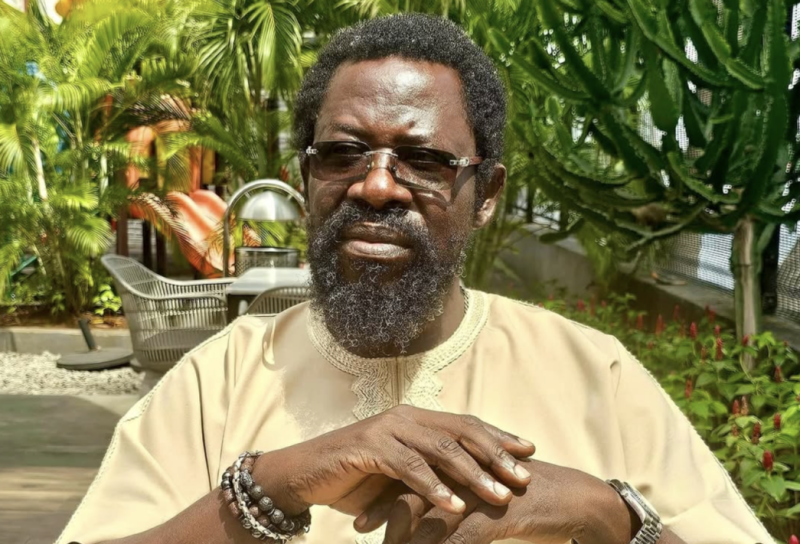
Human rights lawyer and political activist Dele Farotimi has questioned President Bola Ahmed Tinubu's willingness to accept an unfavourable result in the 2027 presidential election, accusing Nigeria's political establishment of weakening democratic institutions and limiting citizens' ability to determine who governs them.
In remarks reported on Thursday, October 15, 2026, Farotimi compared Tinubu with former President Goodluck Jonathan, who conceded defeat in the 2015 presidential election. The activist argued that the circumstances surrounding the approaching election raised serious concerns about electoral credibility, institutional independence and the possibility of a peaceful transfer of power if the incumbent president were defeated.
Farotimi made the comparison in a statement shared on X, where he questioned both Tinubu's political position and the outcome he believed the president wanted from the forthcoming election.
“Tinubu is NOT Jonathan, he is incapable of presiding over an election he will lose, and he has neither a pathway to victory, nor the narrative to explain the outcome he desires. If it were not so tragic, it’d be comedic; feudalism has birthed a monster,” he wrote.
The statement represents Farotimi's assessment of the president's intentions and political circumstances. It does not establish that Tinubu plans to interfere with the election, reject a defeat or prevent a lawful transfer of power.
Farotimi's reference to Jonathan drew attention to the 2015 presidential election, when the then-president, representing the Peoples Democratic Party, lost to Muhammadu Buhari of the All Progressives Congress.
Jonathan accepted the result and congratulated Buhari before the conclusion of the formal announcement process, helping to facilitate a transition between rival political parties at the federal level.
That election marked Nigeria's first transfer of presidential power from an incumbent ruling party to an opposition party through the ballot since the restoration of civilian government in 1999.
Jonathan's concession subsequently became an important reference point in discussions about democratic conduct, political restraint and the acceptance of electoral outcomes.
By contrasting Tinubu with Jonathan, Farotimi suggested that the incumbent president would respond differently if faced with an electoral defeat.
However, the 2027 presidential election has not taken place, and there is no verified electoral result against which such a claim can be assessed.
The activist also expressed concern about the role of the judiciary in resolving electoral disputes. He alleged that Nigeria's courts could ultimately validate disputed outcomes unless citizens became more actively involved in defending democratic institutions.
Farotimi questioned whether voting alone could produce meaningful political change under the existing system, arguing that structural problems extended beyond the individuals contesting elections.
His comments reflected a broader criticism of Nigeria's political institutions, which he has repeatedly described as requiring fundamental reform rather than merely a change of elected leaders.
He maintained that citizens needed to organise around a shared vision of the country's future and demand changes to the structures through which political authority is exercised.
Farotimi described restructuring and political mobilisation as essential elements of that process. He argued that opposition movements should offer voters a clear programme addressing governance, accountability and the distribution of political power.
The lawyer also reiterated his belief that Nigeria requires a revolution to overcome its institutional challenges.
He clarified, however, that the transformation he envisaged could occur through democratic participation and the ballot, provided sufficient citizens supported a coherent programme for national change.
His argument distinguished between replacing a president and reforming the political arrangements that determine how public institutions operate.
According to Farotimi, a political movement centred exclusively on personalities would struggle to achieve lasting change without addressing the underlying system.
The remarks come amid preparations for the January 2027 presidential election, with political parties mobilising supporters, presenting candidates and debating the administration's record.
Tinubu, who assumed office in May 2023, is seeking another term under the APC. Opposition politicians have criticised aspects of his economic policies, governance approach and political relationships.
Supporters of the administration, meanwhile, have defended its reform programme and argued that its policies are intended to strengthen public finances, encourage investment and improve economic conditions over time.
These competing positions form part of the political debate ahead of the election. Neither campaign statements nor individual assessments establish what voters will decide.
Concerns about electoral credibility have also featured in comments by other opposition figures, including African Democratic Congress chieftain Dele Momodu.
Momodu recently questioned public confidence in the conduct of the forthcoming election and expressed concern about whether the incumbent would accept an unfavourable outcome.
Like Farotimi's remarks, those statements represent political opinions and allegations rather than verified evidence of a plan to undermine the electoral process.
The Independent National Electoral Commission is responsible for administering federal elections under Nigeria's electoral framework.
Its duties include organising voting, managing electoral procedures, collating results and declaring outcomes in accordance with applicable laws.
Disputes arising from presidential elections may be challenged through the courts, where parties must present evidence supporting their claims.
The independence and effectiveness of those institutions remain subjects of public scrutiny, particularly following disagreements surrounding previous electoral contests.
Farotimi's criticism focused on whether those institutions could operate without improper political influence during a closely contested election.
The Presidency has publicly expressed a different position concerning the forthcoming vote.
At the signing of a presidential election peace accord in Abuja on August 18, Tinubu pledged that the APC would respect commitments to peaceful campaigning and transparent electoral procedures.
The president, represented at the ceremony by Secretary to the Government of the Federation George Akume, called on political parties to reject violence, misinformation and inflammatory campaigning.
The official statement also encouraged candidates and supporters to debate competing policies while respecting the country's democratic institutions.
Tinubu said political disagreements should not undermine national stability and maintained that elections should not become contests in which participants regard defeat as unacceptable.
Those assurances stand in contrast to Farotimi's expressed doubts about the president's intentions.
Whether the commitments are fulfilled will depend on the conduct of political actors, electoral officials and institutions during the forthcoming process.
Farotimi's use of the term feudalism also reflected his wider criticism of political power being concentrated among influential individuals and networks.
He has argued that citizens must move beyond dependence on prominent politicians and participate more directly in determining the country's political direction.
His comments therefore addressed not only Tinubu's candidacy but also what he considers longstanding weaknesses in Nigeria's democratic system.
The activist's call for a new national vision emphasised the importance of political ideas capable of attracting support across communities and social groups.
He suggested that public mobilisation should be organised around institutional reform, rather than simply opposition to a particular president.
Although his statements were strongly critical of Tinubu, they did not provide evidence establishing the eventual result of the 2027 election or proving that the president intends to reject it.
The forthcoming contest will be determined through the electoral process, subject to the legal procedures governing voting, result declarations and disputes.
Farotimi's intervention has nevertheless added to public discussion about electoral accountability and the responsibilities of political leaders when confronted with outcomes they do not favour.
His comparison with Jonathan places particular attention on the conduct expected of an incumbent president during a competitive democratic election.
For Nigeria's political institutions, the central issue remains whether voters can participate freely and whether the declared outcome will reflect a lawful, transparent process.
As campaigning continues, Farotimi is urging Nigerians to focus on institutional change, while the administration maintains its stated commitment to peaceful and credible elections.
📩 Stone Reporters News | 🌍 stonereportersnews.com
✉️ info@stonereportersnews.com | 📘 Facebook: Stone Reporters News | 🐦 X (Twitter): @StoneReportNew | 📸 Instagram: @stonereportersnews
Add comment
Comments