

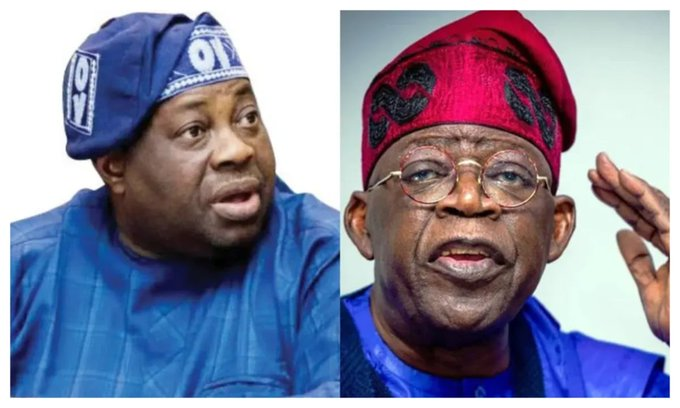
A chieftain of the African Democratic Congress (ADC), Dele Momodu, has declared that opposition forces are developing strategies to challenge President Bola Ahmed Tinubu's re-election bid in 2027, insisting that the ruling All Progressives Congress (APC) should not assume the president's return to office is guaranteed. The veteran journalist maintained that political discussions and preparations were taking place outside public view.
Momodu made the remarks during an interview on Arise Television's Prime Time programme on Wednesday, October 14, 2026. Speaking about the forthcoming presidential election, the publisher of Ovation Magazine said the ADC and other opposition figures were working to prevent Tinubu from securing another four-year term. He declined to disclose their plans, arguing that revealing political strategies publicly would undermine their purpose.
“We are not going to come in public and say this, but we know what to do to make sure that he does not get that second term,” Momodu declared.
He explained that political contests require preparation, organisation and an understanding of how opponents operate. Referring to Tinubu's earlier political career, Momodu recalled the president's efforts to retain office during his tenure as Lagos State governor and suggested that opposition politicians were similarly preparing to defend their electoral interests.
The ADC chieftain insisted that the party's confidence was not based exclusively on internal political calculations. He argued that dissatisfaction among ordinary Nigerians would also influence the presidential contest, although he offered no polling figures establishing the scale of that dissatisfaction.
Momodu further alleged that some politicians publicly expressing support for Tinubu privately opposed his continued leadership. According to him, their public declarations did not necessarily reflect their personal political preferences, particularly where they feared losing influence or attracting hostility from powerful figures.
He accused the president of exercising excessive influence over political officeholders and institutions, alleging that governors, lawmakers and members of the judiciary had become reluctant to challenge him. Those allegations were presented as Momodu's political assessment and were not accompanied by independently verified evidence establishing improper presidential control over the institutions mentioned.
The former presidential aspirant also questioned public confidence in the Independent National Electoral Commission (INEC). He alleged that appointments to the commission had raised concerns about its neutrality and argued that Nigerians would closely examine its preparations for the 2027 election.
Momodu claimed that an overwhelming majority of citizens lacked confidence in the prospect of a credible election under the current administration. However, he did not identify an opinion poll or research methodology supporting his estimate, meaning the figure should be understood as his assertion rather than a verified measurement of public opinion.
His comments also addressed speculation that Tinubu might resist leaving office if defeated. Momodu rejected the suggestion that such an outcome would necessarily be accepted, expressing confidence in the willingness of Nigerians to defend their electoral choices.
The statement did not amount to evidence that Tinubu intends to reject an unfavourable result. Under Nigeria's constitutional system, presidential elections are conducted by INEC, while disputes concerning their outcome are determined through established judicial procedures.
Momodu's latest remarks come as political parties intensify preparations for the 2027 general election. The APC is seeking to retain the presidency, while opposition parties are organising campaigns and developing positions on governance, economic conditions and electoral accountability.
The ADC has become a platform for prominent politicians seeking to challenge the ruling party. Its preparations have included discussions about political cooperation, campaign organisation and the need to build support across different parts of the country.
Momodu has repeatedly advocated cooperation among opposition parties, arguing that divisions can weaken their ability to contest elections effectively. His position has been reflected in earlier statements supporting collaboration between politicians belonging to different parties.
In August 2026, he publicly supported Osun State Governor Ademola Adeleke despite belonging to the ADC. Momodu explained that opposition cooperation sometimes required politicians to set aside party differences where they believed a common political objective was more important.
His position on Osun illustrated the broader approach he has advocated ahead of the presidential election. However, support for cooperation does not establish that opposition parties have reached agreements covering every state or political contest.
The ADC has also experienced disagreements involving prominent members and its presidential nomination process. Such disputes demonstrate that building an opposition coalition involves negotiations over leadership, representation and campaign priorities.
Former Secretary to the Government of the Federation Babachir Lawal, for example, criticised the ADC's presidential primary process earlier in 2026 and subsequently announced his departure from the party. His allegations were disputed by representatives associated with former Vice-President Atiku Abubakar.
The disagreement illustrated the challenges facing parties attempting to bring politicians with different ambitions into a common organisation. It also highlighted the distinction between announcing a coalition and maintaining agreement among its participants throughout an election campaign.
Momodu's assertion that the opposition possesses a strategy therefore remains a statement of political intention. He did not disclose operational details that would allow an independent assessment of the plan, its implementation or the level of support it commands.
His criticism of Tinubu has also intensified in recent months. During the same television appearance, Momodu compared the president's growing political influence with the concentration of power associated with former military ruler Sani Abacha.
The comparison reflected his concerns about political competition and institutional independence. Nevertheless, Nigeria remains under a constitutional civilian government, and the allegation that its institutions are being improperly controlled requires evidence beyond political commentary.
Momodu and Tinubu have a political history extending to Nigeria's struggle for democratic government. Both were associated with opposition to military rule, although their political positions have diverged considerably in recent years.
The publisher has previously acknowledged Tinubu's organisational abilities and extensive political relationships. A video that resurfaced in 2025 showed Momodu discussing the political networks Tinubu developed before winning the 2023 presidential election.
His present criticism reflects a different assessment of the president's leadership and the direction of the country. The change in position is part of the political disagreement surrounding the administration's record and its bid for another term.
For the APC, the forthcoming election will involve presenting its record in government and seeking renewed public support. For opposition parties, the contest will require communicating alternative programmes and persuading voters through the electoral process.
The credibility of that process will depend on compliance with electoral laws, transparent administration and the effective handling of complaints. Political allegations about the conduct of future elections should be distinguished from verified findings concerning actual violations.
Momodu's remarks have consequently brought attention to both the ADC's undisclosed campaign plans and his concerns about the political environment. His confidence in the opposition's preparations does not establish what the election result will be.
With campaigning and political negotiations continuing, the ADC chieftain has made clear that he does not intend to reveal the party's strategy publicly. The effectiveness of those preparations will ultimately be tested through the electoral process rather than determined by competing political declarations.
📩 Stone Reporters News | 🌍 stonereportersnews.com
✉️ info@stonereportersnews.com | 📘 Facebook: Stone Reporters News | 🐦 X (Twitter): @StoneReportNew | 📸 Instagram: @stonereportersnews
Add comment
Comments