

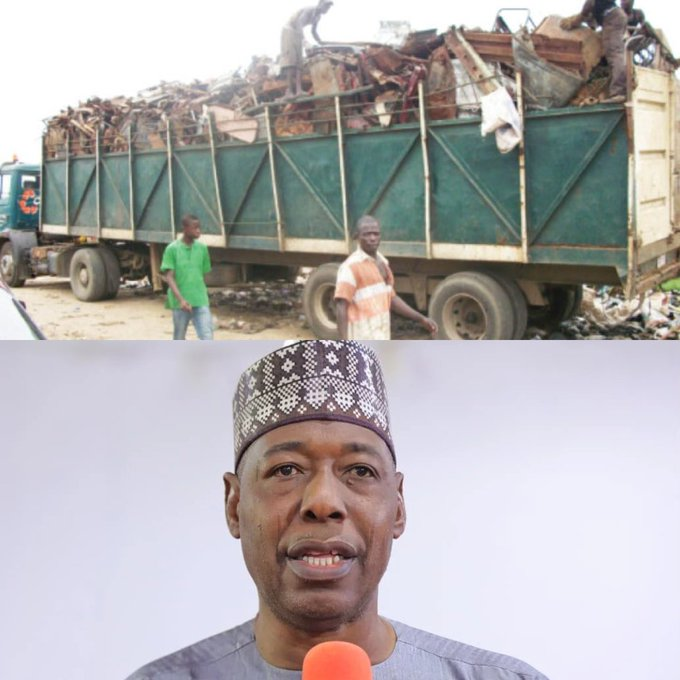
The National Association of Scrap and Waste Dealers Employers of Nigeria (NASWDEN) has challenged Borno State Governor, Babagana Umara Zulum, to provide verifiable evidence supporting his allegation that scrap metal scavengers stole electrical cables purchased for a power distribution project valued at more than ₦3 billion.
The association's Deputy National President, Aminu Hassan Soja, made the demand in a statement reported on Monday, October 19, 2026, following remarks by the governor accusing scavengers of stealing electrical materials intended for a distribution line connecting Damaturu in Yobe State to Maiduguri, the Borno State capital.
Soja questioned the basis of the allegation and demanded that the Borno State Government disclose essential information about the project, including the identity of the contractor, the year the work was undertaken, whether the electrical cables were supplied and installed, and when the alleged theft occurred.
The association maintained that such information was necessary to establish the circumstances of the reported loss and determine whether scrap dealers were responsible.
“Governor Zulum must not use scrap dealers as scapegoats to conceal the government's failures in providing basic social amenities and infrastructure. You cannot accuse an entire industry without presenting credible evidence,” Soja declared.
The dispute followed comments made by Zulum during a meeting with scrap metal dealers and business operators in Maiduguri on Saturday, October 17. According to a statement released on Sunday by his Senior Technical Assistant on Print and Digital Communications, Abdulrahman Bundi, the governor said the state had suffered extensive losses of electrical equipment, metals and other public infrastructure through scavenging activities.
Zulum specifically alleged that cables purchased for the electricity distribution project linking Damaturu and Maiduguri had been stolen, describing the incident as one of the reasons his administration imposed restrictions on scrap metal trading.
The governor said the government had spent more than ₦3 billion on the electricity connection but subsequently lost the wires to scavenging activities. He presented the incident as an example of the damage allegedly caused to public infrastructure by individuals operating within the scrap metal trade.
Zulum also raised security concerns, alleging that intelligence available to the government indicated that insurgents were using scrap metal trading channels to dispose of looted materials.
According to the governor, the restrictions were introduced to protect public infrastructure and prevent commercial activities from creating additional security risks in a state affected by prolonged insurgency.
He further claimed that hundreds of scavengers had lost their lives while searching for scrap metals in communities considered unsafe for civilian activities.
The governor maintained that his administration did not intend to deprive legitimate business operators of their livelihoods. He explained that the restrictions were motivated by security considerations rather than opposition to scrap trading as an economic activity.
However, NASWDEN rejected any attempt to associate its members collectively with criminal activities or insurgent organisations.
Soja insisted that the association represented legitimate scrap and waste dealers operating across Nigeria and had no affiliation with Boko Haram or other terrorist groups.
He warned that accusations directed at an entire industry without establishing individual responsibility could damage the reputations and livelihoods of lawful operators.
The association also questioned the timing of the alleged cable theft, noting that scrap metal trading had reportedly been prohibited in Borno State for more than three years.
Borno's statewide restrictions on metal scavenging date back to July 2023, when the government announced measures against the trade following concerns about the disappearance of public infrastructure and the recovery of materials suspected to belong to government facilities.
NASWDEN argued that the existence of the longstanding restrictions made it necessary for the government to clarify when the alleged theft occurred and identify those responsible.
The association did not deny that infrastructure theft could occur. Instead, it called for an investigation capable of distinguishing individuals involved in criminal conduct from legitimate business operators.
Soja urged the government to identify and prosecute anyone found responsible for stealing public property rather than attributing the alleged offence to the scrap metal industry generally.
The disagreement comes as the Borno State Government considers measures to address the economic consequences of its restrictions on scrap metal trading.
During his meeting with operators, Zulum granted a waiver allowing dealers to evacuate materials accumulated before the ban from designated locations.
He also requested proposals outlining how legitimate scrap businesses could operate without contributing to insecurity or the destruction of public infrastructure.
The move indicated that the administration was prepared to consider arrangements for lawful trading, provided operators could demonstrate safeguards against vandalism and security threats.
However, the association's latest statement has brought renewed attention to the evidence supporting the government's allegations.
The publicly available statements reviewed by Stone Reporters News do not establish the exact date of the alleged cable theft, identify the contractor responsible for the project or provide documentary evidence showing who removed the materials.
The reported ₦3 billion figure also refers to the cost of the electricity distribution project as described by the governor, rather than an independently verified valuation of the allegedly stolen cables alone.
While Zulum has cited infrastructure protection and security intelligence as reasons for restricting the trade, NASWDEN maintains that allegations of criminal involvement must be supported by verifiable evidence and directed at identifiable offenders.
The dispute therefore remains unresolved, with the association demanding project records and proof of wrongdoing while the Borno State Government continues to defend its restrictions as necessary for public safety and the protection of critical infrastructure.
📩 Stone Reporters News | 🌍 stonereportersnews.com
✉️ info@stonereportersnews.com | 📘 Facebook: Stone Reporters News | 🐦 X (Twitter): @StoneReportNew | 📸 Instagram: @stonereportersnews
Add comment
Comments