

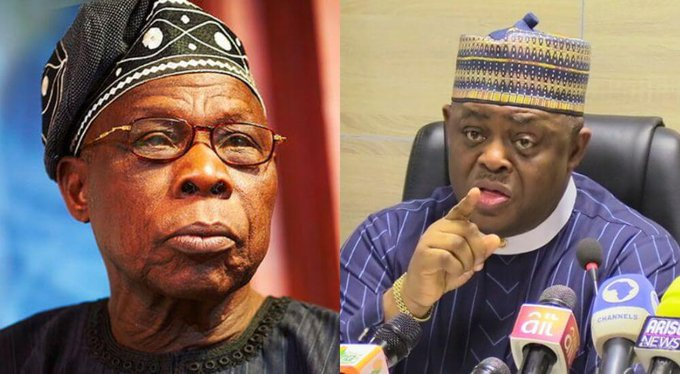
Nigeria's High Commissioner to South Africa and former Minister of Aviation, Femi Fani-Kayode, has defended former President Olusegun Obasanjo against criticism surrounding the collapse of Nigeria Airways, arguing that the national carrier had already been severely weakened by years of mismanagement, corruption and financial difficulties before Obasanjo returned to power in 1999.
Fani-Kayode made the remarks on Thursday, October 15, 2026, in a statement published on his X account, responding to Minister of Aviation and Aerospace Development Festus Keyamo. The disagreement followed Keyamo's criticism of former Vice-President Atiku Abubakar over the liquidation of Nigeria Airways in September 2004 and the unpaid retirement benefits of thousands of former employees.
Fani-Kayode acknowledged that the airline's liquidation occurred under Obasanjo's civilian administration but rejected the suggestion that the former president had caused its collapse. He maintained that the decision to wind up the company followed years of operational decline and unsuccessful attempts to restore its financial viability.
“In fairness to President Obasanjo the Nigeria Airways ‘mess’, as you have described it, was established before he came back to power in 1999,” he wrote.
He added that the problems confronting the airline were inherited rather than created by Obasanjo's administration, describing the condition of the national carrier at the time as deeply troubling.
The former aviation minister recalled that Nigeria Airways had operated a substantial fleet when Obasanjo left office as military Head of State in 1979. According to his account, the airline then possessed 32 functional aircraft, experienced flight crews and an established management structure.
He described the airline during that period as a source of national pride, contrasting its earlier operations with the condition he said Obasanjo encountered two decades later.
Fani-Kayode claimed that only one aircraft remained when Obasanjo returned as civilian president in 1999 and that the aircraft was not operational. He attributed the deterioration to corruption, poor management decisions, mounting debts and the disappearance of valuable company assets.
These figures and explanations formed part of Fani-Kayode's account of the airline's history. They were not presented as findings from a newly published independent investigation.
According to him, successive management teams and boards had contributed to the company's difficulties between 1979 and 1999. He argued that the financial and operational problems had become so extensive that restoring the airline would have required substantial public expenditure without a clear prospect of recovery.
He also referred to attempts to explore alternatives to liquidation, including advice sought from the International Finance Corporation on possible privatisation arrangements. Fani-Kayode said those efforts failed to produce a workable solution.
The former minister maintained that Obasanjo's administration ultimately faced a difficult decision over whether to continue funding an insolvent company or bring its operations to an end.
He defended the liquidation in 2004 as a necessary response to the airline's financial condition, while acknowledging that the decision carried serious consequences for employees and pensioners.
The disagreement arose after Keyamo challenged Atiku over his criticism of President Bola Tinubu's administration, particularly concerning economic hardship and insecurity.
In a statement issued on Wednesday, October 14, Keyamo accused Atiku of selectively distancing himself from controversial decisions taken while he served as vice-president under Obasanjo.
Keyamo pointed to the liquidation of Nigeria Airways as an example, arguing that the administration had left thousands of employees without jobs and outstanding pensions and gratuities.
The aviation minister said some former workers had died while waiting for their entitlements, describing the unresolved obligations as a longstanding consequence of the liquidation.
He further stated that Tinubu had approved and released ₦36 billion to address outstanding payments owed to former Nigeria Airways workers. According to Keyamo, beneficiaries had begun receiving payment notifications.
The payment announcement formed a central part of Keyamo's criticism, as he contrasted the current administration's actions with the handling of employee entitlements following the airline's closure.
Fani-Kayode did not dispute the importance of settling those obligations. Instead, he commended Keyamo for pursuing the payments while explaining his own efforts to address the matter during his tenure as aviation minister.
He recalled that a committee chaired by former Head of the Civil Service of the Federation Yayale Ahmed had recommended financial provisions for affected pensioners.
Fani-Kayode said he subsequently presented a memorandum to the Federal Executive Council in 2006 seeking approval for the payment of outstanding entitlements.
According to his account, the proposal encountered opposition from cabinet members who believed that some former airline managers and board members had contributed to the company's collapse.
He said those opposing the memorandum considered it inappropriate to approve payments in circumstances where they believed individuals associated with the airline had contributed to its financial destruction.
Fani-Kayode maintained that he disagreed with that position and supported payment of the benefits. Nevertheless, he said his proposal failed to secure sufficient backing within the cabinet.
He acknowledged that the rejection had consequences for former employees who continued waiting for their entitlements after losing their jobs.
The former minister said subsequent administrations made progress towards resolving the obligations, identifying the governments of Umaru Musa Yar'Adua and Muhammadu Buhari as having undertaken payments.
He welcomed the latest intervention under Tinubu and expressed regret that the outstanding obligations had not been fully resolved while he was in government.
Fani-Kayode also addressed Atiku's participation in the earlier cabinet discussions. He said he knew the former vice-president's position during the debate but would not disclose it publicly.
He explained that decisions taken by the Federal Executive Council were collective and that members of the administration shared responsibility for their consequences.
His refusal to identify Atiku's position left unresolved whether the former vice-president supported or opposed the particular payment proposal.
The exchange highlights two related but distinct questions: responsibility for the airline's operational collapse and responsibility for addressing employees' entitlements after its liquidation.
Keyamo's criticism focused principally on the decision taken during the Obasanjo administration and the prolonged delay in settling benefits. Fani-Kayode's response concentrated on the airline's earlier deterioration and the circumstances surrounding the liquidation.
Neither position changes the fact that Nigeria Airways was liquidated during Obasanjo's presidency, when Atiku served as vice-president.
However, determining responsibility for its financial decline requires examining management decisions, operational records and government policies across the years preceding liquidation.
For former employees, the immediate issue remains the settlement of verified entitlements and the completion of payments announced by the government.
Fani-Kayode's intervention therefore defended Obasanjo's handling of an inherited crisis while recognising the hardship experienced by workers after the airline's closure.
He concluded by praising efforts to resolve the outstanding pension obligations, maintaining that affected workers deserved payment regardless of disagreements about the causes of Nigeria Airways' collapse.
📩 Stone Reporters News | 🌍 stonereportersnews.com
✉️ info@stonereportersnews.com | 📘 Facebook: Stone Reporters News | 🐦 X (Twitter): @StoneReportNew | 📸 Instagram: @stonereportersnews
Add comment
Comments