

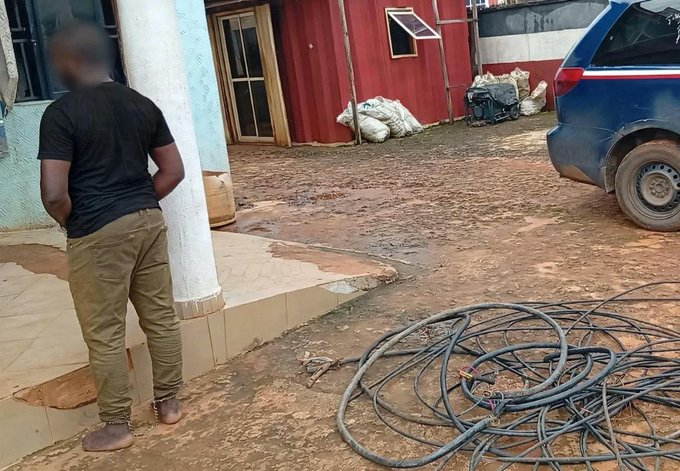
The Nigeria Security and Civil Defence Corps (NSCDC) has arrested a 39-year-old man suspected of vandalising telecommunications infrastructure in Anambra State, as authorities intensify efforts to protect installations that support mobile communications and other essential services. The command says the suspect was apprehended at a mast facility in Awka, where officers recovered cables and other components allegedly removed from the installation.
The suspect, identified as Anuba Chisom, was arrested at approximately 4am on Thursday, October 15, 2026, at an IHS-MTN telecommunications mast in Okpuno, Awka South Local Government Area, near the temporary site of Nnamdi Azikiwe University. The Anambra State Commandant of the NSCDC, Olatunde Maku, disclosed the arrest while presenting the suspect to journalists at the command headquarters in Awka.
According to Maku, personnel attached to the command's anti-vandal unit were conducting a routine patrol when they received information about suspicious movements within the telecommunications facility. The officers subsequently approached the location and apprehended the suspect.
The commandant identified the installation by its site reference, IHS_ANA_0888A, and said it was situated near the palace of the traditional ruler of Okpuno. The location was described as one of the telecommunications facilities requiring protection against unauthorised interference and theft.
Maku said the patrol team found the suspect with cables and other components believed to have been removed from the mast installation. The recovered materials are expected to form part of the evidence examined during the investigation.
Chisom was identified as a resident of Amaputa in Isiala Ngwa North Local Government Area of Abia State. The authorities did not immediately disclose how long he had been in Awka or whether he had any legitimate connection with the telecommunications facility.
The commandant alleged that preliminary investigations linked the suspect to a group involved in the vandalism of infrastructure across Anambra State. He said officers were examining whether other individuals participated in the reported activities.
According to Maku, the suspect admitted during preliminary questioning that he had previously vandalised two other telecommunications sites. The commandant said Chisom attributed his alleged involvement to unemployment.
The reported admission has not been tested in court, and the command did not identify the two additional installations or provide independent documentation establishing the suspect's involvement in those incidents.
Maku rejected unemployment as a justification for damaging essential infrastructure, warning that the command would continue pursuing individuals suspected of interfering with public and private facilities.
He also commended the anti-vandal personnel whose response led to the arrest, describing timely intelligence and patrol operations as important elements of the command's enforcement activities.
The commandant directed investigators to conduct a thorough examination of the incident before presenting the suspect for prosecution. He said Chisom would be charged to court when the investigation was completed.
No court appearance, formal charge or conviction had been confirmed at the time of the announcement. The suspect remains entitled to the presumption of innocence and the protections available under Nigerian law.
The NSCDC did not disclose the monetary value of the recovered components or estimate the cost of repairing the affected installation. It also did not confirm whether the alleged vandalism caused an interruption to mobile telecommunications services in the surrounding area.
Those details would be relevant in assessing the practical consequences of the incident, particularly because telecommunications facilities support voice calls, internet connectivity and digital transactions.
Damage to power cables and other equipment can disrupt the operation of a telecommunications base station, depending on the components affected and the availability of backup systems.
Such disruptions can affect residents, businesses and institutions relying on network connectivity for daily activities. However, there is currently no verified evidence that the Okpuno incident caused a particular service outage.
The facility was described as an IHS-MTN mast, reflecting the relationship between telecommunications infrastructure providers and mobile network operators. The authorities did not provide additional details about the site's ownership or operational arrangements.
The latest arrest follows another telecommunications vandalism case reported by the Anambra NSCDC earlier this month.
On October 1, officers arrested a 24-year-old man, identified as Nweke Friday Wisdom, at Esther Obiakor Estate in Agu-Awka following information about suspected interference with a telecommunications mast.
The command said that suspect, who was identified as being from Izzi South Local Government Area of Ebonyi State, was found with materials believed to have been removed from the installation.
Those items reportedly included direct-current cables and armoured cables used in telecommunications infrastructure.
At the time, Maku said preliminary investigations suggested that the suspect was involved in stealing valuable equipment from telecommunications installations.
The command announced that further investigation would be conducted before prosecution. The outcome of that earlier case has not been established in the reports reviewed.
Although the two arrests occurred within the same month and involved similar infrastructure, authorities have not presented evidence connecting the suspects or establishing that they belonged to the same group.
The incidents nevertheless reflect the command's continued attention to the protection of telecommunications facilities around Awka.
Beyond telecommunications equipment, the NSCDC has responsibility for safeguarding designated critical national assets and infrastructure, including facilities whose destruction or disruption could affect essential public services.
Its enforcement activities involve surveillance, intelligence gathering, patrols and cooperation with other security agencies and relevant organisations.
In Anambra, the command has recently emphasised the need for stronger supervision and operational discipline among officers assigned to protect infrastructure.
During a tactical meeting held earlier in October, Maku directed heads of departments, area commanders and other operational leaders to take responsibility for security activities within their jurisdictions.
He stressed that effective protection required coordination between different formations and the consistent implementation of the command's operational priorities.
The command has also explored cooperation with the Anambra State Electricity Regulatory Commission on protecting electricity infrastructure against vandalism.
That engagement reflected concerns about damage to facilities that support essential services and the financial consequences of replacing stolen or destroyed equipment.
While telecommunications and electricity installations perform different functions, both depend on infrastructure that can be vulnerable to unauthorised access and theft.
Security officials have therefore continued urging members of the public to report suspicious activities around such facilities rather than attempting to confront suspected offenders themselves.
Maku repeated that appeal following Chisom's arrest, saying credible information from residents could assist officers in identifying threats and responding before further damage occurred.
The commandant also warned people involved in infrastructure vandalism that the NSCDC would continue investigating reported offences and pursuing prosecution where evidence supported criminal charges.
Such warnings form part of the command's enforcement position and do not remove the obligation to investigate allegations fairly or establish guilt through the judicial process.
In a separate address to officers on October 5, Maku warned against extortion, excessive force and violations of citizens' rights.
He said personnel were required to operate within the law and the Corps' established procedures, adding that officers who abused their authority would face disciplinary measures.
Those instructions are relevant to the handling of suspects because effective enforcement must also respect lawful arrest, investigation and prosecution requirements.
For the Okpuno incident, investigators are expected to establish precisely what happened at the mast, identify the recovered materials and determine whether the evidence supports the allegations made against Chisom.
The command has not announced additional arrests or disclosed whether investigators have identified other suspected participants.
The immediate confirmed development is the arrest of the 39-year-old man and the recovery of materials alleged to have been removed from the telecommunications installation.
Further findings, including any formal charges, will depend on the outcome of the NSCDC investigation and subsequent legal proceedings.
📩 Stone Reporters News | 🌍 stonereportersnews.com
✉️ info@stonereportersnews.com | 📘 Facebook: Stone Reporters News | 🐦 X (Twitter): @StoneReportNew | 📸 Instagram: @stonereportersnews
Add comment
Comments