

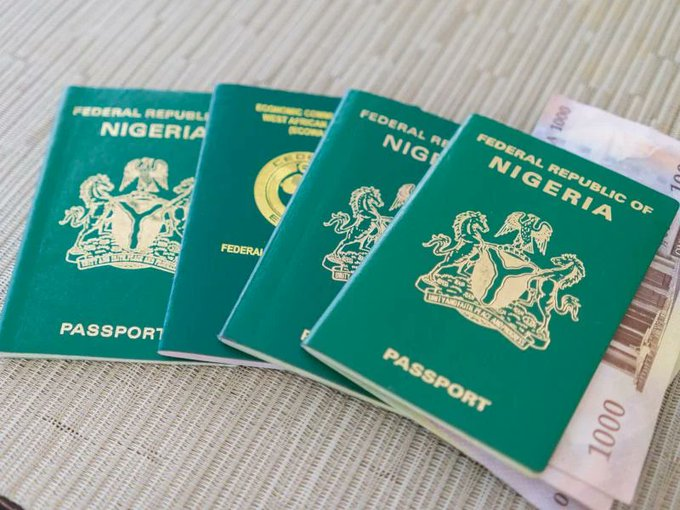
Nigeria's passport has been ranked 181st out of 196 countries in the latest IziVisa Passport Ranking Index, highlighting the limited number of destinations Nigerian citizens can visit without obtaining a visa before travelling.
The ranking, reported on Tuesday, October 20, 2026, places Nigeria among the lower-ranked countries in the assessment, with the index listing 24 visa-free destinations, 16 countries offering visas on arrival and 43 destinations accessible through electronic visas.
The findings have renewed attention on the international travel opportunities available to Nigerian passport holders, particularly as different global passport indices continue to produce varying assessments of the country's travel privileges.
According to the latest figures attributed to IziVisa, Nigerian travellers can enter 24 destinations without obtaining a visa, while an additional 16 provide visas upon arrival.
Another 43 destinations offer electronic visa arrangements, which generally require travellers to submit applications online and obtain approval before departure.
The distinctions are important because visa-free entry, visas on arrival and electronic visas involve different requirements, costs and procedures.
A visa-free arrangement generally allows eligible travellers to enter a destination without securing a visa beforehand, subject to applicable immigration conditions.
A visa on arrival permits eligible visitors to obtain entry authorisation at a designated point of entry, while an electronic visa normally requires an online application and approval.
Consequently, the availability of an electronic visa does not provide the same freedom of movement as unconditional visa-free access.
The latest IziVisa ranking has been widely compared with Nigeria's 90th-place position in the July 2026 Henley Passport Index, which recorded a mobility score of 44 destinations.
However, the two assessments are produced by different organisations and apply different methodologies. Their positions and access scores cannot be treated as directly equivalent.
The Henley Passport Index evaluates passports using travel information from the International Air Transport Association and assesses access across 227 destinations.
Its methodology generally combines qualifying visa-free and visa-on-arrival arrangements, alongside certain electronic travel authorisations, when calculating mobility scores.
IziVisa, meanwhile, publishes separate information on visa-free entry, visas on arrival and electronic visas, with rankings reflecting its own classification and destination coverage.
As a result, the difference between Nigeria's 90th-place position on one index and 181st place on another does not establish that the country lost 91 ranking positions within the same assessment.
Similarly, the difference between the reported scores of 44 and 24 does not independently demonstrate that 20 countries recently withdrew visa-free privileges from Nigerian citizens.
Establishing such a decline would require comparing the same entry categories, destination lists and assessment methods across two dates.
The latest figures nevertheless underline the travel restrictions Nigerian citizens face compared with passport holders from countries enjoying wider visa-free access.
According to the reported IziVisa assessment, the United Arab Emirates occupies the leading position, with extensive access to destinations through a combination of visa-free entry, visas on arrival and electronic visa arrangements.
Switzerland also features prominently, alongside several European countries, including Luxembourg, Malta, Denmark, Spain and Finland.
The substantial differences between passport access scores illustrate how nationality can affect the ease of international travel.
For Nigerian travellers, visa requirements may involve application fees, supporting financial documents, travel histories, accommodation evidence and waiting periods before a journey can proceed.
These requirements can affect tourists, businesspeople, students and families seeking to travel internationally.
Businesses that depend on overseas meetings, conferences or short-notice travel may also face additional planning requirements when employees must obtain visas before departure.
However, passport rankings alone do not establish the causes of a country's travel restrictions.
Visa policies are determined by individual governments and may reflect bilateral agreements, immigration regulations, diplomatic arrangements and other considerations.
Changes in a passport's ranking may also result from improvements or declines among other countries rather than alterations to the passport holder's own entry privileges.
Earlier assessments have shown that Nigeria's position can improve even when its total number of accessible destinations remains unchanged.
In April 2026, the Henley Passport Index placed Nigeria 89th globally, compared with 90th in July, while its reported mobility score remained at 44 destinations.
That movement demonstrated how ranking positions and actual travel access can change independently.
Other African countries have generally recorded stronger performances in the Henley assessment.
In July 2026, South Africa ranked 49th with a mobility score of 101 destinations, while Botswana placed 61st with 81.
Morocco occupied 67th position with 71 destinations, followed by Kenya in 68th place with 70 and Ghana in 70th place with 67.
Nigeria's position in that assessment placed it below those countries in the number of destinations accessible without obtaining a conventional visa in advance.
The differences have implications for discussions about regional mobility, international travel arrangements and the opportunities available to African passport holders.
However, the latest IziVisa figures should not be interpreted as proof of a sudden collapse in Nigeria's travel privileges without a consistent comparison of the underlying destination data.
Another report published on October 20 noted that IziVisa's Nigeria-specific page contained slightly different figures from its continental ranking, including 25 visa-free destinations rather than 24.
That discrepancy further illustrates the need to check the precise date and classification of any passport assessment before drawing conclusions about changes in travel access.
For Nigerian citizens planning international journeys, the practical requirements of the destination country remain more important than a passport's overall ranking.
Travellers are advised to verify current entry conditions through official immigration authorities or diplomatic missions, particularly where electronic visas, visas on arrival or travel authorisations are involved.
The latest ranking therefore draws attention to Nigeria's relatively restricted international mobility, while also demonstrating the importance of distinguishing between different passport indices.
Although Nigeria is listed 181st in the reported IziVisa assessment, the available information does not establish that its passport has fallen from 90th to 181st within a single consistently measured ranking.
A clearer assessment of whether Nigerian travel privileges are expanding or contracting will depend on comparable destination-level data and verified changes in visa policies.
📩 Stone Reporters News | 🌍 stonereportersnews.com
✉️ info@stonereportersnews.com | 📘 Facebook: Stone Reporters News | 🐦 X (Twitter): @StoneReportNew | 📸 Instagram: @stonereportersnews
Add comment
Comments