

Reported by: Oahimire Omone Precious | Edited by: Oravbiere Osayomore Promise.
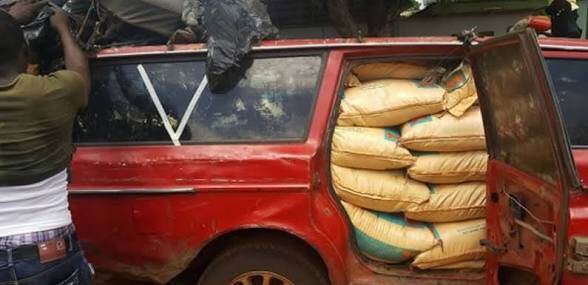
For residents and motorists plying the Ota-Idiroko Road in Ogun State, the daily commute has become a gamble. For months, smugglers ferrying contraband from the Republic of Benin—rice, turkey, and groundnut oil—have been blocking the highway at will, turning a critical economic corridor into a nerve-wracking obstacle course. The situation reached a breaking point on Friday, July 17, 2026, when the smugglers shut down the Goro section of Atan-Ota for about six hours, trapping schoolchildren, workers, and families in a gridlock that exposed the growing power of illicit trade along Nigeria's western border.
The Friday morning blockade was not an isolated incident but the culmination of a months-long crisis that has turned the Ota-Idiroko Road into a no-go zone during peak hours. According to residents, the smugglers operate with near-impunity, moving in convoys of 50 to 100 cars, buses, and trucks stretching up to five kilometres, typically between 11 p.m. and 5 a.m., when the cover of darkness reduces their chances of being intercepted by Customs officers and other security agencies. However, any delay can prove catastrophic. When the smugglers fail to clear the road before daybreak, they resort to reckless speeding and dangerous overtaking, often facing oncoming traffic and triggering total lockdowns.
Friday's blockade was a textbook example of this dangerous pattern. In an attempt to beat daybreak, the smugglers faced oncoming traffic, bringing the entire highway to a standstill. Among those trapped in the chaos was a parent trying to get his child to school in Canaanland, Ota, from the Agbara axis. Stranded in the Goro Section for about two hours, the man lamented that his son would miss a crucial examination. "Now I have to beg the school authorities to arrange a separate examination for my son when we get to school because, as you can see, we are still here locked down in the traffic at 9 a.m., and we don't know whether we can get to the school before 11 a.m.," he told Sunday Vanguard.
The disruption on Friday was a stark reminder of a more severe incident a resident recalled, when a traffic lockdown lasted from 11 p.m. until 10 a.m. the following day—a staggering 12-hour paralysis that left commuters stranded overnight. "Imagine what would have been lost in terms of man-hours in that kind of situation?" the resident asked. "And the saddest part of it is that the authorities who must be aware of what is happening appear not to be bothered, otherwise they should have done something about it".
Despite the scale and frequency of these disruptions, the Nigeria Customs Service, the primary agency responsible for curbing smuggling along the border, has remained conspicuously silent. When contacted, a Customs official told Sunday Vanguard: "We are not aware". The response has done little to reassure residents who accuse authorities of turning a blind eye to the crisis, even as the illicit economy flourishes. The smugglers typically move their contraband to destinations including Lagos Island markets, where they discharge their cargo before retreating into side streets until nightfall.
The crisis along the Ota-Idiroko Road is a symptom of a deeper malaise at Nigeria's western borders. A SaharaReporters investigation revealed allegations that officers of the Army, Police, and Nigeria Customs Service are part of a sophisticated smuggling syndicate generating between N4 billion and N6 billion every week along the Seme Badagry and Idiroko borders. The Idiroko corridor is not merely a road; it is a sprawling economic and social ecosystem where legitimate trade and illicit commerce often blur into one another. Cannabis remains the most dominant illicit commodity moving through the Idiroko axis, feeding a growing domestic market.
The Nigerian Customs Service has recorded significant seizures, including contraband valued at N6.77 billion within a 41-day period between April and June 2026. However, these enforcement efforts have not stopped the smugglers from blocking roads, attacking officers, and disrupting the lives of ordinary Nigerians. In February 2026, at least one person was killed when smugglers attacked Customs operatives in Idiroko following a confrontation that lasted several hours. The violence and lawlessness have prompted the Federal Road Safety Corps to raise concerns over the activities of smugglers, describing them as a major challenge that confronts its operations.
For the residents of Ota-Idiroko Road, the question is not whether the government will act, but when. As one resident put it, "the authorities who must be aware of what is happening appear not to be bothered". The Friday blockade was a temporary disruption, but it was also a warning. If the government fails to address the root causes of smuggling—porous borders, collusion with security agencies, and the economic desperation that drives the illicit trade—the Ota-Idiroko Road will remain a hostage to criminal enterprise, and the people of Ogun State will continue to pay the price.
📩 Stone Reporters News | 🌍 stonereportersnews.com
✉️ info@stonereportersnews.com | 📘 Facebook: Stone Reporters News | 🐦 X (Twitter): @StoneReportNew | 📸 Instagram: @stonereportersnews
Add comment
Comments