

Reported by: Oahimire Omone Precious | Edited by: Oravbiere Osayomore Promise.
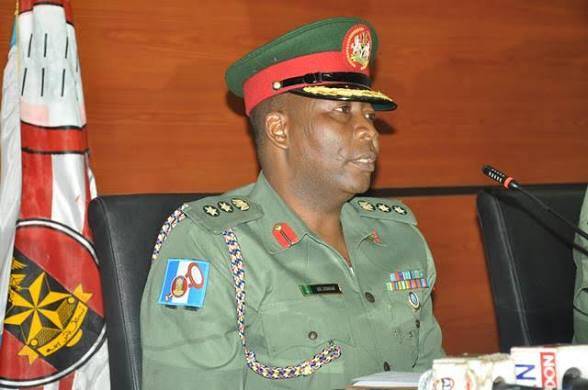
Former Director of Army Public Relations, Brigadier General Sani Usman (retd.), has issued a powerful call for the Nigerian government to fully embrace technology and intelligence-driven operations in the fight against terrorism and banditry, arguing that the system has historically failed to check individuals with a long-standing propensity for violence and criminality. Usman made the remarks during an appearance on Channels Television's 'Sunday Politics' programme, where he spoke extensively on the role of intelligence in counter-terrorism operations, stressing that a fundamental shift in approach is required to end the insecurity plaguing the nation. He maintained that many of those leading bandit and terrorist groups have exhibited violent extremist tendencies from the very beginning of their lives, yet the system repeatedly failed to curb their activities.
"All the leadership of the banditry and the kingpins of terrorists, if you look at their history, they have exhibited some form of violent extremism right from the beginning, or they have this tendency of criminality over time, and the system was unable to check them too," Usman said. According to the former army spokesman, deploying technology in counter-terrorism operations would serve as a powerful deterrent because it creates a reality where criminals can no longer operate with impunity. "Technology helps in the sense that even if a criminal has a tendency of committing crime, the system will eventually catch up with him. And somehow people will have a second thought because you know that you can't hide; there is a limit to which you can hide because you can't go far," he stated.
Usman's remarks come amid a worsening security situation across Nigeria, where banditry, terrorism, and kidnapping have continued to escalate despite sustained military operations. In the North-West, bandits have killed and abducted scores of civilians, while in the North-East, Boko Haram and ISWAP have sustained their insurgency, launching attacks on military formations and civilian populations. The former army spokesman had previously warned that terrorists are adaptive and opportunistic, and that any success in the counter-terrorism war must be followed by intensified efforts rather than complacency.
He had earlier described the elimination of Abu-Bilal Al-Minuki, the second-in-command of the Islamic State globally and one of ISWAP's most influential commanders, as an "extraordinary milestone" in the counter-terrorism war. In a statement on that operation, he noted that the success was the culmination of "painstaking intelligence gathering, surveillance, target acquisition and operational planning," demonstrating the increasing sophistication of Nigeria's counter-insurgency efforts. However, he warned that the military must seize the momentum to relentlessly pursue remnants of Boko Haram and ISWAP elements across the Lake Chad Basin and beyond.
Usman has also consistently emphasised that tackling insecurity is a collective responsibility that cannot be left to the military alone. He has called on citizens to recognise that the fight against insurgency requires vigilance, information sharing, community resilience, and support for lawful authorities. According to him, intelligence provided by local communities has repeatedly proven decisive in disrupting terrorist activities. He has also stressed the importance of collaboration among all levels of government, noting that the local government system, which should serve as a buffer, is not functioning effectively.
The retired general has also highlighted the role of international cooperation in strengthening Nigeria's counter-terrorism efforts. He described the US military support, including intelligence sharing and surveillance, as both timely and strategic, noting that it has improved the effectiveness of Nigerian troops on the ground. He explained that before the enhanced collaboration, delays in intelligence transmission often undermined military operations, but with US personnel now working more closely with Nigerian forces, that gap has been significantly reduced. However, he maintained that the US role appears limited to operational support and that the collaboration remains a necessary step in consolidating recent gains and stabilising the region.
As Nigeria continues to grapple with the multifaceted challenge of terrorism and banditry, Usman's call for a tech-driven, intelligence-led approach has resonated with many Nigerians who have grown weary of the persistent violence. His argument that the system must evolve to check criminality before it escalates into large-scale violence underscores the urgent need for proactive, rather than reactive, security measures. The former army spokesman's remarks serve as a reminder that the fight against insecurity requires not only military might but also the effective use of technology, community engagement, and sustained cooperation among all stakeholders. As he put it, the system must eventually catch up with criminals, and there is a limit to which they can hide.
📩 Stone Reporters News | 🌍 stonereportersnews.com
✉️ info@stonereportersnews.com | 📘 Facebook: Stone Reporters News | 🐦 X (Twitter): @StoneReportNew | 📸 Instagram: @stonereportersnews
Add comment
Comments