

Reported by: Oahimire Omone Precious | Edited by: Oravbiere Osayomore Promise.
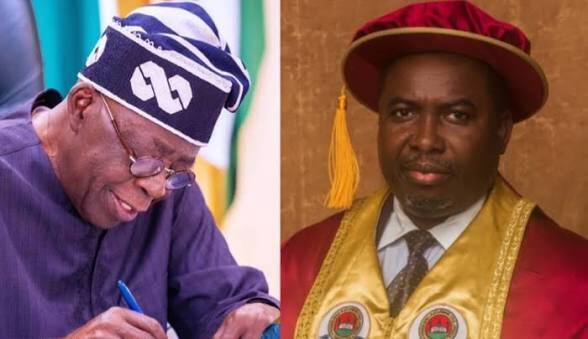
The Chairman of the Independent National Electoral Commission, Professor Joash Amupitan, has issued a stark warning that the electoral umpire cannot achieve true independence without full financial autonomy, cautioning that continued reliance on the normal budgetary process weakens its operational independence and could undermine efforts to deliver free, fair and credible elections in 2027. Speaking at the public presentation of a two-volume book authored by ThisDay Managing Director Eniola Bello at the Shehu Musa Yar'Adua Centre in Abuja on Thursday, July 23, 2026, Amupitan shifted attention from the familiar debate over electoral reforms to a more fundamental question: whether an election management body expected to inspire public confidence can effectively do so while relying on other institutions for its funding and operations.
Although the 1999 Constitution places INEC on the first-line charge, the commission still depends on the federal government's annual budget process, a situation Amupitan said limits its operational independence. He explained that despite its current status on the first-line charge, the election management body still grapples with funding challenges due to its reliance on the normal appropriation process and the envelope system. "Experience over the years has shown that as long as INEC is still subject to the normal envelope system and the processes of appropriation, having to go to the National Assembly, it is very difficult to operate in such a situation without wasting your time," Amupitan said. He argued that the commission's constitutional responsibilities extend beyond conducting presidential and National Assembly elections, stressing that INEC also conducts governorship and state assembly elections, registers and regulates political parties, and maintains the national register of voters used for elections at all levels.
He noted that despite these nationwide responsibilities, the burden of funding the commission rests on the federal government because its finances are drawn from the consolidated revenue fund, and governorship and state assembly elections cost more to conduct than presidential and National Assembly polls, making the current funding structure unsustainable. "It is for this reason we feel that although the Constitution tried to place INEC on the first-line charge, it is not strong enough," the INEC chairman said. "INEC should come as part of the Federation Account so that we can have seamless operations and what we call operational efficiency." He maintained that while the Constitution places INEC's funding on the Consolidated Revenue Fund, practical experience has shown that the arrangement falls short of guaranteeing genuine independence because the Commission still passes through the normal appropriation process.
The INEC chairman stressed that strengthening Nigeria's electoral process requires collective responsibility rather than focusing solely on the electoral commission. "When we talk about strengthening institutions, there are several institutions involved in the conduct of elections. Most times, people think only of the Independent National Electoral Commission, but beyond INEC, we also have the media, the security agencies, civil society organisations and, indeed, the Nigerian people. The health of our democracy is reflected in the strength of this wider institutional framework," he said. Drawing from international democratic principles, he recalled that the Inter-Parliamentary Council had long recognised that building democratic institutions is a shared responsibility of government, voters and organised political forces. "Therefore, if we truly want the 2027 elections to be free, fair, credible and peaceful, all these institutions must work together," he said.
Addressing concerns over the appointment of INEC's leadership, Amupitan said the Constitution already provides safeguards by requiring the President to appoint the Chairman and National Commissioners in consultation with the Council of State, subject to Senate confirmation. However, he argued that the real challenge often lies not with the law but with those entrusted to implement it. "Sometimes, however, the issue is not the law itself but those who operate it," he said, citing former Chief Justice of Nigeria, Justice Aloma Mukhtar, as having argued that Nigeria's challenge is not the provisions of the law but the operators of the law.
Beyond funding, the INEC chairman also called for further amendments to the Electoral Act to give the commission greater powers to supervise political parties, arguing that stronger oversight would help ensure parties comply with their constitutions, the Electoral Act and the Nigerian Constitution while reducing the growing number of pre-election court cases. He disclosed that the commission is considering introducing a mediation process that would resolve internal party disputes within three months instead of allowing prolonged litigation, and proposed that every dispute involving political parties should be concluded at least one year before a general election to prevent last-minute legal battles from disrupting the electoral timetable. "Can INEC truly be independent without financial autonomy? If we are serious about strengthening our institjutions and conducting free, fair and credible elections, then financial autonomy is essential," Amupitan declared.
📩 Stone Reporters News | 🌍 stonereportersnews.com
✉️ info@stonereportersnews.com | 📘 Facebook: Stone Reporters News | 🐦 X (Twitter): @StoneReportNew | 📸 Instagram: @stonereportersnews
Add comment
Comments