

Reported by: Ijeoma G | Edited by: Oravbiere Osayomore Promise.
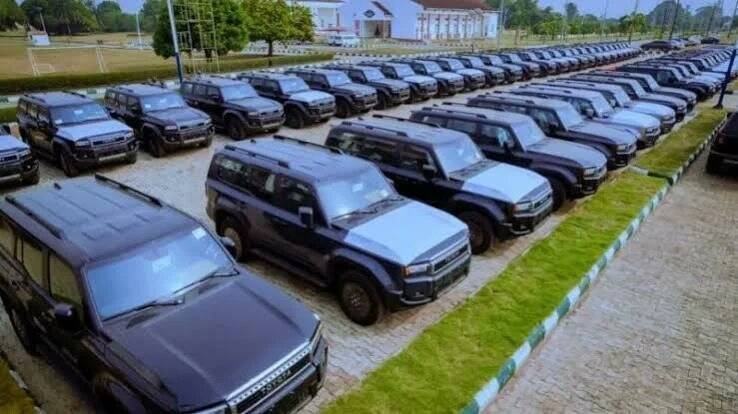
The Federal Government has earmarked N962.83 billion in the 2026 Appropriation Act for the procurement of Sport Utility Vehicles and empowerment projects, an amount that exceeds the combined allocations to seven key federal ministries, according to a review of the budget by civic technology organisation Tracka . The allocation comprises N15.13 billion for the procurement of 39 SUVs and N947.70 billion for 2,579 empowerment projects, bringing the total to N962.83 billion . Tracka noted that this amount surpasses the combined N960.27 billion appropriated to the Federal Ministries of Industry, Trade and Investment; Housing and Urban Development; Women Affairs; Justice; Livestock Development; Aviation and Aerospace Development; and Petroleum Resources .
According to the group's analysis, the Ministry of Industry, Trade and Investment received N156.8 billion in the 2026 budget, Housing N145.3 billion, Women Affairs N169.39 billion, Justice N150.7 billion, Livestock Development N177.6 billion, Aviation and Aerospace Development N87.3 billion, while Petroleum Resources was allocated N73.1 billion . Tracka expressed concern over what it described as a lack of transparency surrounding many of the empowerment projects, noting that "only 70 of the 2,579 empowerment projects have clearly identified implementation locations" . The organisation argued that the omission raised fundamental accountability questions regarding project implementation and oversight, asking: "How can citizens track projects with no stated location? How can oversight institutions verify implementation? How can taxpayers know who ultimately benefits from these allocations?" .
Beyond the absence of project locations, Tracka said the projects were spread across 184 implementing agencies, including several institutions whose statutory mandates do not ordinarily cover empowerment programmes . According to its findings, the Federal Cooperative College, Oji River, was assigned 393 projects worth N127.1 billion, while the National Agricultural Development Fund was allocated six projects valued at N89.5 billion. The Federal College of Horticulture, Dadin-Kowa, Gombe, received 216 projects worth N88.1 billion, while the Federal Cooperative College, Ibadan, was assigned 94 projects valued at N36.9 billion .
A review of the budget document based on Tracka's analysis shows that the largest single empowerment allocation was N89.09 billion for the Renewed Hope Fertiliser Support Programme under the National Agricultural Development Fund . Other high-value allocations include N14 billion for the procurement and distribution of economic empowerment equipment and utility vehicles through the Federal Cooperative College, Oji River; N14 billion for youth empowerment programmes under the Federal Ministry of Youth Development; and another N14 billion for youth empowerment and medical outreach under the Ministry of Humanitarian Affairs and Poverty Alleviation . The document also contains numerous allocations for the procurement of buses, tricycles, motorcycles, electric vehicles, sewing machines, fertilisers, vocational equipment, grants and other empowerment items across different agencies and regions .
Reacting to the disclosures, former Minister of Youth and Sports, Solomon Dalung, described the allocation as troubling, particularly at a time when the government is asking Nigerians to make "necessary sacrifices" amid economic hardship . In a Facebook post, Dalung said, "There is something deeply troubling about a government asking Nigerians to endure pain, hunger, and economic hardship in the name of 'necessary sacrifices' while the same government presides over a budget where nearly ₦1 trillion is tied to questionable priorities" . He questioned how "empowerment projects alone can swallow more resources than ministries responsible for building the foundation of a nation" .
Dalung argued that "the problem is a system where billions can be inserted into thousands of vaguely defined projects, many without clear locations, transparent beneficiaries, or measurable outcomes," adding that when citizens cannot see where money is going, it raises doubts about whether the programmes are "truly designed to empower the poor or simply to empower the politically connected" . He concluded, "A government cannot preach sacrifice to struggling families while maintaining a culture of unexplained spending at the top" . The 2026 Appropriation Act, which President Bola Tinubu signed into law in April 2026, provides for an aggregate expenditure of N68.32 trillion, with capital expenditure accounting for about 50 per cent of the budget .
📩 Stone Reporters News | 🌍 stonereportersnews.com
✉️ info@stonereportersnews.com | 📘 Facebook: Stone Reporters News | 🐦 X (Twitter): @StoneReportNew | 📸 Instagram: @stonereportersnews
Add comment
Comments