

Reported by: Oahimire Omone Precious | Edited by: Oravbiere Osayomore Promise.
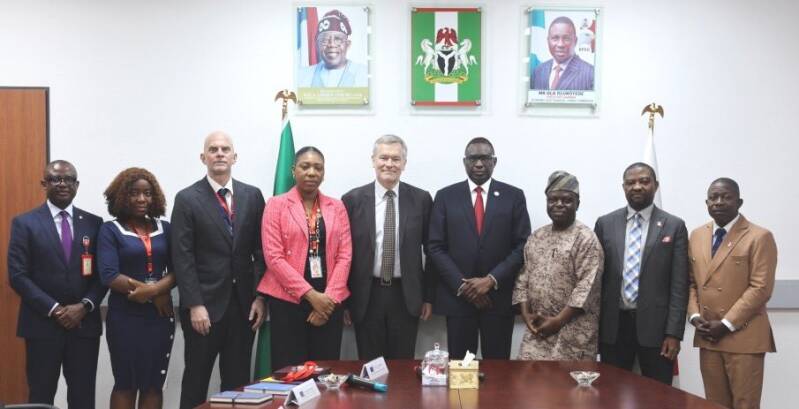
The European Union has reaffirmed its commitment to strengthening its partnership with the Economic and Financial Crimes Commission (EFCC), with the bloc's top diplomat in Nigeria describing the anti-graft agency as a critical institution for assuring foreign investors of a safe and compliant business environment. EU Ambassador to Nigeria and ECOWAS, Gautier Mignot, made the pledge on Tuesday, July 28, 2026, when he led a delegation on a courtesy visit to the EFCC's corporate headquarters in Abuja, where he met with the Commission's leadership.
Mignot stressed the strategic importance of the EFCC, stating that its role is vital for both the stability and prosperity of Nigeria and for the EU-Nigeria partnership. "To be able to tell our potential investors: you can safely come to Nigeria. There is a compliant business environment because you have strong institutions like the EFCC to make sure that this is the place," he said. The ambassador expressed satisfaction with the long-standing collaboration between the EU and the EFCC, which he said had existed since the establishment of the Commission, noting that the relationship had continued over the years, particularly through the Rule of Law and Anti-Corruption (RoLAC) programme. He assured that the EU remained committed to continuing the partnership and supporting efforts to strengthen the institutional capacity of the EFCC, improve investigative effectiveness and enhance prosecution.
Mignot further stressed that the EU had ongoing actions aimed at supporting the fight against cybercrime, describing the issue as a priority for the EFCC in view of its growing prevalence. He disclosed that the EU had proposed specialised training for EFCC personnel on the Cybercrime Response Centre, with the modalities of the training still being worked out. He added that the EU was also strengthening its support for Anti-Money Laundering and Countering the Financing of Terrorism (AML/CFT) compliance, while congratulating the EFCC on its efforts in the fight against corruption and cybercrime. The ambassador noted that the visit was taking place at a very good moment in the EU-Nigeria partnership, stressing that the EU, alongside its 14 member nations, remains a major trading, investment and cooperation partner of Nigeria.
According to Mignot, the EU is committed to deepening its partnership with Africa and leveraging more private investment, particularly by mobilising European companies to partner with Nigerian businesses to develop local manufacturing value chains and other sectors, including agriculture. He observed that European companies are particularly attentive to the business environment and compliance issues, stressing that the role of the EFCC was therefore important to the stability and prosperity of Nigeria as well as the EU-Nigeria partnership. He expressed optimism that the existence of strong institutions such as the EFCC would give potential European investors confidence to do business in Nigeria. This diplomatic overture comes just days after the EU announced fresh support packages worth €70 million for Nigeria, including €45 million for security and peacebuilding and €25 million for agriculture.
Responding, the Executive Chairman of the EFCC, Ola Olukoyede, described the Commission as Nigeria's foremost anti-corruption agency, responsible for coordinating the investigation and prosecution of financial crimes in the country. Olukoyede said the Commission had, over the years, continued to work towards ridding the country of economic and financial crimes, noting that it had recently recorded significant progress in the fight against cybercrime and terrorism financing. The EFCC chairman's response, however, was notably brief, focusing on the agency's achievements rather than outlining concrete new initiatives or addressing the persistent challenges that have plagued Nigeria's anti-corruption efforts—including low conviction rates, prolonged trials, and the perception of selective justice that continues to undermine public confidence in the Commission. The EFCC's own data on asset recovery and prosecutorial outcomes remains opaque, and the agency has faced criticism for its perceived focus on low-level offenders while high-profile corruption cases involving politically exposed persons often languish in courts for years.
The partnership with the EU comes at a time when Nigeria is seeking to present itself as a reformed investment destination. Notably, the Nigeria Financial Intelligence Unit (NFIU) recently announced that Nigeria had been removed from the European Union's list of high-risk third countries following intensified efforts to combat terrorism financing and money laundering. This removal, announced on July 2, 2026, was attributed to deepened collaboration between the NFIU and the EFCC, among other agencies. However, critics argue that the removal from the EU's high-risk list may have more to do with diplomatic pressure and less with tangible improvements in Nigeria's anti-money laundering framework.
The EU's increased focus on cybercrime support is timely, given the exponential rise in cyber-enabled fraud in Nigeria, which has tarnished the country's international reputation and led to significant financial losses for both individuals and businesses. However, the EU's proposed training for EFCC personnel on the Cybercrime Response Centre, while welcome, represents a relatively modest intervention. The EU has been funding the Rule of Law and Anti-Corruption (RoLAC) programme in Nigeria for years. Phase II of the programme, funded by the EU and implemented by International IDEA, aims to consolidate rule of law and anti-corruption reforms. While RoLAC has supported various initiatives, including the signing of an MoU between BudgIT and the EFCC in February 2026 to enhance capital project monitoring and transparency, the overall impact of these interventions on Nigeria's corruption perception remains marginal. Nigeria continues to rank poorly on Transparency International's Corruption Perceptions Index, suggesting that the billions of naira and millions of euros invested in anti-corruption programmes have yet to translate into meaningful improvements in governance and accountability.
The EU's support for the EFCC also raises questions about conditionality and oversight. European taxpayers have a right to know how their funds are being utilised and whether they are achieving the desired outcomes. The EU's continued partnership with the EFCC, despite the agency's mixed record, suggests that diplomatic and economic considerations may be taking precedence over rigorous performance evaluation. The EU's engagement with Nigeria is clearly driven by strategic interests, including access to Nigerian markets, energy resources, and cooperation on migration and security. The EFCC, in this context, serves as a convenient partner for the EU to demonstrate its commitment to good governance, while also providing a veneer of respectability for European companies operating in Nigeria.
While the partnership is a positive development on paper, its success will ultimately be measured by tangible results. The EFCC's own credibility has been called into question by its failure to successfully prosecute many high-profile cases, including those involving former governors and ministers. The EU's continued support for the EFCC, without demanding significant reforms to the agency's operational independence and prosecutorial track record, risks being seen as enabling a system that is long on rhetoric and short on accountability. The EU must ensure that its partnership with the EFCC is not merely a public relations exercise but a genuine effort to strengthen Nigeria's anti-corruption architecture, including supporting judicial reforms, witness protection programmes, and the autonomy of the EFCC from political interference. Until these fundamental issues are addressed, the EU's pledge of support will remain a missed opportunity to effect meaningful change in Nigeria's fight against corruption.
📩 Stone Reporters News | 🌍 stonereportersnews.com
✉️ info@stonereportersnews.com | 📘 Facebook: Stone Reporters News | 🐦 X (Twitter): @StoneReportNew | 📸 Instagram: @stonereportersnews
Add comment
Comments