

Reported by: Oahimire Omone Precious | Edited by: Oravbiere Osayomore Promise.
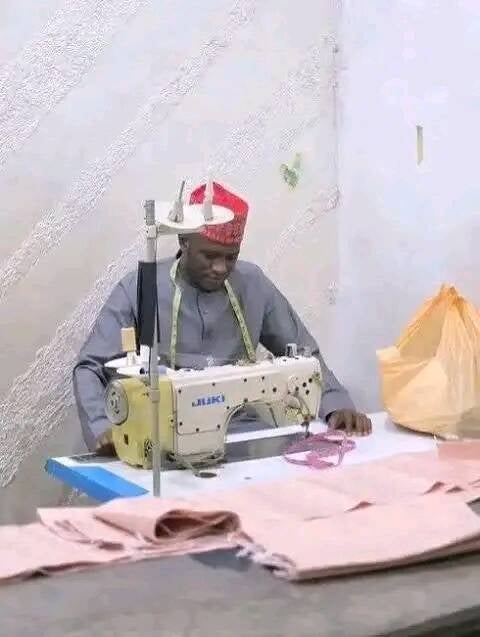
In the Sheka Ward of Kumbotso Local Government Area, the hum of sewing machines and the rhythm of scissors cutting fabric tell a story of resilience and quiet defiance. Here, Abdullahi Gali Shitu, popularly known as Comrade Abdullahi Gali Basaf, spends his days cutting fabrics, supervising apprentices and stitching garments—a far cry from the corridors of power he once occupied. Until March 2026, Basaf was the chairman of Kumbotso LGA of Kano State, but he recently chose to return fully to tailoring, a trade he insists offers more stability than politics.
Basaf's return to the sewing machine was not born of idleness or despair. When a Kano State High Court nullified his election as chairman of Kumbotso Local Government Area in March 2026, he did not spend months seeking another political appointment. Instead, he returned to the tailoring shop where his political journey began. Speaking to Daily Trust on Wednesday, the former council boss said his decision to resume tailoring was intended to demonstrate that politics should not be regarded as a full-time profession or the only source of livelihood. He argued that politicians must have a trade that sustains them and view politics as just an opportunity to serve people.
“Tailoring is not a small trade. It is a major one. It sustains livelihoods,” Basaf said. He revealed that tailoring has remained his primary occupation for more than a decade and played a key role in financing his political career. “Even in politics, my tailoring business helped me financially to support my campaigns and organisations. Without it, it would have been impossible to sustain political activities,” he explained. According to him, a trade gives stability and independence, and public office should never replace a sustainable means of livelihood.
Basaf currently runs a tailoring workshop in Sheka Ward, Kumbotso LGA, where he supervises about 20 workers and apprentices. But his ambitions extend far beyond the shop floor. “My goal is to modernise tailoring, establish a garment company, and employ fifty or more people. I want to contribute to the economy,” he said. He envisions a garment manufacturing company that rivals factories abroad and creates jobs for at least 50 people. His long-term goal is to build a thriving clothing business that proves vocational skills can generate lasting wealth.
Basaf’s return to tailoring is deliberate and carries a powerful message. He wants young people to see dignity in trades. “My message is that they should not despise trades; they should value and modernise them,” he said. He believes that tailoring offers more stability than politics and urged Nigerians to embrace vocational skills instead of relying solely on politics for survival. “Value your trade more than politics, because it sustains you and enables you to support your political activities,” he advised.
For Basaf, tailoring is not just a livelihood but a philosophy. It is a way to show that honest work can outlast the uncertainties of political office. “Politics can change overnight. You can be in office today and out tomorrow. But tailoring remains. It feeds you, it supports your family, and it allows you to help others,” he said. Despite holding Bachelor’s and Master’s degrees in Political Science, he chose to go back to tailoring because it has always been his passion, and he wishes to build it to a greater level and make more impact on society.
Basaf’s political journey provides context to his story. He founded the Kwankwasiyya Reporters platform in 2015, served as Kano State chairman of the Alliance National Party, contested for a Senate seat in 2019, and later joined the New Nigeria People’s Party, where he served as Senior Special Assistant on Information. In 2024, he won the chairmanship of Kumbotso LGA and, during his one year and three months in office, established schools, facilitated hospitals, and sponsored the education of over 2,000 students. However, his tenure ended in March 2026 after a Kano State High Court nullified his Certificate of Return and declared Ali Musa, popularly known as Hardworker, the duly elected chairman.
Although he remains active in politics, Basaf said tailoring would continue to take precedence. He ruled out quitting politics entirely but insisted that everyone should have a profession or business that can sustain them regardless of political fortunes. His decision has drawn attention across Nigeria, where it is rare to see a politician return to a trade after leaving office. In a country where many cling to political appointments or seek new ones, Basaf's choice stands as a powerful rebuke to the notion that politics is the only path to success. His workshop in Sheka Ward has become a symbol of resilience—a reminder that dignity lies not in the office one holds, but in the work one does.
📩 Stone Reporters News | 🌍 stonereportersnews.com
✉️ info@stonereportersnews.com | 📘 Facebook: Stone Reporters News | 🐦 X (Twitter): @StoneReportNew | 📸 Instagram: @stonereportersnews
Add comment
Comments