

Reported by: Oahimire Omone Precious | Edited by: Oravbiere Osayomore Promise.
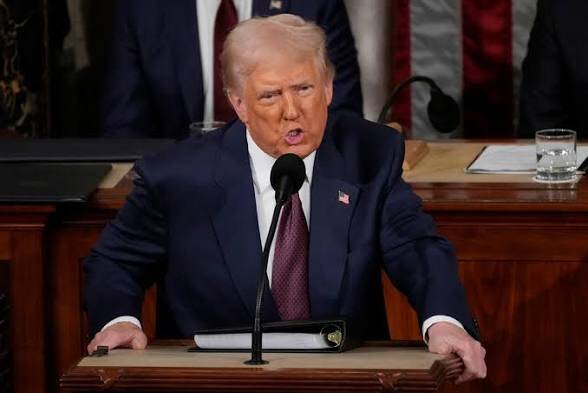
President Donald Trump joked on Friday that he is not yet a target of the International Criminal Court (ICC), even as his administration wages an aggressive diplomatic offensive to dismantle the tribunal, urging member nations to withdraw and threatening new sanctions against the Hague-based institution. The remark, which drew laughter from cabinet members gathered at the Camp David presidential retreat, came as Secretary of State Marco Rubio briefed the president on the administration's campaign against what it describes as an "illegitimate" court that threatens American sovereignty.
Interrupting Rubio's presentation, Trump quipped: "By the way, there's no information that they're after me," but "it could happen," he added, according to multiple reports. He quickly clarified that the administration's push against the ICC was not aimed at protecting himself but rather Israeli Prime Minister Benjamin Netanyahu, who is the subject of a 2024 ICC arrest warrant for alleged war crimes and crimes against humanity in the Gaza conflict. "He's not trying to defend me. He is trying to defend Bibi and various other people," Trump said, using Netanyahu's nickname. "But there are many people that shouldn't be looked at that way. But there is no indication that I'm one of them at this moment".
The lighthearted exchange occurred against the backdrop of a major diplomatic offensive launched by Washington in mid-July 2026, aimed at isolating the ICC and encouraging member states to follow the lead of Chad and Venezuela, which have both recently announced their withdrawal. Rubio told the cabinet meeting that five countries had now either withdrawn or planned to do so, and urged others to follow suit. "We tried to get them to reform and listen to us. They wouldn't do it. They're very arrogant. We've now begun an effort to really try to bring that court to heel," Rubio said.
The ICC, established in 2002, is responsible for prosecuting perpetrators of war crimes, genocide, and crimes against humanity when nations lack the will or capacity to do so themselves. However, neither the United States nor Israel are parties to the Rome Statute, the international treaty that established the court. Despite this, the ICC's statute grants it jurisdiction to prosecute atrocity crimes committed on the territory of member states by nationals of non-member states, a provision that has long alarmed Washington.
Trump's hostility toward the ICC predates his current term. It resurfaced with renewed vigour in November 2024, when Trump was reelected and the ICC issued an arrest warrant for Netanyahu and former Israeli Defence Minister Yoav Gallant over allegations related to the Gaza war. The administration has since pursued a multi-pronged strategy to undermine the court, including travel bans and further sanctions against ICC officials and affiliated organisations. In a separate development in June 2026, three ICC judges sued the Trump administration over sanctions imposed on them, arguing that the measures were unlawful. Two U.S.-based advocacy groups also filed a lawsuit in July, contending that the sanctions violate constitutional free speech protections.
Rubio, who has been at the forefront of the administration's campaign, described the ICC as "an illegitimate international organization" during the Camp David meeting. He warned that the court poses a long-term threat to U.S. troops and political leaders, who could face prosecution years later over their actions in war. The secretary of state also cited calls from activists for the ICC to investigate U.S. personnel over actions like the deportation of migrants or U.S. strikes on boats that officials say are carrying narcotics.
Trump's comment that he is not currently a target of the ICC comes amid intensifying global debate over the court's jurisdiction and legitimacy. While the United States has never been a member, the ICC's assertion of jurisdiction over non-member states has been a persistent source of tension. The Trump administration's latest offensive has drawn both praise from allies who share its scepticism of the court and criticism from human rights groups and international legal experts who view the ICC as an essential mechanism for accountability.
The president's joke, while lighthearted, underscores the broader geopolitical stakes of the administration's campaign. By framing the effort as a defence of Netanyahu and others rather than himself, Trump sought to deflect speculation that his personal legal vulnerability might be driving U.S. policy. However, his acknowledgment that the ICC "could" target him in the future hints at the underlying anxiety that the court's reach could one day extend to American leaders.
The administration's push to isolate the ICC has already yielded tangible results, with Chad and Venezuela announcing their withdrawal and others reportedly considering similar steps. However, the court retains the support of most of its 123 member states, and the Trump administration's heavy-handed tactics have drawn sharp criticism from European allies and human rights organisations. The ICC, for its part, has shown no sign of backing down, with its judges and prosecutors continuing to pursue cases against individuals accused of the world's most serious crimes.
As the United States continues its campaign against the ICC, the court's future remains uncertain. Trump's joke that he is "not yet" a target may prove prophetic if the administration's efforts to dismantle the tribunal succeed. But if the ICC survives the assault, the question of whether American leaders could one day face prosecution at The Hague may cease to be a laughing matter.
📩 Stone Reporters News | 🌍 stonereportersnews.com
✉️ info@stonereportersnews.com | 📘 Facebook: Stone Reporters News | 🐦 X (Twitter): @StoneReportNew | 📸 Instagram: @stonereportersnews
Add comment
Comments