

Reported by: Ijeoma G | Edited by: Oravbiere Osayomore Promise.
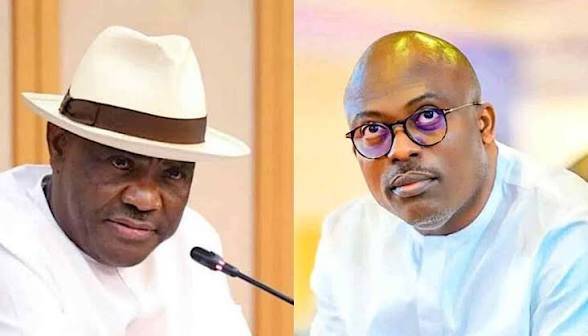
The Minister of the Federal Capital Territory, Nyesom Wike, has declared that Rivers State Governor Siminalayi Fubara is the biggest loser in the protracted political crisis that has rocked the oil-rich state, insisting that the governor's failure to secure a second-term ticket and his inability to control key state institutions have rendered him the principal casualty of a battle he was ill-advised to fight. Wike made the remarks on Saturday, August 1, 2026, during a media chat in Port Harcourt, where he also named four close associates whom he accused of misleading Fubara and worsening the crisis that at one point led to the declaration of a state of emergency and the governor's suspension for six months.
Speaking with unusual candour, Wike expressed pity for his successor but did not mince words about the political consequences of Fubara's choices. "I feel for Governor Siminalayi Fubara because he is the biggest loser," Wike said, according to multiple news reports. He argued that Fubara had been handed power on a "platter of gold" but squandered the opportunity by listening to wrong counsel. The FCT minister identified former Speaker of the Rivers State House of Assembly Edison Ehie, Chijioke Ihunwo, Victor Oko Jumbo, and human rights activist Ann-Kio Briggs as the key figures who allegedly gave the governor faulty advice that deepened the rift between them and sabotaged the peace agreement brokered by President Bola Tinubu. Wike alleged that these individuals pushed Fubara to renege on commitments made during the peace deal, thereby prolonging a conflict that could have been resolved much earlier.
Wike's assessment of Fubara's political standing was brutal and unequivocal. He pointed to the governor's failure to preside over the last local government election, which produced the current council chairmen across the 23 local government areas, as evidence that Fubara was never truly in charge. He also noted that Fubara had no control over the state House of Assembly, where none of the 29 members aligned with him. "Assembly of 29 members, not one was taken away. What does it tell you?" Wike asked. "You're a leader, for example, in Okrika, the Assembly member is here. You're a leader in Ogba/Egbema/Ndoni Local Government, the Assembly member is not with you. You're a leader in Khana Local Government, the Assembly member is not with you."
The FCT minister also dismissed the notion that money could have saved Fubara's political fortunes, stating: "All these people who surrounded the governor, look at all the fights. What impact or input did they make to help the governor succeed? They were there and a state of emergency was declared. What did they do?" Wike emphasised that Fubara's inability to secure a second-term ticket—despite defecting to the All Progressives Congress—was the clearest indication of his political defeat. "The governor did not preside over the local government election. He did not. The one he did was nullified by the Supreme Court and they were all sacked. How do you think that, as a governor, I did not superintend over the election? Two, because of some people who surrounded him, giving him advice, the governor did not secure a second term," he said.
Wike also reflected on his own expectations for Fubara's tenure, revealing that he had flagged off the Port Harcourt Ring Road project and encouraged the governor to complete it as a pathway to securing a second term. "Remember when I flagged off the Ring Road. I flagged off the Ring Road and I said if you complete this Ring Road, nobody will stop your second term. Now, if I had said that, it means that I laid a foundation for you. You know how painful it is," Wike lamented. He accused Fubara of losing focus and attempting to build an independent political structure within his first 100 days in office, a move he described as the governor's biggest mistake. "In politics, you have to be careful. If you make the mistake of saying you can do it alone and that you don't need those who supported you, those who never wanted you in office will take advantage of the situation," Wike said.
The political crisis between Wike and Fubara, which erupted shortly after the latter assumed office in 2023, has been one of Nigeria's most intense power struggles in recent years. The feud escalated to the point where President Bola Tinubu declared a state of emergency in Rivers State on March 18, 2025, suspending Fubara for six months and appointing a sole administrator to oversee the state's affairs. Although Fubara was later reinstated and subsequently defected to the All Progressives Congress, he was unable to secure the party's ticket for a second-term bid. In a surprising twist, Fubara recently announced his return to Wike's political camp, a development that Wike acknowledged during the media chat.
Wike's decision to name the four individuals he believes misled Fubara has added a new layer of intrigue to the ongoing political drama. By publicly blaming Edison Ehie, Chijioke Ihunwo, Victor Oko Jumbo, and Ann-Kio Briggs, the FCT minister appears to be sending a clear message that the governor's inner circle bears significant responsibility for the political turmoil that has consumed Rivers State. Wike also warned that those who encouraged Fubara to confront the political structure that brought him to power were no longer in positions to help him, suggesting that the governor had been abandoned by the very people who pushed him into the conflict.
As the 2027 general elections approach, the fallout from the Rivers crisis continues to shape the political landscape of one of Nigeria's most strategically important states. Wike's declaration that Fubara is the "biggest loser" in the crisis is not merely a political jab but a pointed assessment of a governor who, despite being handed power by one of Nigeria's most formidable political godfathers, now finds himself without a clear path to re-election and with his political future hanging in the balance. Whether Fubara can recover from this political setback or whether he will remain the principal casualty of a feud that has left Rivers State in chaos remains to be seen. But for now, Wike's words have laid bare the brutal arithmetic of Rivers politics: in a battle between godfather and godson, the godson often pays the heaviest price.
📩 Stone Reporters News | 🌍 stonereportersnews.com
✉️ info@stonereportersnews.com | 📘 Facebook: Stone Reporters News | 🐦 X (Twitter): @StoneReportNew | 📸 Instagram: @stonereportersnews
Add comment
Comments