

Reported by: Ijeoma G | Edited by: Oravbiere Osayomore Promise.
A major crisis has erupted within the Kwara State Council of the Nigeria Union of Journalists (NUJ) following the suspension of three members by the union's National Executive Council (NEC), a decision that has sharply divided members and raised serious questions about due process, fairness, and the interpretation of the union's constitution. The suspended journalists – Adamu Usman Sabi, Mosunmola Ayobami, and Dare Akogun – were sanctioned during the NEC meeting held in Dutse, Jigawa State, on August 11, 2026, for alleged anti-union activities and involvement in legal action against the union. The decision has triggered a fierce backlash from a significant faction of the state council, who have accused the national leadership of acting on misleading information and denying the affected members an opportunity to defend themselves.
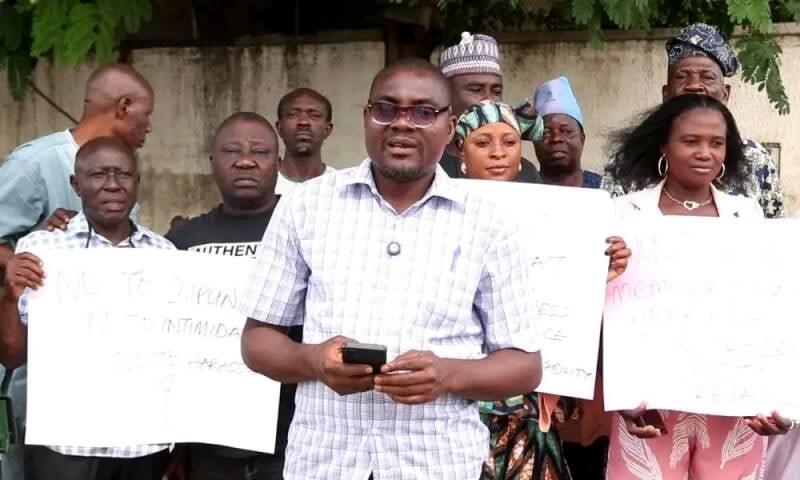
The protest, which culminated in a press conference in Ilorin on Wednesday, saw journalists carrying placards and demanding the immediate suspension of the Kwara State Council Chairman, Abdullateef 'Lanre Ahmed, pending an investigation into his alleged role in the events leading to the suspension. The protesting members argued that the three suspended journalists were not the ones who initiated the original court case against the union, pointing out that the litigation was instituted by Fadeyi Babajide of the Federal Information Chapel and the late Saka Laaro of the Correspondents' Chapel. They maintained that Ayobami and Akogun only became involved through an appeal that arose from the case, and that the circumstances may have been misrepresented to the NEC, giving the false impression that the trio themselves had taken the union to court.
In a sharp rebuttal, Chairman Ahmed insisted that the suspended members could not distance themselves from the litigation, stating that they were active actors in cases before the National Industrial Court and the Court of Appeal. He cited Article 7(5)(d) of the NUJ Constitution, which, according to him, prohibits members from taking the union to court without first exhausting internal dispute resolution mechanisms, and makes suspension automatic for those who violate this provision. However, Ahmed's defence did not directly address the protesters' claim that a mediation held between April 1 and 3, involving him, Ayobami, and Akogun, had resulted in an agreement to discontinue the appeal, with a draft letter reportedly sent to Akogun's lawyer to that effect. This omission has left a critical question unresolved: whether the subsequent attempt to withdraw the appeal was considered in the disciplinary process or presented to the NEC.
The controversy has thus moved beyond the suspension itself to fundamental questions about the interpretation of the NUJ Constitution, the actual roles played by the suspended journalists in the litigation, whether due process was followed before the NEC's decision, and the chairman's alleged role in the entire affair. The protesters have called for an independent, impartial, and transparent investigation into the matter before the suspension is allowed to stand. They have also demanded that Chairman Ahmed be suspended while allegations concerning his conduct are investigated. As the crisis deepens, the national leadership of the NUJ is under increasing pressure to intervene, uphold the principles of fairness and justice it preaches, and restore peace and unity to the Kwara State Council.
📩 Stone Reporters News | 🌍 stonereportersnews.com
✉️ info@stonereportersnews.com | 📘 Facebook: Stone Reporters News | 🐦 X (Twitter): @StoneReportNew | 📸 Instagram: @stonereportersnews
Add comment
Comments