

Reported by: Ijeoma G | Edited by: Gabriel Osa
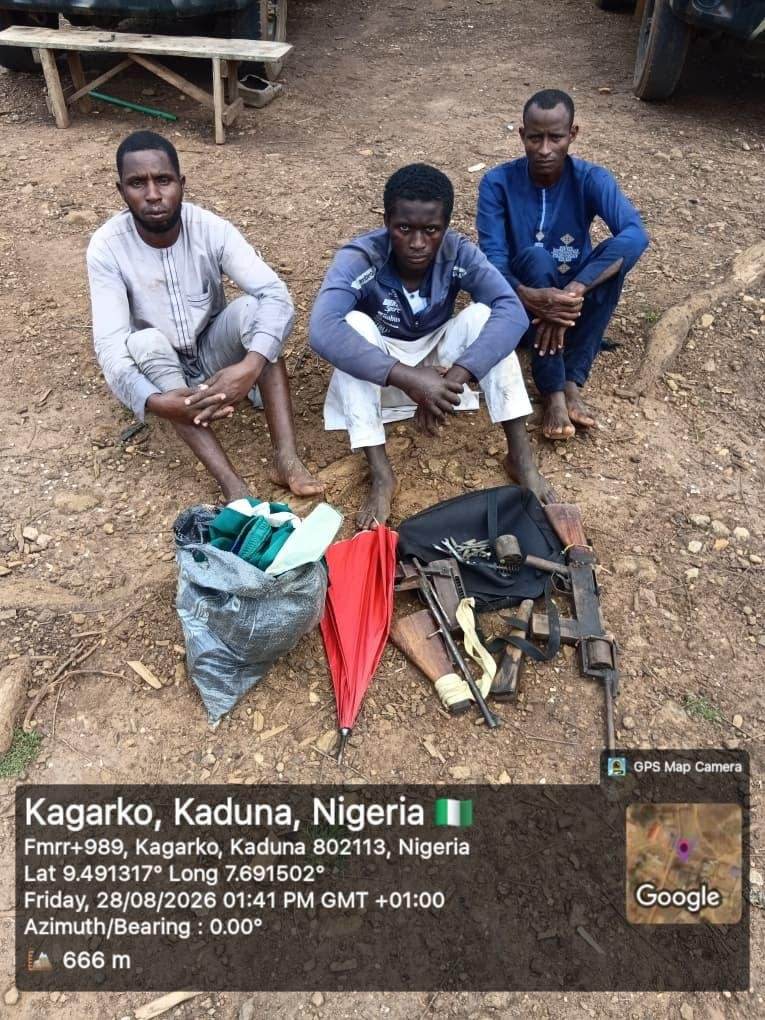
Nigerian troops operating under the Joint Task Force North West, Operation FANSAN YAMMA, have arrested three suspected terrorist collaborators in Kaduna State and destroyed several terrorist enclaves in Katsina State in separate operations carried out on August 27 and 28, 2026, according to the military. The operations resulted in the recovery of locally fabricated firearms, 13 rounds of ammunition, an RPG-7 tube, a motorcycle, mobile phones and other items.
The latest operations form part of intensified military activity across Nigeria’s north-west, where armed groups have continued to exploit remote forests and rural settlements as bases for attacks, kidnapping and other criminal activities. In Katsina, the Matazu axis has remained a particular focus of security operations following repeated attacks and abductions affecting communities in and around Matazu and neighbouring Musawa Local Government Area. The military has increasingly targeted not only armed fighters but also the camps, weapons supply routes and logistical networks supporting them.
In Kaduna State, troops of Sector 1 acted on intelligence concerning a suspected terrorist collaborator on August 27. The suspect was arrested with two locally fabricated guns and 13 rounds of ammunition, which the military said had been concealed inside a bag. The discovery prompted further investigation aimed at determining where the weapons were headed and who was expected to receive them.
According to Lieutenant Colonel Aliyu Danja, the Media Information Officer of the Joint Task Force North West, preliminary questioning of the arrested suspect indicated that he had allegedly been tasked with delivering the weapons and ammunition to another individual. Acting on information obtained during the investigation, troops conducted a follow-up operation that resulted in the arrest of two additional suspects allegedly connected to the movement of the weapons.
The three suspects remain in custody and are undergoing further investigation, while the recovered firearms, ammunition and other items have been retained as part of the investigation. The military did not disclose the identities of the suspects or provide details about the individual they were allegedly intending to supply. Their arrest also highlights the security forces’ continuing reliance on intelligence-led operations to identify networks supporting armed groups beyond those directly involved in attacks.
The seizure of locally fabricated firearms is significant because improvised weapons remain widely available in parts of Nigeria affected by armed violence. Security agencies have repeatedly sought to disrupt the movement of weapons and ammunition to terrorist and criminal groups, particularly by targeting couriers, suppliers and intermediaries who help sustain armed networks.
In neighbouring Katsina State, troops of Sector 2, working alongside other security agencies, carried out a separate clearance operation on August 28 around Maharba and Karaduwa in Matazu Local Government Area. The operation targeted identified terrorist enclaves and structures allegedly used by armed groups to support their activities in the area.
The military said troops successfully cleared and destroyed the identified enclaves, along with other structures associated with the terrorists. The operation was intended not only to remove immediate threats but also to deny armed groups the fixed locations from which they can organise attacks, store equipment, shelter fighters and move freely through surrounding communities.
One of the locations targeted was an enclave linked by the military to Kachalla Muhammadu Filani, a notorious terrorist leader whose group has been accused by authorities of terrorising residents in Matazu and Musawa local government areas. During the operation, Filani reportedly escaped shortly before troops reached the enclave.
The military did not claim that Filani had been captured or killed. Instead, it said he narrowly escaped as troops advanced towards the location. The distinction is important because the operation represents a disruption of the group’s base rather than the confirmed removal of its leader. The military subsequently continued operations in the surrounding area in an effort to prevent the group from immediately re-establishing its presence.
A further search of the area produced an RPG-7 tube, a motorcycle, mobile phones and other items. The recovery of an RPG-7 tube indicates the potential presence of equipment associated with heavier weapons capability, although the military did not say whether the tube was accompanied by a complete launcher or ammunition. Authorities also did not disclose the ownership of the motorcycle or phones recovered from the site.
The operation comes against a backdrop of continuing insecurity in parts of Katsina, particularly communities around Matazu and neighbouring local government areas. In recent months, residents have faced attacks attributed to armed groups, while security agencies have stepped up efforts to dismantle camps and pursue commanders operating in the wider region.
Matazu has also featured prominently in recent military operations following renewed concern over the activities of armed groups in the area. Security forces have increasingly combined ground patrols, intelligence gathering and clearance operations to disrupt terrorist movements and prevent fighters from using forested areas as safe havens.
The military’s latest statement did not provide casualty figures from the Katsina operation and did not report any confirmed deaths or arrests among the terrorists whose enclaves were destroyed. It also did not say whether troops encountered armed resistance during the clearance operation. The available information therefore confirms the destruction of the identified sites and recovery of equipment, but not the number of terrorists affected.
Following the clearance operation, troops conducted further fighting patrols across the general area. The purpose, according to the Joint Task Force, was to consolidate the gains made during the operation and deny terrorists the freedom to move back into the cleared locations.
The Joint Task Force said the operations demonstrate its continuing efforts to dismantle terrorist networks, disrupt the movement of weapons and logistics, and deny armed groups access to enclaves within its area of responsibility. Lieutenant Colonel Danja said the task force remained committed to coordinated and intelligence-driven operations aimed at degrading terrorist capabilities and restoring security to affected communities.
For residents of the affected areas, the immediate challenge will be ensuring that cleared locations do not become vulnerable to renewed occupation. Military operations can disrupt established camps, but sustained patrols, reliable intelligence and cooperation between security agencies and local communities remain important to preventing armed groups from regrouping.
The latest arrests in Kaduna and the destruction of terrorist enclaves in Katsina therefore represent two related aspects of the security campaign: attacking the supply networks that move weapons and ammunition, and dismantling the physical bases from which armed groups operate. Authorities are expected to continue investigations into the three Kaduna suspects while troops maintain pressure on terrorist networks around Matazu and other vulnerable areas of the north-west.
📩 Stone Reporters News | 🌍 stonereportersnews.com
✉️ info@stonereportersnews.com | 📘 Facebook: Stone Reporters News | 🐦 X (Twitter): @StoneReportNew | 📸 Instagram: @stonereportersnews
Add comment
Comments